


Lesson IV. Use Of Try-Square And Bevel. Continued
Description
This section is from the book "Elementary Woodwork", by George B. Kilbon. Also available from Amazon: Elementary woodwork.
Lesson IV. Use Of Try-Square And Bevel. Continued
Problem III. Use Of Gauge And Try-Square Combined
Take a board 4 in. X 2 in. X 5/16 in. Hold the rule on it, as in
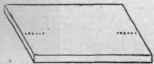
Fig. 59.
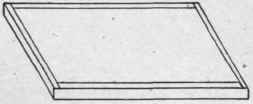
Fig. 60.
Fig. 52, and place six knife-points 1/8 in. apart, measuring from each end, as in Fig. 59.
Square knife-lines through the two extreme points; set the gauge 1/8 in. and gauge from each edge of the board, starting and stopping on the squared lines, as in Fig. 60. Square knife-lines through the second points from each end, starting and stopping on the gauged lines; set the gauge 1/4 in. and gauge between the knife-lines as before. Proceed in this manner till all of the twelve points are utilized, when the work will appear as in Fig. 61. Rapid workmen may draw diagonals on the opposite side of the board, and between them gauge lines 1/8 in. apart and square lines 1/4 in. apart, as in Fig. 62.
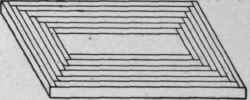
Fig. 61.
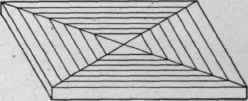
Fig. 62.
Problem, IV. Use Of Bevel
In making lines other than at right angles to the edge of a board an adjustable square or bevel is needed, as in Fig. 63. It is held and used the same as the try-square.
Prepare a board, as directed in connection with Fig. 52, and through each point, with the bevel set at any chosen angle, draw pencil-lines on one side of the board. Continue these lines around the board in a manner similar to Problem I., squaring across the edges and bevelling across the opposite side. The work will appear as in Fig. 64.

Fig. 63.
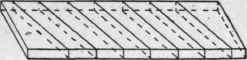
Fig. 64.
Problem V. Use Of Bevel With Knife
Place knife-points on the board at half-inches and cut bevelled lines through them, continuing them around the board like the pencil-lines. Repeat at 1/4 in. if necessary.
Problem VI. Let rapid workmen take a new board and draw lines around it, using the bevel on both sides and both edges. The work will appear as in Fig. 65.
It will be a sufficient register of a pupil's attainment to inspect the work represented by Fig. 61, and mark 1 off from
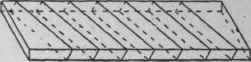
Fig. 65.
100 for every crooked line and for every line that crosses another.
Continue to:


My Books

