


Lesson VIII. Edge And End Planing
Description
This section is from the book "Elementary Woodwork", by George B. Kilbon. Also available from Amazon: Elementary woodwork.
Lesson VIII. Edge And End Planing
In mechanics, as in arithmetic, there are four fundamental rules, one or more of which are practised in every problem, and no workman can become a skilful operator without understanding and mastering them. They are as follows :-
Rule I. Measure accurately according to plan.
Rule II. Make perfect lines.
Rule III. Cut rapidly near to lines.
Rule IV. Cut carefully exactly to lines.
The present lesson illustrates these rules clearly.
As in arithmetic, multiplication is really a short method of performing uniform addition, and division a short method of performing uniform subtraction, and thus the four rules can be considered analytically as two; so in mechanics the above first two rules may be condensed into the statement: Lay out work accurately, and the last two into the statement: Work to lines.
Problem I. Edge-Planing
Hold in the vise one of the boards which were surface planed in Lesson VII (Surface Planing)., and use the finishing-plane (Fig. 89, Lesson VII.) to true one edge, thus: -
Imagine a line to be drawn along the middle of the edge, as in Fig. 102, dividing the edge in two sections, A and B.

Fig. 102.

Fig. 103.
To insure driving the plane so that the middle point of its cutting-edge shall glide along the middle of section A, guide it with the fingers of the left hand, as in Fig. 103. In this guiding the left fingers are held under the plane and in contact with the wood as the plane glides along. .
Take a similar shaving from section B, and a third one along the middle of the edge, imaging no line on it.
Test the work with straight-edge lengthwise in three places as in Fig. 98, Lesson VII (Surface Planing)., and with try-square crosswise in three places, as in Fig. 104 below, and plane where these tests show the face to be high. Remember the blade of the plane must be kept properly adjusted, and set as fine as will do the work required.
A plane should never be driven over a board unless it cuts, as that will dull it more than the process of cutting, and a blade edge should never rest on the board when the plane is being drawn back, as that also will dull it.
Place a tried mark, as in Fig. 105, on the first side and first edge finished, enclosing their common corner. This side and this edge are to be worked from in all future laying out.
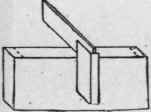
Fig. 104.

Fig. 105.
To finish the second edge set the gauge 2 3/4 in., Rule I.; gauge on both sides from the finished edge, Rule II.; plane away the surplus wood till the lines are nearly reached, using the roughing-plane, Rule III.; and then plane exactly to the lines, using the finishing-plane, Rule IV. Test with try-square just before reaching the lines, and complete the planing as its tests suggest, but do not on any account plane below the lines, even though the edge is not perfectly square with the side. It will be square, however, if skill is acquired to make it so just before reaching the lines, and then to keep it so as the lines are reached.
Plane all four of the boards in like manner. Rapid workmen will finish the four boards, and perhaps make one or two more, while slower workmen are making one or two only.
Continue to:


My Books

