


Lesson VII. Surface Planing
Description
This section is from the book "Elementary Woodwork", by George B. Kilbon. Also available from Amazon: Elementary woodwork.
Lesson VII. Surface Planing
The two sides of a board, or the four sides of a square stick, being larger surfaces than edges or ends, are often technically called surfaces, and planing them is known as surface planing.
The principal planes used by wood workmen are jack-plane 14 in. long, fore-plane 14 in., jointer 22 in., smooth-plane 8 in., and block-plane 6 in., and these may be of wood or of iron. The blade of the jack-plane is ground so that its edge is a continuous curve, as in Fig. 84. All other plane blades are ground as in Fig. 85; that is, with the edge straight for somewhat more than one-half of its length, then rounded slightly at each end. The jack-plane and block-plane each have single blades, as in Fig. 86. All others have double blades; that is, the blade is provided with a cap, as in Fig. 87.
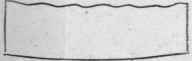
Fig. 84.
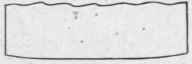
Fig. 85.
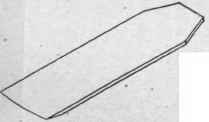
Fig. 86.
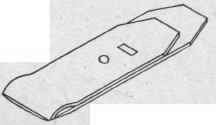
Fig. 87.
This cap is necessary when cross-grained or complex-grained boards are to be planed. It is then brought down as near to. the cutting-edge of the blade as possible, but for straightgrained wood it is of no special service, and had better be set back about 1/32 in. It is so set in these lessons.
Only three planes are needed in this series of lessons, to the first two of which we will for convenience give special names of our own. An 8 in. wooden smooth-plane (Fig. 88) is used for all rough planing, and we will call it the roughing-plane. An 8 in. iron smooth-plane (Fig. 89) is used for all finish planing parallel with the grain; that is, on sides and edges of boards, and we will call it the finishing-plane. A 6 in. iron block-plane (Fig. 90) is used for all planing on the ends of boards.
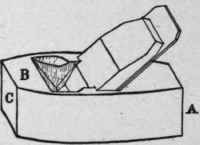
Fig. 88.
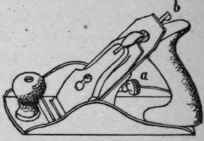
Fig. 89.
The block-plane differs from all others in having its blade inverted, as in Fig. 91, and is set at a more acute angle with the face or under side of the block, as will be seen in comparing Fig. 90 with Figs. 88 and 89.
The knob on the front end of the block-plane seen at A Fig. 90 is a screw to hold in place the throat-plate which is
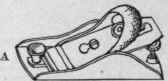
Fig. 90.
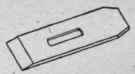
Fig. 91 the adjustable front portion of the face or under side of the plane. Sometimes this throat-plate is accidentally slipped till it strikes the blade, and the throat is thereby closed so that shavings cannot come out. Look out for this danger.
Continue to:


My Books

