


Lesson V. Explanation Of The Difference Between Slitting And Cutting-Off Saws
Description
This section is from the book "Elementary Woodwork", by George B. Kilbon. Also available from Amazon: Elementary woodwork.
Lesson V. Explanation Of The Difference Between Slitting And Cutting-Off Saws
Provide for the teacher two models in wood, one of a slitting and one of a cutting-off saw. These may be each 30 in. X 3 in. X 1/2 in. the slitting teeth 2 1/2 X 1 1/4, and the cutting-off teeth 2 in. X 1 1/4 in.
Problem I. Slitting-Saw
Take a board 4 in. X 2 in. X
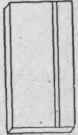
Fig. 66.
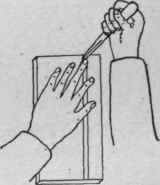
Fig. 67.
5/16 in.; on one side of it gauge two lines 1/2 in. and 5/8 in. respectively from one edge, as in Fig. 66.
Place the chipping-block on the bench and lay the board on it with an end toward you, guiding the chisel-edge with a finger of the left hand. Hold the 1/8 in. chisel in the right hand exactly vertical, as in Fig. 67, with the bevelled edge away from you, and cut between the gauged lines a chip about 1/16 in. long and entirely through the board from its upper to its lower side, as in Fig. 68.
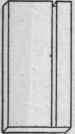
Fig. 68
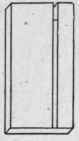
Fig. 69.
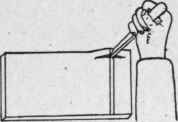
Fig. 70.
Continue in this manner to cut successive chips, each about 1/16 in. long, and each entirely through the thickness of the board, until the slowest workmen have made a cutting about 1/2 in. long, as in Fig. 69. This cutting is called a kerf.
Rapid workmen will have made a kerf nearly or quite the length of the board.
If we should make two lines crosswise of the board and endeavor to chisel between them, we could not make a kerf, but should splinter the board, as in Fig. 70.

Fig. 71.
Fig. 71 is a view of the wooden model of a slitting-saw.
Its teeth are a succession of chisels. The front edge of each tooth, as a b, is at right angles to a line touching the points, and all of the slant of the tooth is on the rear edge, as a c From the above experimental problem it is manifest that such a saw is suitable for slit-sawing only.
Problem II. Cutting-Off Saw
Take the board used in the previous problem, or one similar to it, and using try-square and knife, make two lines across the board 1/16 in. apart, the right hand line being 1/2 in. from the end, as in Fig. 72.
Lay the board on the chipping-block, holding it with the left hand. Hold the knife as a pen is held in writing. Incline it toward you about 30° from a vertical position, as in Fig. 73, but do not incline it at all toward the right or left. Draw the knife across the board along one of the above lines, and then along the other. Continue to do this alternately, and what happens? "The wood splits out between the lines, making a kerf." If we proceed in this manner, the board will soon be cut in two.
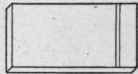
Fig. 72.
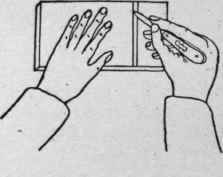
Fig. 73.
A kerf cannot be cut lengthwise of the grain by this process, because the wood will not split out between the lines.
If we had a knife with two blades of equal length and 1/16 in. apart, we could draw it through both lines at the same time.
Fig. 74 is a view of the wooden model of a cutting-off saw. Its teeth slant about equally on each edge and are bevelled so that alternate teeth are pointed on one side of the saw, the intervening teeth being pointed on the other side.

Fig. 74.
Its use produces a result quite similar to the above experimental problem with the knife; that is, marking two parallel lines across the board and breaking out the wood between them. The teeth of a cutting-off saw may then be considered as a succession of pairs of knife-points.
Another important fact concerning saws is that the teeth are "sell;" that is, alternate teeth bent toward one side, and the intervening teeth bent toward the other side. In the cutting-off saw the teeth which are pointed on a given side are bent toward that side, as in Fig. 75.

Fig. 75.
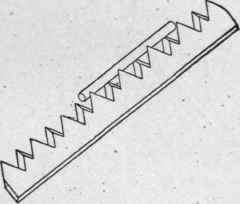
Fig. 76.
The object of this is to have the saw cut a kerf wider than the thickness of its blade, in order that the saw may pass easily through the kerf which it is making. Owing to this setting and to its bevelled filing, a cutting-off saw appears grooved along the line of teeth when viewed endwise, as in Fig. 75. Hold the model inclined, as in Fig. 76, and a straight rod 10 in. long X 1/4 in. diameter will slide down this groove. An ordinary needle will slide down the teeth of a cutting-off saw in a similar manner.
Each pupil may take in hand the two 18-in. saws on his bench, examine them carefully, and hold the slitting-saw in his right hand and the cutting-off saw in his left.
Very few pupils will fail to make the selection accurately after the above experimental description.
Continue to:


My Books

