


Lesson I. Use Of Hammer. - Nail-Driving. Part 3
Description
This section is from the book "Elementary Woodwork", by George B. Kilbon. Also available from Amazon: Elementary woodwork.
Lesson I. Use Of Hammer. - Nail-Driving. Part 3
Problem V. Blind Nailing
Supply each pupil with two pieces of soft wood 4 in. X 11/16 in. X 5/16 in. to represent joists, one piece 4 in. X 2 in. X 5/16 in. to hold them together conveniently, and five matched boards, 4 in. X 3/4 X 1/4 in.
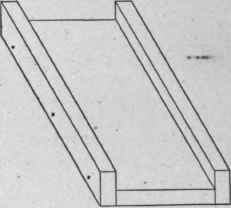
Fig. 26.
Use 5/8 patent brads, and nail the joists to the board, as in Fig. 26. Place one matched board on the joists with its grooved edge agreeing with the end of the joists, and drive two brads near the grooved edge of the board, securing it thus to each joist. Fig. 27 is an end view of the nailed board, while at A Fig. 31 is seen a perspective view.
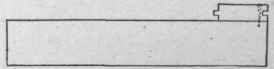
Fig. 27.
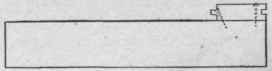
Fig. 28.
Drive two nails obliquely at the base of the tongue of the board, as in Fig. 28, setting them flush by means of the brad set, thus further securing the matched board to each joist. These last two nails are said to be blinded, since the next board which is put on blinds or hides them, as in Fig. 29.
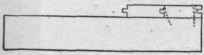
Fig. 29.
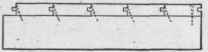
Fig. 30.
Blind nail the second board, and adding each of the remaining boards blind nail them in a similar manner, as in Fig. 3.0. The completed work is shown in perspective in Fig. 31.
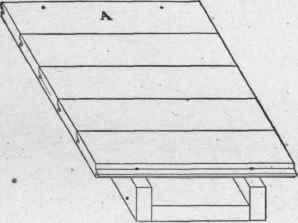
Fig. 31.
No brad heads appear in sight except the two which were perpendicularly driven near the grooved edge of the first laid matched board and the two with which the last board was secured. Rapid workmen may make two or three problems while the slowest ones are making one. Mark 5 off from 100 for every open joint between any two boards, and for every nail whose driving has caused the work to be marred.
Continue to:


My Books

