


Lesson IX. Use Of Bit And Brad-Awl
Description
This section is from the book "Elementary Woodwork", by George B. Kilbon. Also available from Amazon: Elementary woodwork.
Lesson IX. Use Of Bit And Brad-Awl
Problem I. Boring Across The Grain
Take one of the boards 8 in. X 2 3/4 in. X 7/8 in. planed in the last two lessons, and set the gauge to one-half its thickness, thus:
Measure the thickness of the board, set the gauge one-half of the amount, and on one edge of the board gauge a point from each side, as in Fig. 115.
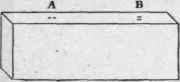
Fig. 115.
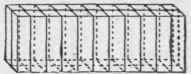
Fig. 116.
If these points coincide, as at A, the gauge is correctly adjusted. If they do not coincide, as at B, change the gauge slightly and gauge two more points, thus trying till they do coincide.
Gauge from the tried face (See Fig. 105, Lesson VIII (Edge And End Planing).) on both edges of the board, and with the knife square around at 5/8 in. from one end and afterwards at every 3/4 in., as in Fig. 116.
Place the board in the vise with an edge uppermost, taking care that it is secured in a horizontal position. With one leg of the dividers held vertically, press a point at each intersection of lines deep enough to hold the spur of the bit.
Fasten the 1/4 in. auger bit in the bit-brace, place its spur in one of these points, stand in front of the bench, and holding the brace as in Fig. 117, turn it two or three revolutions, watching to see that it stands vertical as viewed from that position.
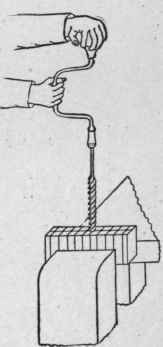
Fig. 118.
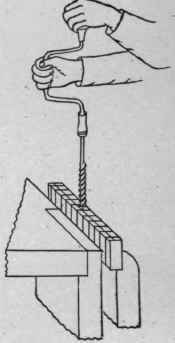
Fig. 117.
Cease boring, move to a position at the end of the bench, as in Fig. 118, and observing the above directions turn the brace two or three more revolutions. Resume the first position and repeat. Alternate thus between these two positions, revolving the brace two or three times in each, taking great care that the bit stands vertical as viewed from either position, and that it is never pushed from or toward you, thereby disturbing the vertical adjustment of the previous position. The first inch of depth in boring will give direction to the hole. It cannot be changed much after that.
When the bit is nearly through the board, place the finger underneath at every revolution of the brace, and when the spur is felt, cease boring. Now turn the brace backward two revolutions to loosen the spur, and then draw it out, either without revolving it at all, or revolving it forward. This is to clean the boring-chips out of the hole, for if the bit is revolved backward while it is being withdrawn the boring chips will remain in the hole. Note this and remember it.
Bore at every intersection of lines in like manner. The under side of the work will present a succession of points nearly or quite agreeing with the intersection of lines thereon.
Mark 10 off from 100 for every point that varies 1/8 in. from the intersection which it should meet.
It will be noticed that we have used the smallest auger bit, though a larger one is represented in Figs. 117 and 118, for clearness of illustration. We use the 1/4 in. because all the principles involved can be taught with it as well as with any size, because greater care is necessary with it than with a larger one, and because it is found that notwithstanding its frailty the percentage of breakage is too small to need taking into account.
Continue to:


My Books

