


Lesson VIII. Edge And End Planing. Part 3
Description
This section is from the book "Elementary Woodwork", by George B. Kilbon. Also available from Amazon: Elementary woodwork.
Lesson VIII. Edge And End Planing. Part 3
Problem III. To Make A Bread-Board
For practice in truing wider surfaces than the preceding, take a white wood board 7/8 in. thick, roughly sawed, 12 1/2 in. X 9 1/2 in., true both sides, as in Lesson VII (Surface Planing)., and both edges and ends as in the present lesson, making it 12 in. X 9 in. On one side of the board measure from each corner 3 in. along each edge and 2 in. along each end, and draw pencil-lines, as in Fig. 113.
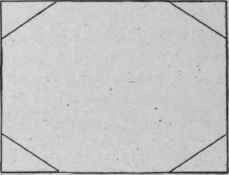
Fig. 113.
Square across edges and ends, and make corresponding lines on the opposite side. Saw near to and plane exactly to these lines, thus observing all four of the fundamental rules. Chamfer the corners as follows: Hold the work in the vise, and with fine-set plane take off the corners, making instead new faces
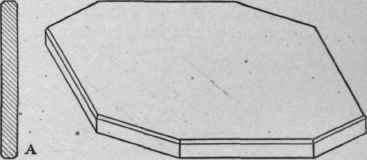
Fig. 114.
1/8 in. wide at an angle of 45 degrees with the sides of the board, giving the finished work the appearance of Fig. 114. The larger view in this figure is a perspective, and allows only four of the chamfered corners to show. The smaller view at A is a section.
Take a quarter of a sheet of No. 1/2 sand-paper, fold it over a block, and sand-paper the completed work, without marring any corners. This board is a useful article in the home to lay a loaf of bread on while cutting it.
Continue to:


My Books

