


Occasional Tables (Figs. 10 And 11)
Description
This section is from the book "Handcraft In Wood And Metal", by John Hooper, Alfred J. Shirley. Also available from Amazon: Handcraft In Wood And Metal.
Occasional Tables (Figs. 10 And 11)
The Rim
The elevation and plan shows a suitable treatment for this type of furniture; a half-plan shows the method of forking the legs into the rim, a general constructive feature of circular and elliptical work. When building up the rim, a board of 3/4 in. pine should first be planed up true, and the true shape of rim set out upon it. This is divided into four parts, one of which is duplicated in 1/4 in. mahogany and constitutes the templet. The templet is used to mark out twelve pieces or segments, four for each layer, and each segment can then be spokeshaved exactly to the templet size. Next, one piece is fitted to the board and pinned in position, then the remaining three segments are fitted in and secured with pins, glueing the joints as one proceeds. This completes one layer, which is then planed true and toothed; the next layer is spaced so that the joints fall midway between those of the bottom layer, usually called brickwork fashion. As these are fitted, they are glued down and pressure applied with handscrews. When dry this layer is also planed and toothed, and the third layer fitted in the same relative position as the first (see diagram below).
The Legs should be planed up perfectly square to size, then marked for turning. A detail of the foot is shown in Fig. 8, from which it will be seen that the under-framing is secured by introducing a pinned foot which glues through the under-framing into the legs.
The Under-framing should be prepared in the form of an X. One piece is mortised right through to receive two short rails (see diagram, Fig. 2) tenoned into same. When this is fitted and glued together the design is traced to the wood, or as an alternative, a pattern of one-quarter the shape is cut in cardboard, the remaining three parts being marked from this.
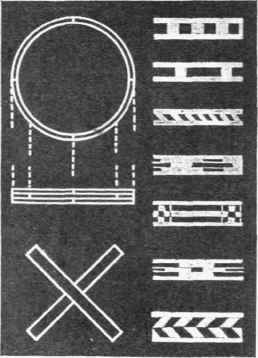
Fig. 9.-Plan and elevation of rim and various mosaic stringings.
The Top can either be cut from solid material and veneered on both sides or laminated, viz. five-ply material can be adopted, in which case it is only necessary to veneer the top side. The veneer of the circular top shown on p. 52 is intended to be of the curl variety; eight pieces are used to form the centre part. These should be secured between two thin V-shaped pieces of wood during the process of cutting; the curved edge is finished with a fine file and the V shape is planed. They may then be separated and glued down to a sheet of damp stretched paper; the top is completed by fitting round the curved cross banding, glueing each segment down as they are fitted. The top is then veneered with this built-up work and the paper is removed with a toothing plane after the glue has dried. Cross banding on edge of top is best laid with a hammer.
Square Tables
Various treatments are shown in Fig. 8 for the tops of square tables, the only different constructive feature of these types being the connexion of straight rails to the knee parts of legs. This is dealt with in reference to the table illustrated on p. 55 and described on p. 56.
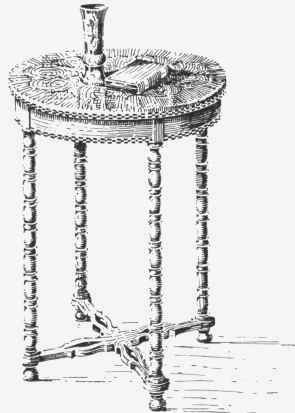
Fig. 10.-Sketch of circular table.
Continue to:


My Books

