


Doors. Part 4
Description
This section is from the book "Inside Finishing", by Charles A. King. Also available from Amazon: Inside Finishing (1912).
Doors. Part 4
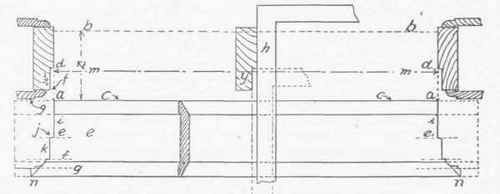
Fig. 38. - Cutting down a Threshold.
Do not use the try-square to lay out the ends, as they should be made to fit the horizontal section of the doorframe, which is rarely set perfectly square with the faces of the partition; therefore the cuts may be made with a knife at the angle of the jamb, which is found by using a straightedge, or by the blade of a steel square, as shown at h. The square is in position to obtain the first cut (i) which is from the rabbet (d) to the edge of the threshold (c). Upon the line, e, of the threshold, lay off the exact size of the rabbet (d); measuring from i, mark j with the point of a sharp knife. With the steel square held against the long side of the rabbet, as indicated by dotted lines at y, move the threshold until the point, j, coincides with the edge of the square. Draw the line, k, which will rest against the long side of the rabbet at w when the threshold is in place.
Following the above method, make all marks necessary for the fitting of that end of the threshold. The length of the threshold is found by measuring the exact distance between the two jambs, from m to m opposite, and by laying it off upon the threshold from the cut, i, to the corresponding cut upon the other end. This should be a little long, not a measurable distance, say a little less than 1/64" in order to be forced to a close fit. Having obtained this point, proceed in the same way as in marking the first end, moving the threshold so as to make the points of length coincide with the straightedge when held against the members of the doorframe which are to be fitted by corresponding members of the threshold, as described above.
All cuts should be made a little under, that is, shorter on the back or under side than on the face, so that the threshold may be forced into its place without marring the jamb. The outside ends of the threshold should be returned upon themselves, as shown at n.
The result of the work will depend upon the care used, and while the process may seem intricate, if it is followed through carefully once, it will be found to be much more simple than it appears.
Suggestive Exercises
26. Are the doors in common use made to order? Why? Compare doweled and mortised doors. What sized dowels should be used? Describe a coped-joint door. How is a door forced together and the joints held? Why should coping be done before the dowel holes are bored? Describe the groove and how the panel fits into it. Why should a panel be narrower than the distance between the bottoms of the grooves?
27. Give the sizes of the doors most generally used.
28. Describe the three grades of doors. What should be considered in buying a door? Of what kinds of wood are solid doors made?
29. How should hardwood doors be made? Describe the process of their construction.
30. What governs the kind of wood of which doorframes are made upon the best work? What governs the width of the door jamb? What should be its thickness? How is a rabbet sometimes formed upon cheap work? How should this be done? Describe a veneered door jamb, and tell why it is necessary. Describe two ways of fastening doorframes together.
31. Compare the doorframes of a frame house and of a brick house.
32. What is the relative size of a doorframe, and the opening in the partition? Describe the process of setting a doorframe. What should be done where the hinges are to be fitted to provide a "hold" for screws?
33. Describe the process of jointing in a door. If the stiles of a door are not perfectly straight, which side should go next the rabbet? What difference will it make if a carpet is to go over the threshold?
34. Describe the process of marking and cutting in a hinge. Compare two kinds of hinges. How far should hinges project from the finish? Why should not the stile be planed straight? Describe the different forms of hinges in common use. What is meant by the "hand" of a door? How are cupboard hinges usually cut in?
35. Upon what grade of work is the rim lock generally used? Describe the process of putting on mortise locks. How should the striker be put on to prevent the rattling of the door? What kind of padlock should be used in damp places?
36. What is the first step in cutting down a threshold? Should the marks for the cuts to fit the inside of the jambs be made perfectly square with the edges of the threshold? Is it necessary that a try-square be used for this purpose? Describe the process of finding the cuts which are parallel to the edges of the threshold. The cuts for the ends. Should the marks be made with a knife or with a pencil? Should the ends be cut square or under a little?
Continue to:


My Books

