


Glazed Sash. Part 2
Description
This section is from the book "Inside Finishing", by Charles A. King. Also available from Amazon: Inside Finishing (1912).
Glazed Sash. Part 2
The end of the cord should then be pushed through the 3/8" hole (d, Fig. 43) and the knot tied, when the sash is ready for the stop strips which are to hold it in place.
42. Hotbed or skylight sash are made upon a principle entirely different from those in ordinary use, as they must be so constructed that water will run off easily. They are made to lay upon a pitch which should be not less than 2" to a foot. There are no middle rails; the bottom rail is thinner than the stiles or the top rail, the glass extending over it, so that the water will have no obstruction in its flow.
Upon sash of this description, the glass usually is lapped about 1" over the pane below, with no putty in the joint. It is bedded and puttied at the sides by the usual method, the glass being held in place by glazier's points, and prevented from dropping down while the putty is setting by means of a glazier's point bent to hold the glass or by a small brad driven in the sash below each pane of glass, as at a, Fig. 51. These brads or points should be driven so that the putty will cover them.
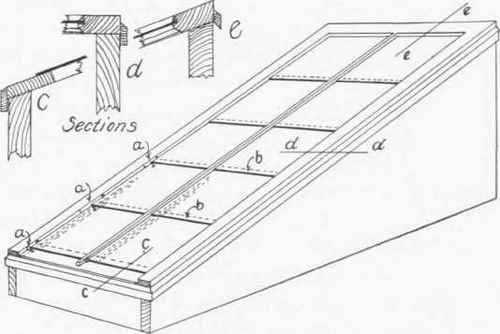
Fig. 51. - Skylight Sash.
The sash for hotbeds and greenhouses need not be placed with so much care to prevent leakage as would seem necessary; the glass may be cut as square as possible, and laid end to end with a butt joint, instead of lapping as shown at b, Fig. 51; a strip is then screwed upon the frame of the sash to hold the glass in its place, as shown at a, Fig. 52. This eliminates all putty, and allows repairs to be made easily, and the water which will leak through, if the glass is cut accurately, is insignificant.
In hanging a skylight sash, the joints should be made rain-proof by some method similar to that shown in Fig. 51, at sections c, d, e, in which strips are fastened upon the sash in such a way as to allow the sash to be lifted easily, but which will be water-tight when the sash is closed. The worst feature of a skylight is the condensation of moisture from the inside of the house upon it, the dropping of which is often mistaken for a leak. This may be remedied by an arrangement of grooves and gutters to carry the condensation away and allow it to run out of doors upon the roof. This is not practicable nor advisable, unless there is a considerable area of roof to be treated, as in a dwelling house the skylights are rarely of a size which will make this an important matter.
There are patent forms of hothouse frames, similar to Fig. 52, b, which will care for the condensation of large areas of glass.
43. Store sash. - Sash for store fronts are of the same construction at the corners as other sash, except that the stiles and rails are heavier and should be put in place with the molded side out, instead of the puttied side, as in common sash. In store fronts large lights are sometimes held in place with a bead instead of putty, as in Fig. 53; this allows a certain amount of elasticity, as the bead will spring and allow the glass to move a little, so that a strain, which would break the glass if it were held rigidly with putty, may do no damage.
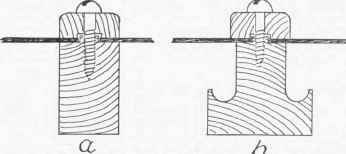
Fig. 52. - Hotbed Glass Frames.
If a large glass is broken, pieces may be left which would be of value if they could be removed safely, and the bead setting makes this possible. This method of setting glass has its disadvantages if the sash is to be exposed to the rain. This may be remedied by bedding the glass upon the outside with putty, or rubber tape. Such bedding alone will not hold the glass sufficiently to interfere with removing it, if necessary, by simply taking out the bead from the inside of the sash.
In making glass doors which are to receive hard usage, the molded side of the door should fit against the rabbet of the doorframe, so that the weight of the glass will be against the wood instead of against the putty and points when the door is slammed.
44. Blinds are made in factories under the same conditions as are sash and window frames. They are ordered generally by the size of the glass, the same as sash. They usually are hung upon gravity hinges, which are so made that when the blind is swung past the center in either direction, it will swing the rest of the way itself, and will remain either open or closed.
Upon window frames which have blind stops, the blinds are hung between the outside casings, but if the frame has nothing but the casing outside of the pulley stile, the blinds are hung with special hinges. This latter is the usual method of hanging blinds in certain parts of the country; in other places the gravity hinges are more popular.
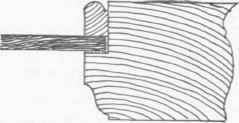
Fig. 53. - Setting Glass in Store Windows.
Suggestive Exercises
37. Under what conditions are common window frames made? Describe and compare the frames in common use in different parts of the country. What should be the pitch of a window stool? What provision is made to allow the cord to be repaired? What is the difference between the frames of a wooden and of a brick building? How are the latter usually fastened in the wall? How is the joint between the stone sill and the window stool made tight? What is the principal difference between the frames for common and the best work? What is the advantage of the latter? What kind of frame is it that has two or more windows in the same frame? What is the objection to pulleys made of light metal? How should the sash in a casement frame swing? Why? How should a center hung sash be hung? Should a pivot hung sash be used for an outside window?
38. What is the chief difference in the construction of the sash in different parts of the country? Name and describe the different members of a sash. What kind of stock should be used in the manufacture of sash? What is apt to happen if the sash springs after the glass is set? Describe the joint used at the top and bottom rails of the sash. What is the best method of wedging the tenons of the mortise joints? Describe the joint of the meeting rails. Describe the form of sash which does away with the weakness of the ordinary sash at the meeting rail. What should be done to a sash to prepare it for the cord?
Continue to:


My Books

