


Parted Or Split Work
Description
This section is from the book "Wood Turning", by George Alexander Ross. Also available from Amazon: Wood Turning.
Parted Or Split Work
Methods for turning a piece of "split" work, such as would be used for decorative purposes on flat surfaces. In Fig. 88 is shown a piece that is semicircular in section, such as would be used in connection with moldings on flat surfaces, where they are "planted on" as decorations.
In some cases it is customary to finish the end of a straight piece of molding with a "final," such as is shown in the figure. In order to produce this piece so that one side will be flat, several methods are made use of in preparing the stock for the lathe. {These methods are also used on such work as turned pilasters and on parted cylindrical patterns.) For convenience the methods are numbered, No. 1 being given the preference, as in most cases it saves time but uses a trifle more stock.

Fig. 88.
As indicated in the cuts, two pieces of stock are used in working out problems of this kind. The surface of each piece should be planed true before being fastened together.
Method I. Fig. 89 shows this method where screws are made use of to hold the pieces together. That part of the stock in which the screws are placed should be outside of the exercise so that there will be no holes in the work when finished.
Method 2. In Fig. 90 is illustrated the method where glue and paper are used to hold the pieces together. The glued surfaces should be outside of the exercise, as indicated in the figure.

Fig. 89.

Fig. 90.
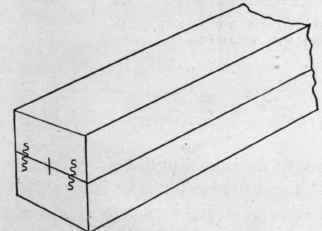
Fig. 91.
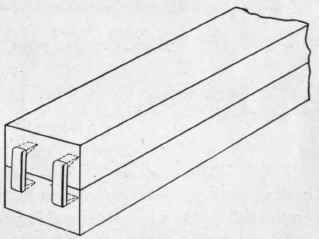
Fig. 92.
Method 3. Fig. 91 illustrates a method where corrugated nails are made use of, and for very light work this method is an excellent one.
Method 4. Fig. 92 illustrates a method where pinch dogs are used, and in connection with method No. 1 is often used on heavy work.
Method 5. Where much of this character of work is done, special attachments are used on the lathe, which are practical and time-savers. These attachments can be made of wood in connection with the face plate. Fig. 93 shows the attachments. The pieces from which the work is to be turned should be fitted snugly between the jaws of the chucks. The screws shown are filed sharp, the work is driven between the jaws, and the points of the screws hold it from slipping sidewise. For the dead-center end, a cone center and a small plate fastened to the wooden plate make a serviceable chuck. These chucks can be made of cast iron, and would be valuable additions to any wood-turning room equipment.

Fig. 93.
Continue to:


My Books

