


Hull Planking. Continued
Description
This section is from the "The Elements Of Wood Ship Construction" book, by W. H. Curtis. Also see Amazon: The Elements Of Wood Ship Construction.
Hull Planking. Continued
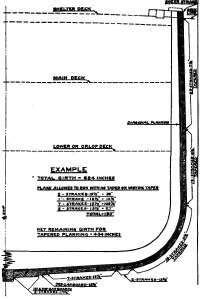
Figure 152. Planking Layout On Section Having The Greatest Girth.
The frequent adjustments of taper necessary to keep the untapered planking near natural lines will in all probability prevent the liner exactly reaching the original points selected on the stem and stern post. In this problem it is assumed that the remaining girth for tapered planking, at the stem is 312 inches and at the stern post 352 inches, which it will be seen are somewhat less than the original girths decided upon. It is also assumed here that the tapered planking begins on the same strake at the stem and stern, but this is by no means an invariable rule. Quite frequently the shape of the stern will require a different number of tapered strakes from that used at the stem. The principles of determining the taper, however, remain the same.
Girths for tapered planking must now be measured at frequent intervals as shown in Fig. 154. The number of girths shown here is suitable for small boats only. In large vessels a greater number should be taken. It is not necessary to take them at even intervals as shown. In fact an experienced liner will check girths wherever he suspects there is a necessity for so doing, keeping a record of them by merely noting the frame numbers at which they were measured. For the purposes of this problem they have been numbered from one to six. The girths as measured may be set down in a table as shown in Fig. 155.
Now, the widths of the strakes at the greatest girth of 434 inches are 9«, 8«, and 7« inches respectively. To find the required width at any other girth less than the greatest girth it is only necessary to find the percentage that the lesser girth bears to the greatest girth, then this same percentage of the width of the stroke at the greatest girth will give the required width at the lesser girth. This operation may be set down as follows:
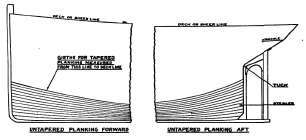
Figure 153. Planking Lining.
Planking Lining Example Same As In Figure - 152.
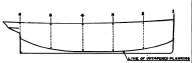
Figure 154. Girths.

Figure 155.

Figure 156.
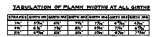
Figure 157.
Figure 158. Graphic Method Of Finding Plank Tapers.
Required: | Width of strakes at girth No. 2. Greatest girth equals 434 inches. Girth No. 2 equals 376 inches. 376 is 86.7 per cent. of 434. |
Then | 86.7 per cent. of 7« inches equals 6« inches. 86.7 per cent. of 8« inches equals 7⅜ inches. 86.7 per cent. of 9« inches equals 8¬ inches. |
And 6«, 7⅜, and 8¬ inches will be the required widths of planking at girth No. 2. A like calculation is made for each girth less than the greatest girth. It will be easier for some to set the calculation down in the following form:
376×15/434×2 = 6« inches.
376×17/434×2=7⅜ inches.
376×19/434×2=8¬ inches.
After the widths are calculated for each girth they may be tabulated as shown in Fig. 157. The widths are here given to the nearest 1/32 inch.
Figure 158 shows a graphic method of determining the required planking widths at the various girths without any calculation whatever, which is laid out as follows:
On the straight line A measure from the point O one-tenth (one-twentieth would do as well) of each girth and from each point so measured draw a line down and square from the line A. On the last line so drawn measure down from line A the widths of planking at the greatest girth, and join each of the points thus measured to O with a straight line. This completes the figure, and the required widths of the 7«-inch strakes at all girths may be directly measured from line A to the line drawn from O to the 7« mark, these measurements being taken on the lines previously squared down from the line A at the points representing the lengths of the various girths, as shown by the arrow heads in the figure. Likewise the required widths of the 8«- and 9«-inch strakes may be taken directly from the figure.
Tapered planking is not generally spiled, as it is usually of such narrow widths as to easily take the required edge set.
It is customary to plank first from the keel to a point above the turn of the bilge, and then plank from the deck line down to this point, the last strake placed being known as the shutter. Thus, if any unfairness in planking lines develops as the tapered planking is run on, the correcting strakes will be located at or below the water line, near the shutter, and will not spoil the appearance of the job. Sometimes two planking gangs are worked at the same time, one working from the bottom up, and the other working from the top down, in which case, if the tapered planking is started before the untapered is finished, it is run in on estimated tapers at the top, the correction strakes being located in the vicinity of the shutter.
It is seldom that any two liners will approach the lining problem in exactly the same manner, and for this reason no two will arrive at exactly the same result in the finished job, either in the respective number of tapered and untapered strakes used, or the amount of taper on the tapered planking.
Continue to:


My Books

