


Chapter I. Keels, Stems And Stern Posts. Keel Blocks - "The Ship's Foundation"
Description
This section is from the "The Elements Of Wood Ship Construction" book, by W. H. Curtis. Also see Amazon: The Elements Of Wood Ship Construction.
Chapter I. Keels, Stems And Stern Posts. Keel Blocks - "The Ship's Foundation"
Every structure must have a suitable foundation. Floating structures, such as ships, are built on temporary foundations called slips. When completed they are then launched, or permitted to slide into the water.
While the slip is purely a temporary foundation for the ship during construction, it usually is permanent in itself and may be used for many ships.
The slip usually consists of a very strong arrangement of piling, suitably capped, and decked over with heavy planks. The decking of the slip serves as a working platform under the ship. Since the ship must be launched into the water it is necessary for end launchings to build the slip on an incline which slopes downward toward the water. This slope is usually about 5/8 to ¾ of an inch to the foot, i. e., ⅝ to ¾ of an inch of fall to one foot of length.
The keel blocks are arranged on top of the slip. They serve to carry the weight of the ship and to obtain the proper working room between the ship's bottom and the slip. Keel blocks must be so built as to be easily removed just before the ship is launched. The keel is the first piece in any ship to be assembled in the building slip, and since the keel blocks form the foundation proper for the keel, it is necessary to have them in place before the keel can be laid.

Keel Block Crib.
Flgure 1. Elevation.
Figure 2. End View.
Keel blocks may be cribbed, as in Figs. 1 and 2, or plain, as in Figs. 3 and 4. The cribbing is to steady the blocks during the early part of construction, when they do not carry much weight. At least half of the blocks should be cribbed, and in some yards they are all cribbed. In all cases they must be placed directly over the piling of the slip. Thus the spacing of the keel blocks is regulated by the bents of piling under the slip. This is ordinarily six to eight feet from center to center of the blocks.
Since the slip has an incline, the keel blocks, if left square on the bottom, would not stand plumb, but would lean toward the lower end of the slip. If wide blocking is used, say 18 inches or over, this inclination of the blocks need not be considered. If the blocking is much narrower than 18 inches, the bottom block should be scribed off so that the entire set will stand plumb. Where the blocks are cribbed this latter operation involves a great deal of extra work on the upper and lower blocks, as the cribbing planks, if the block stands plumb, must stand on a level. It is, therefore, economy to use wide blocking and then permit the set to lean with the slip.
The top, or wedge, block should be shaped as shown in Fig. 3 and fitted with wedges to be used in lining up the keel. Good proportions and proper settings for wedges are shown in Figs. 5 and 6.
If a shoe or false keel is to be fitted it cannot be placed until the frames have been erected and the keelson is in place and fastened down, as the main keelson bolts are clinched up under the keel. Therefore, an extra block, having the same thickness as the shoe, should be fitted above the cribbing and under the wedge block, as shown in Figs. 1 and 2. This block is to be removed when the shoe is fitted, as shown in Fig. 3.
Keels are customarily laid on the same slope as the slip. However, since wood ships have considerable tendency to hog, i. e., drop at the ends, after launching, the keel is laid with a spring, or sag, in the middle. Thus, when the vessel hogs slightly after launching, the keel, instead of showing the hog, merely tends to straighten out. The amount of spring used varies greatly with different designers. A fair average would be between 1« and 2 inches for each 100 feet of keel length.

Plain Keel Block- Showing Shoe In Place.
Figure 3. End View.
Figure 4. Elevation.
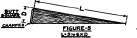
Proportions Of Wedges.
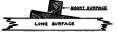
Figure 6. Proper Placing Of Wedges.
Where the keel is laid on the same slope as the slip the two end blocks will be the same height. The middle block will be lower by just the amount of the spring. On the blocks between the middle and the ends the spring is roughly estimated when the blocks are first set up, the final adjustment being made by dubbing the top block, or driving and slackening the wedges after the keel is up. The tops of the wedge blocks must be dubbed to fay accurately to the bottom of the keel.
The blocks and cribs should not be spiked together. If it is necessary to steady the blocks while the keel is being laid, they should be lightly toenailed. The nails should be removed as soon as the blocks have enough weight on them to be steady.
The height of keel blocks used in different yards is by no means uniform. However, the distance from the top of the slipway planking to the top of the keel should not be less than five feet, nor more than six feet.
Continue to:


My Books

