


Chapter I. Glossary
Description
This section is from the "The Elements Of Wood Ship Construction" book, by W. H. Curtis. Also see Amazon: The Elements Of Wood Ship Construction.
Chapter I. Glossary
Athwartshiu
Across the ship - at right angle to the keel.
Dimensions. Molded Length
The extreme distance from plank rabbet on the stem to the plank rabbet on the stem. Length between perpendiculars. The distance from the fore side of the stem to the after side of the rudder post, measured on the keel.
Molded Depth
The perpendicular distance amidship from the top of the keel to the top of the main deck beam at the outside of the frame.
Depth Of Hold
The perpendicular distance amidship, from the top of the bottom ceiling to the top of the main deck beam at the centerline.
Molded Beam
The width of the ship at the main deck taken amidship to the outside of the frame.
Breadth. Extreme
The greatest width of the ship over the planking.
Dub
To cut fair with an adz. Dubbing, in general, covers the operation of fairing up the frame of the ship inside and outside. Used in connection with any work performed with an adz.
Fay
To fit together. Faying surfaces are surfaces that must be fitted together, as in scarfs. To fay means to fit- Fayed means fitted. Both in the sense that fitting means the securing of good contact between the surfaces.
Fair
Smooth, without irregularities. A fair curve means a curve pleasing to the eye - without sudden sharp turns or humps.
Inboard
Inside the ship's, hull or superstructure. Inboard side means the side facing inboard, or toward the inside.
Midship
The center of the ship. Amidships means at the center of the ship.
Molding
That dimension of a plank or timber reading from outboard to inboard.
Outboard
Outside the ship's hull or superstructure. Outboard side means the side facing outboard, or away from the inside.
Rabbet
In general, a recess, or groove, to receive the edges or ends of planking, siding, etc. A rabbet may be nothing more than a small surface squared off to receive a plank edge as in Fig. 28. The rabbet in general is marked out by three lines, namely: The outer rabbet line, the inner rabbet line, and the bearding line. See Figs. 29 and 30. The surface between the inner and outer rabbet lines is called the rabbet. The surface between the inner rabbet line and the bearding line is called the bearding.
When the plank next to the keel, or the garboard, as it is called, is very thick, and the keel rather narrow in siding, a back rabbet is cut near the ends of the ship, to keep from cutting in too far in on the keel. The principal object of the rabbet as used on a ship's hull is to protect the plank ends and. permit calking. Therefore the rabbet must be nearly square with the surface of the plank fitting into it.
Scantlings
A term used in referring to the sizes of the various timbers comprising the ship's structure. The expression "Light scantling ship" means a ship with light timbers, etc.
Siding
The dimension of a timber reading opposite to the molding. Example: Keel sided 18 in., molded 24 in., means a keel having a depth of 24 in. and a width athwartship of 18 in.
Scribe
To mark one timber off against another, so that when the first timber is cut to the marks it will fit the second timber.
Ship
To place or mount on the ship. Shipping a rudder means placing the rudder in its position on the ship. Contrariwise to unship anything, means to take it from its position on the ship.
Scarf
To join together with an overlap. Joints between timbers, as shown in Figs. 33 to 36 inclusive. These figures show the four principal forms of scarfs used in shipbuilding. Several modifications of these forms are also used, which will be shown later on. Timbers are scarfed to secure strength and it is therefor important that the proportions of the scarf be correct. The length should not be less than six times the depth, the depth being measured as indicated by the letter D in the figures.
The nib should be about 25 per cent, of the depth "D." The following formula will be found to give excellent proportions for all ordinary scarfs.
Let I D = Depth of Scarf. L = Length of Scarf. N = Depth of Nib. K = Width of Key.
Then L = 6 × D
N = D/8 + 1 in., where D is 8 in. or more.
N = D/4 where D is less than 8 in.
K=D/4
Keys for keyed scarfs are made of hardwood. They should be made in two pieces, wedge shaped, with a taper of about « inch to the foot, as shown in Fig. 37, and should be driven simultaneously from each side of the timber until very tight, then sawed off flush and wedged at the small ends so that they cannot possibly back out.
Flat And Edge Scarf
A scarf is called flat when the depth, or dimension D, reads across the edge, or narrow face of the timber. An edge scarf is one where the dimension D reads across the side, or wide face of the timber.
Various Forms Of Rabbets

Figure 28. As on Keel.
Figure 29. As on Stem.
Figure 30. As on Rim.
Figure 31. Door Jamb - In Joiner Work.

Figure 32. Corner Stanchion - In Joiner work.
Common Forms Of Scarfs
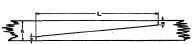
Figure 33. Plain Scarf.
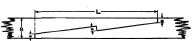
Figure 34. Hooked Scarf.

Figure 35. Key Locked Scarf.

Figure 36. Key Locked Hook Scarf.

Figure 37. Wedges.
Continue to:


My Books

