


Stems
Description
This section is from the "The Elements Of Wood Ship Construction" book, by W. H. Curtis. Also see Amazon: The Elements Of Wood Ship Construction.
Stems
There are several good arrangements of stem construction in common use. A few of these are shown in Figs. 17, 18 and 19. In some cases the inner rabbet line is laid out on the joint between the stem and the apron, resulting in what is known as a free stem. See Fig. 18. It will be noted, in this case, that the planking merely butts against the stem and that all of the plank end fastening will land in the apron. The more common method is to lay out the rabbet well onto the stem, so as to get some of the plank end fastening into the stem proper.
Stems are not set up square off the keel, as this would make them appear to be leaning backward. Not only is the stem leaned, or raked forward, but very often the forward face is cut on a slight forward spring, or roman nosed, as it were, to avoid the hollow appearance which a perfectly straight stem has. In a stem 48 feet long the rake forward would be from 6 to 12 inches, and the spring about 1 to 1 1/2 inches.
Molds, showing the exact shape of each piece of the stem structure, are furnished from the loft. These molds have the waterlines and frame centers marked upon them, and these lines should be transferred to the various pieces by the carpenter laying them out. They are used for future location of framing, etc. The molds also show the outer rabbet line and the bearding line. If the rabbet varies in depth this also will be marked, thus giving full information for laying out and cutting the rabbet. In addition, the width of the forward face of the stem and forefoot will be marked at frequent intervals on their respective molds. Since the tapered side of the stem always extends back to the outer rabbet line, this gives sufficient information for the shaping of that portion of the stem forward of the outer rabbet line. The siding of the stem in way of the outer rabbet line always remains constant, i. e., it will be the same at top, middle and bottom.
The stem, apron and forefoot are assembled and bolted together on the ground. If knightheads axe fitted they axe also worked out and fastened down to the apron at this time. (Knightheads are really a part of the frame and will be more fully described in the next chapter on framing.) Then, at the proper time, the entire stem structure is erected and shored in position. Three long, heavy shores are used - one forward and one on each side. Care must be taken to set the stem plumb and to the correct rake with the keel.

Figure 17. Typical Steamer Stem.
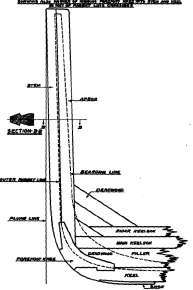
Figure 18. Typical Free Stem.
The straight rabbet on the stem is cut before erection. Below the turn of the forefoot it usually is not cut until the frame has been set up and is being dubbed. With careful loft work, however, the entire rabbet may be cut with very little danger of making a serious error.
The fastening of the stem at the forefoot must be carefully laid out, or it will be impossible to drive a sufficient number of bolts through. Stern and forefoot bolts, whenever possible, are driven through and clinched. An example of this fastening is shown in Fig. 20. Plans for this fastening are usually furnished and should be closely followed.
Propeller Posts
Figs. 21 and 22 show two typical forms of stern, or propeller posts that are in common use. In Fig. 21 the post is cut off at and mortised into the horn timber, while in Fig. 22 it is extended upward between two horn timbers and connects to a deck beam. The two forms result in entirely different stern frame arrangements, which will be shown in the next chapter. The post in Fig. 21 is most commonly used in small, single-deck vessels, and that in Fig. 22 in larger vessels with more than one deck. Either post, however, may be used on large or small ships.
The figures show the posts as finished. Molds are furnished from the loft, giving the exact length and shape of the post, tenons at top and bottom, location and size of shaft hole, and the seat for the arch knee. As a rule the rabbets are not cut until the stern framing is completed, and then only as the dubbing proceeds, as it is difficult to lay them out with sufficient accuracy. But the shape of the post, in siding, can, and ought to be, roughed out a little over size, as this saves dubbing after erection. The post is not finally faired off to the shape shown in the figures until after the planking has been completed.
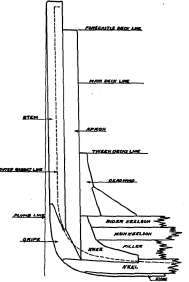
Figure 19. Typical Stem With Gripe.
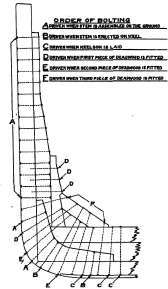
Figure 20. Typical Stem Fastenings.
Where extreme care is taken in molding and setting the stern frame and in laying out the Biding and rabbets on the post, the rabbets may be cut before the post is set up. Even in this case it is best to rough out the rabbets under-size, leaving the finishing operation until the dubbirg is being done.
The post should be left full in siding forward of the rabbet at the top, so that most of the bearding will fall on the post. Where this is not done, i. e., where the post is cut straight from top of boss to top, shims and chocks have to be fitted to take the plank end fastening. They make a poor job and, in addition, are very troublesome.
Continue to:


My Books

