


Square Frames
Description
This section is from the "The Elements Of Wood Ship Construction" book, by W. H. Curtis. Also see Amazon: The Elements Of Wood Ship Construction.
Square Frames
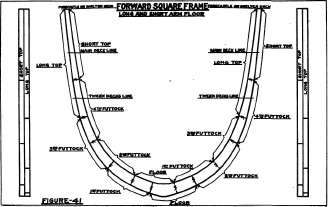
Square frames may be divided roughly into two types; namely, those having long and short arm floors, and those having long and short floors. Figure 38 shows a typical long and short arm floor midship frame. In this arrangement both floors are the same length, each being molded with a short arm on one side of the center line and a long arm on the other, and so placed that the short arm of one floor extends on the same side of the center line as the long arm of the other floor. The long arm of each floor thus furnishes a lap for attaching the first futtock.- While it is common in large vessels to keep the deadrise down so that the floors amidship may be made straight on top without tapering too much toward the bilge, this type of floor may be used for boats having considerable deadrise. The top will then no longer be straight but would have the general appearance shown in Fig. 41.
In this type of frame it will be noticed that the first futtock on one side is in the same tier as the second futtock on the other side. (It is customary to refer to these tiers as upper and lower, and for clearness hereafter, timbers having butts shown dotted on the plates will be considered as being in the lower tier, while timbers having butts shown in solid fines will be in the upper tier.) Then, keeping in mind the location, of the tiers, on one side of this frame in the lower tier there will be the first and third futtocks and a long top timber, while on the other side in the same tier there will be the second and fourth futtocks and a short top timber. When the frame happens to be in way of a well where there is a bulwark, then the long top timber will become a long stanchion, and the short timber a short stanchion. Stanchions generally are placed in the same tier on all frames. In short, futtocks and tops of the same number and name occurring in the lower tier on one side of this frame will occur in the upper tier on the other side.
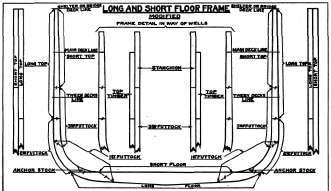
Figure 40.
Figure 39 shows a midship frame having long and short floors. This type of frame can be used only where the vessel has small deadrise so that the tops of the floors may be left straight. In the figure the short floor is shown in the lower tier and the long floor in the upper tier, the extension of the long floor past the ends of the short floor furnishing the lap for attaching the first futtocks. In this style of frame, futtocks of like numbers and tops of same name will fall in the same tier. Also, stanchions will be of the same length should the frame call for them. Hence this frame is much simpler to assemble than the long and short arm floor frame.
It will be noticed that the second futtocks in this frame abut the ends of the long floor and that an anchor stock is used to fill out this tier flush with the inside of the first futtock in the lower tier. This construction forms a short scarf at the bilge, which, after the ceiling and planking bolts have been driven through it, tends to increase the strength of the frame at this point.
Figure 40 shows a modification of the long and short floor frame, which, however, is seldom used because of the trouble experienced in fitting the butts in the vicinity of the bilge. Here the first futtock is scarfed to the short floor and third futtock, while the second futtock lands on top of the long floor. The anchor stock is much smaller than that shown in Fig. 39 and might be more properly called a chock. The only difference between the two frames shown in Figs. 39 and 40 is in the arrangement of the butts around the bilge.
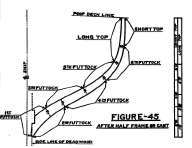
No matter what type of frame is used amidship, as soon as points forward and aft are reached where the deadrise increases rapidly, or the frame assumes the general shape shown in Fig. 41, it is necessary to use long and short arm floors to secure frames of the greatest strength. As the last square frames forward and aft are approached they will assume the general forms shown in Figs. 42 and 43. It will then be found best and most economical to mold the long and short arm floors as indicated in these figures. So far, in all of the frames discussed, the timbers have been sawn from straight-grained flitch. In some localities, such as the coast of Maine, the bilge futtocks, where the frame is not too large, are molded from oak natural crooks. On the Pacific Coast, where very large natural crook fir knees are available, the long and short arm floors for such frames as those shown in Figs. 42 and 43 are sometimes made from knees. In this case the short arms would have butts square with the frame.
Continue to:


My Books

