


Exercise XIX. A Box With Grooved And Tongued Joints (Across The Grain)
Description
This section is from the book "Manual Instruction: Woodwork. The English Sloyd", by S. Barter. Also available from Amazon: Manual Instruction: Woodwork.
Exercise XIX. A Box With Grooved And Tongued Joints (Across The Grain)
Fig. 245. The drawing shows the plan of box, a longitudinal section on a b, and a cross section on c d. They should all be drawn, and preferably an enlarged section of the joint also, as in fig. 246.

Plan.

Section on c d.

Section on a b.
Fig. 245.
The timber required, Weymouth pine or yellow deal, will be as follows: -
For the long sides .... 13 1/2 ins. x 3 3/4 ins. x 3/4 in.
„ short sides .... 8 ins. x 33/4 ins. x 3/4 in.
,, bottom .... 6 ins. x 31/2 ins. x 3/4 in.
Plane up all the wood true, and saw the pieces for the sides and ends in halves across the grain. Place the long pieces with the face sides together, and mark the extreme length of the sides on them, so that the waste is equally divided at both ends.
Set out on the edges first, as in fig. 247, marking the 9/16 in. for the thickness of the sides, and then from these lines mark lines 1/4 in. in for the grooves; continue the lines for the grooves across the outside and on the back edges. Fig. 248 shows the setting out of the short sides, which are placed together back to back. The inner pair of lines on the face edge which show the width of the outside will be continued across the face, but the outer pair, which give the extreme width of these sides, should be continued across the back of each piece. Gauge lines 3 ins. from the face edge on the back of each of the sides, for the grooves to take the bottom of the box. These grooves are 1/4 in. deep and 1/4 in. wide, and will run from end to end of the short sides, but will join the upright grooves in the long sides.

Fig. 246.
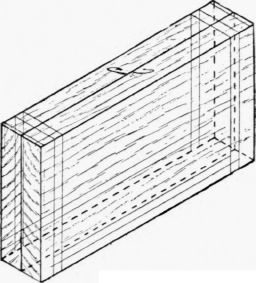
Fig. 247.

Fig. 248.
Saw out the tongue at the ends of the short sides, and the groove along the bottom also, removing the waste with a chisel, as in Exercise I. With saw and chisel make the grooves across the grain in the long sides, and mortise out the bottom grooves between the upright ones with a 1/4-in. chisel, as in the case of the rebate in Model X., fig. 184. The bottom of the box is tongued all round, and should be gauged on the face or outside 1/4 in. away from a line made all round, to indicate the exact measurement.
Saw the tongues on the ends of the bottom, and with the rebate plane make the shoulders of the tongues on the sides of the bottom. Fit the box together, and, if correct, take it apart and glue up the joints. The box should now be finally cleaned off with the smoothing plane, taking care to plane from the outside edges towards the middle of the faces on the ends and bottom, where the end grain might be broken.
Continue to:


My Books

