


How To Make A Telephone Line
Description
This section is from the book "The Boy's Book Of Mechanical Models", by William Bushnell Stout. Also available from Amazon: The Boy's Book Of Mechanical Models.
How To Make A Telephone Line
DID you ever make a tin can telephone ? Simply take two empty tin cans and punch a hole in the center of the bottom of each. Run a string through the holes and tie a button or a large knot inside so the string can't slip out again.
Let the string be, say fifty feet long, and let a boy at each end hold the can in his hands, drawing the string tight.
If nothing touches the string - be sure you don't have your fingers on the bottom of the can - when a boy talks in the can at one end, you can hear him at the other, and I'll tell you why.
When you talk into the can, if you hold your fingers lightly on the bottom of it, you'll feel it shake or vibrate against your finger tips.
If a string then runs to another can some distance away, and you start the bottom of your can shaking or vibrating by talking into it, the string will carry the vibrations to the can at the other end, provided you keep the string tight, this will reproduce your words just as you spoke them into the first can, only not quite so loud.
This kind of a telephone is called an "acoustic" telephone and can be made to work up to a distance of several blocks if you construct your line carefully and make a "diaphragm," as it is called,-and which corresponds to the bottom of the can, - a little more sensitive to the voice, so it will vibrate harder when you talk into it. Anybody can understand how the telephone is going to work now.
In the first place, get two boxes about the size you want for your phones at each end. Cigar boxes will do very well.
In the bottom of the cigar box, and about in the center up and down, cut with your knife - after first marking it out with a compass to be sure it is true and round - a circle an inch less in diameter than the bottom of the box is wide.
Just opposite this hole and in the cover cut a circular hole two inches in diameter, or thereabouts. This hole will be for the mouthpiece to fit into.

Details of Call Telephone made from a Cigar Box.
Take a piece of light but tough paper, such as is used in typewriters, - or, if your line is to be long, stout Manila paper will do, - and cut from it a circle as 1 rge across as the bottom of your box inside.
Dampen this piece with a wet cloth, - not wet enough so the water stands on the surface too much, but good and damp, - and while still in this condition, glue it or stick it with strong library paste to the bottom of the box inside and over the large round hole that you cut there, being sure that it is even around the edges.
Never mind stretching it, for as it dries it will stretch itself, and when fully dry will be taut as a drumhead.
This is to form the diaphragm of our telephone and, as you can well imagine, it will be much more sensitive than the thick tin bottom of a tomato or baking-powder can.
If your line is especially long, you can use instead of paper, which might not stand the pull of the stretched line, a circle of "tintype tin" such as photographers use for tintypes. It may be obtained from almost any photographer.
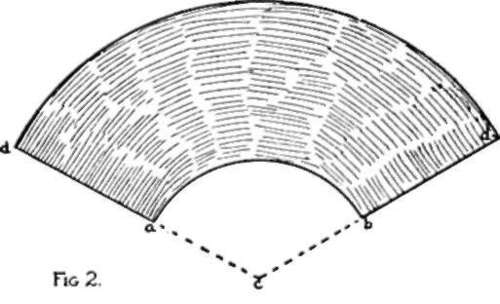
The mouthpiece, Figure 2, is cut out of tin or stiff cardboard like the pattern, and when bent up and curled into a conical shape as at My Figure 3, fits into the hole in the cover of the box with its smaller opening pointing toward the center of the diaphragm D.
To further hold the diaphragm in place, a washer W is glued or pasted over the edge of the paper, the outside diameter being the size of the paper diaphragm and the inside the size of the hole in the bottom of the box over which the diaphragm fits.
This finishes the telephone proper, and the line is ready to be strung.

Fasten two of these phones up in their desired places, held out from the wall by little blocks so that the diaphragm, when pulled by the line L, won't touch the wall, as in Figure I.
An inch hole is bored through the wall and the string prevented from touching its sides by the little threads shown in the separate sketch at f, Figure 7, held by tacks.
Where the line needs support outside, it cannot be tied to anything, but may be held by little threads or insulators h as shown in Figure 8. Corners are turned, as in the corner sketches, Figure 5, by means of threads f from a light stick F, held in turn at its middle to some support by a cord g.
The string is fastened to the diaphragm at each end by means of a flat button R so it won't pull back through.
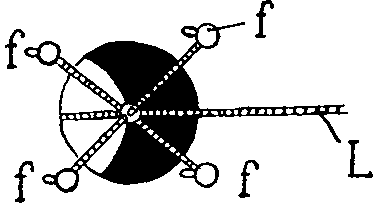
Fig. 7.

The hole in the center of the diaphragm must be as small as possible.
When you are sure your line is tight and that nothing is touching it to hinder its vibration, talk into the mouthpiece at one end, and your partner at the other end can hear you plainly. To call up your partner, all you have to do is to tap sharply on the diaphragm, and in the drawings I have shown a way to do this with a crank.
Toward the top of the box a piece K, Figure 3, runs crosswise, pivoted on a shaft b cut on it. This may be made of one piece of wood, as indicated in Figure 6, or the shaft may be separate. A crank is on the outer end.
Inside, a wire "tapper" bent up, as shown in Figure 4, with a spring part C, a corner to press on K at P, and a hammer or head H, is fastened to the box in the position shown bv a small screw S through the cover and a small block if necessary.
When the wire is in position, it pushes upward on K when the flat side is toward it or down, and then the hammer below barely touches the paper diaphragm.
When you start to turn the crank, the wire corner P will be pressed down more and more as you turn, until it will suddenly run off of K and by its spring fly back and up. This brings the hammer below sharply back against the diaphragm, and the boy at the other end hears a sharp tap, twice for every turn of the crank. The tapper, however, does not interfere with the working of the phone after the boy is called up.
You may use a stout hemp shoe thread for the line L, if it isn't over a block long. A longer line needs thin wire.
Fix this line up between your shop and the house kitchen or shed, where they will be more likely to let you bore a hole through the wall, and then maybe your mother can call you to dinner easier. Perhaps if you promised ahead of time that you would come right away, she would let you bore the hole anyhow.
Another kind of call arrangement for this type of telephone is shown in Figure p. This shows the telephone part made of a doughnut of inch wood, instead of a cigar box as at A, but with a paper diaphragm, etc., just like the phone we have described. This phone has the mouthpiece M cut into the wood itself rather than made separately of paper, the central part being an inch hole.
This phone is fastened to a lath I but separated from it by little blocks m so the diaphragm will not touch the lath. There is a hole in this lath also at O, through which the line passes. The lath is fastened by screws S to a block b at its top end, so the lath itself acts as a wooden spring to keep the line tight. An ordinary bell B is fastened to the phone at the bottom by a small screw. Both ends of the line are the same, and you can easily see how this arrangement works, for if you take hold of the bell or lath at one end and shake it back and forth, the action of the string line will shake the lath at the other end and ring the bell, thus calling the other party.

This kind of telephone is great fun and is very practical where only two parties are concerned and the line is not over a block long.
Continue to:


My Books

