


Priming a Centrifugal Pump
Description
This section is from the book "Workshop Receipts For Manufacturers And Scientific Amateurs. Supplement Aluminium To Wireless", by The Chemical Publishing Co.. Also available from Amazon: Workshop Receipts For Manufacturers And Scientific Amateurs.
Priming a Centrifugal Pump
Before the pump will work the whole of the suction pipes and pump should be filled with water. Where the pumps are steam driven, or steam is easily available, this may be accomplished by means of a steam ejector which exhausts the air from the pipes and allows the water to flow in by atmospheric pressure.
Where priming is required a priming plug or funnel is arranged on the top of the pump, and the pipes can be filled through this. A footvalve at the end of the suction pipe, which should be some depth below the fluid to be raised, prevents the priming water from escaping. When the pipes are full and the pump is started the flow of water is continuous, and if the footvalve is in good condition it should retain the water for some time without needing priming again. The length of time the water is retained depends upon the joint of the valve and its seating.
Pet cocks are also fitted to enable the attendant to ascertain if the pump is drawing water. It is advisable to open these as soon as the pump is started, and thus avoid the risk of damage being done on account of the pump running dry. As soon as the water is forced through they may be shut again, (see Fig. 30.)
Centrifugal pumps, like the rest of moving machinery, have their troubles, some of which with their remedies are dealt with as follows :
(1) Pump Revolves, But Delivers No Water
Ascertain at once whether the pump has been primed (see page 52), this priming ought always to be done before the pump is started up. By priming is meant filling up by some means the whole of the suction pipe and the pump itself with water, or the liquid being pumped. If the pump is properly primed but still does not deliver water, etc., check the number of revolutions per minute, if this is lower than it should be, take the necessary steps to raise it to the proper figure at once, the correct figure is always stamped upon the pump, or should be. If still there is no delivery make sure that there is no valve closed or other stoppage in the delivery pipe. If the pump is properly primed, runs at the correct speed, with a clear delivery pipe, and still delivers no water at all, then the impellers or impeller must be blocked by some foreign matter, always assuming that they themselves have been revolving, be certain that the pump shaft really did revolve. Open the pump up, see whether the impellers are firmly fixed to the shaft and did revolve with it, also whether they are quite clear of any blockage. It is not likely that the impellers are loose on the shaft, but the key might have been left out after some overhaul, so leaving the shaft free to turn without the impeller. A stoppage in the pump itself, i.e., in the impeller is more likely, and should be easily seen. Such things as large eels, pieces of thick rope, sacks, and a mass of clay are among the things that have been allowed to get into centrifugal pumps through a defective foot valve.
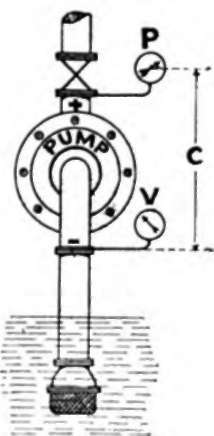
Fig. 32.
(2) Pump Revolver, But Not With Full Delivery
See that the speed is correct, if correct check by means of pressure and vacuum gauge as to whether the total head is correct for the pump, if too high on the pressure side, ascertain the reason and remedy it, it probably is due to too small diameter delivery pipes having been installed. If the reading is too high on the vacuum gauge (suction side) see Fig. 32, it would appear that either the lift is too much or the pipes on the suction side are too small, or too long, or with too many bends. It must be clearly understood that no centrifugal pump can be expected to deliver full bore of water to a greater height or against greater pressure than that for which it was designed. If all these points appear in order then listen carefully for a peculiar , rattle inside the pump, this may : be continuous or intermittent, and is due to air getting into the pump somewhere on the suction side, see page 50, the leak must be found and stopped. If this is not the fault make quite certain that the pump is revolving in the correct direction, and if it has just been re-erected after some overhaul, then suspect that one or more impellers were put back the wrong way, open up the pump and examine.
(3) ;Pump After Overhaul Takes More Power To Drive
Stop it and see whether it can be revolved as easily as usual by hand, if not then open at once. Examine whether the bearings are too tight and so cause the stiffness. If everything turns quite easily by hand with cool bearings, also without noise in the pump, but distinctly too much power is being taken below full discharge, and it happens to be a pump with more than one impeller, then suspect that one impeller at least has been put on in the wrong way. i.e., wrong way round so that it revolves backwards, open up, and examine.
(4) ;Pump Glands Gel Hot
These are generally water cooled by a small pipe carrying pressure water to them, examine to see whether such water is passing to the gland, also whether the gland is not screwed up too tight.
(5) ;Pump Bearing Gets Hot
If too hot and possible to stop the pump without causing trouble elsewhere, do so at once, if the bearing can be eased in the time available, do so at once. If there is no time, then ease it off as much as possible, and keep somebody standing by it until it can be stopped and properly attended to. Make certain that the machine foundations are true, and do not put a strain upon the shaft and bearings.
(6) ;Pump Will Not Prime
Clearly the foot valve is at fault, i.e., it is leaking, have it taken off and thoroughly examined, an emergency start may sometimes be made with a pump that has a leaking footvalve, by forcing water by a firehose down the delivery pipe while the pump is run up to full speed, but this will not always succeed, but still is worth trying if the pump is urgently wanted to give delivery. This operation does not at first sight appear as at all likely to be successful, but it has definitely been known to get a pump going.
(7) Pump Developes An End Thrust
This must either be due to something inside the pump having upset the hydraulic end balance, in which case the pump must be opened for examination, or else if some device is used on the pump for taking an end thrust, then this may have developed a defect, so giving a false impression, i.e., that an additional end thrust has arisen, careful examination of the thrust taking device should show which is the real trouble.
Continue to:


My Books

