


Tools For Wood And Soft Materials. Part 2
Description
This section is from the book "Workshop Receipts For Manufacturers And Scientific Amateurs. Supplement Aluminium To Wireless", by The Chemical Publishing Co.. Also available from Amazon: Workshop Receipts For Manufacturers And Scientific Amateurs.
Tools For Wood And Soft Materials. Part 2
Chucking the work or gripping it on the rotating spindle is a very important part of every job. It has to be done not only quickly but also firmly, so that the piece shall not jump out of the mandrel when one starts cutting it. There is no hard and fast rule to go by here, for everything depends on the piece of work and the operations one has to do to it.
If one only has to turn the outside of a piece, as in the case of a handle or simple pillar, such a piece can be chucked between centres. One will pencil mark the centre at both ends and set the piece between the mandrel centres. A smart tap with a mallet on the end of the tailstock spindle will drive this sufficiently into the wood to make a suitable recess, when the piece can be turned end to end and a corresponding recess tapped into the other end. A nail driven into the wood, headstock end so that it butts against a chuck jaw or against a driver bolt in one of the face-plate holes, will suffice to carry the work around with the spindle.
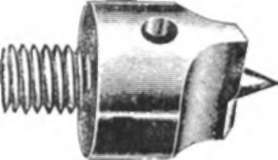
Fig. 107.
A Wood Prong Centre (Fig. 107) is supplied as an accessory for this same purpose if called for. The two chisel edges on either side of the centre drive the work piece round instead of the nail as suggested before. For work between centres this accessorv will be found very convenient. It screws into the spindle in place of the ordinary centre.
The Taper Wood Screw (Fig. 108) offers another means of quickly chucking work. In this case the centre hole has to be bored out with a gimlet. The piece of work is held by the taper screw; the further the work is screwed in the tighter it is held. This taper wood screw is also very useful for carrying buffs, polishing wheels and brushes.
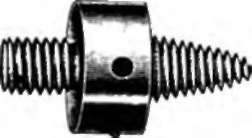
Fig. 108.
Pieces of wood have all sorts of irregular shapes and it is usually easiest to hold them by the four face-plate jaws supplied with the mandrel. One can shift the piece about in all directions on the faceplate by loosening one jaw and tightening the opposite one, this to bring the work as central as wanted. The opposite end of the work can be supported by the back centre for roughing or facing, and the centre can be withdrawn for boring out, as in vases, bowls or boxes, or for drilling, as in electric light standards, flutes, brushes, wood pulleys. The four jaws go into their slots either way, just as they may be wanted. They will grip from the outside, the inside, or with two jaws facing one way and two the other way. This method of holding the work, being able to shift it about on the faceplate, being able to dispense with the tailstock when required and to replace the same with a steady, make it very convenient. There is in fact no other way of rechucking pieces. In thin pieces such as plates, bowls, table-tops, ash-trays, bread platters and so forth when one has faced and recessed one side, it is very convenient to glue an odd square of waste wood on to the turned face. One can rechuck the piece the opposite way round by this square held in the four jaws. When the piece is entirely finished, this glued square can easily be prised off with a chisel. Glass-paper will remove all trace of this glued part. Odd pieces of wood giving a pretty curly grain are easy to chuck by the four jaws. The work can be moved about on the face-plate to bring the grain of the wood out to its best advantage.
It will be observed that there are four holes through the face-plate near the centre, also four holes through the rim. With the four jaws and centre removed any piece of work can be fixed to the plate by screws running through these holes from the back.
One of the most convenient methods of all is by means of chuck-plates. These are discs of steel with screwed shanks fitting the headstock and tailstock spindles. These discs have countersunk holes so that they can be fixed to the end of work by means of wood screws.
Continue to:


My Books

