


Cutting Facets. Part 3
Description
This section is from the book "Turning And Mechanical Manipulation", by Charles Holtzapffel. Also available from Amazon: Turning and Mechanical Manipulation.
Cutting Facets. Part 3
Figs. 1155.

1156.

In cutting a stone to the form of fig. 1155, it is cemented on a stick, the flat surface of the table is first cut, and the edge is brought to the desired shape of the girdle. Two water basils are then cut around the top, in the same manner as for fig. 1154, but the facets on the front are not cut until the back has been completed; for this purpose the stone is re-cemented upon the stick, and the back is rounded to the general form; a single water basil is then cut around the girdle, to determine the height of the first row of squares, and these squares are next cut, with the aid of the gim peg; the second row of squares are then cut in like manner, but without the preparatory step of cutting the water basil, as the first row of squares serves as a sufficient guide for keeping the squares in the second row uniform; the third row of squares is cut in the same manner, the cement stick being shifted to a higher notch in the gim peg between every row; and, lastly, the stick is held vertical to cut the culasse.
The squares are then polished in the same order, the gim peg being carefully adjusted for height between every row, in order that the stick may be inclined at exactly the same angle as that employed for cutting the squares. As mentioned in the catalogue, a pewter mill supplied with rottenstone and water is employed for polishing stones of about the hardness of carnelian, and a copper mill is generally employed for harder gems. Some lapidaries, however, prefer a bell-metal mill for polishing hard gems, such as the sapphire, as the bell metal, being harder than the copper, the mill is less liable to be worn into ridges.
The stone, when polished on the back, is detached from the stick, and re-cemented with the front outwards. The position of the stone requires to be very carefully adjusted to make it exactly central and square with the stick, or the front of the stone would be liable to be cut oblique to the back. When the stone has been properly adjusted, the squares are cut on the front of the stone exactly as for fig. 1154. The surfaces of the table and squares are then polished, and the stone is detached from the stick by gently warming it over a candle. Lastly, the stone is washed with turpentine to remove any small particles of cement.
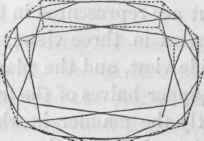
The brilliant cut, variously modified, is the form of facetting most generally adopted for the fronts of gems and pastes, and the backs of these stones are mostly trapped, or cut in squares. The principal varieties of the brilliant cut are represented in figs. 1157 to 1168, in which every stone is shown in three views, viz. the plan of the front of the stone, the side view, and the plan of the back. The dotted lines around the upper halves of the front views, are inserted to show more distinctly the manner in which the brilliant cut, consisting of lozenge-shaped facets alternated with triangular facets, is derived from the square or trap cut, by the removal of the angles indicated by the dotted lines.
With the same view of rendering the diagrams more distinct, the outlines of nearly all the girdles are represented of the polygonal forms they would assume, if the facets adjoining the girdles were made strictly angular, so as to terminate in straight lines upon the girdle. In the brilliant cut, however, the girdles are not generally cut to the polygonal forms, but they are made as easy curves, nearly approaching the forms shown in the diagrams, if the extreme angles are supposed to be removed; and in cutting the rows of facets adjoining the girdles, these angles are not quite developed. The rounded form of the girdle is adopted partially with the view of keeping the stone as large as possible, and avoiding the liability of the angles being chipped in cutting the facets, and partially because the rounded girdle is more convenient in setting the stone.
The size of the table, in proportion to that of the girdle, depends in great measure upon the thickness of the stone, compared with its width or spread, and the taste of the lapidary, no invariable rule being adopted; but the table is seldom made less than half, or more than two-thirds, the length of the girdle.
The size of the culasse is very small, being only just sufficient to prevent the facets at the back of the stone from meeting in a point, and its width is seldom more than about the thirtieth of an inch, although in large and long stones it is sometimes as much as one quarter of an inch in length. The culasse has the effect of reflecting a small quantity of light into the table, that would otherwise be lost; but its principal purpose is to prevent the formation of a weak angle, that would be liable to be easily broken.
The half brilliant, figs. 1157 to 1159, is the most simple variety of the brilliant cut, and is very generally employed for those stones that are too small to admit of numerous facets being cut upon their surfaces. In cutting a stone to the form of the half brilliant the front is prepared exactly as for a single height of trapping, the first step being to cut the table; secondly, the girdle; and thirdly, the water basil. The stone is then inverted for cutting the back; in the figure this is shown as consisting of two rows of squares, or trapping, with eight triangular facets cut upon the angles of the eight squares adjoining the girdle; these triangular facets are called under squares, and are very generally employed upon stones that are trapped on the back, partly in order to diminish the size of the large squares, and increase the number of facets, and partly to give the stone a more rounded figure, by removing the prominent angles that would be liable to interfere with the setting.
Figs. 1157.
1160.

Continue to:


My Books

