


What is Astrology or Horoscopy? Part 5
Description
This section is from the book "The Brihat Jataka Of Varaha Mihira", by N. Chidambaram Aiyar. Also available from Amazon: Brihat Jataka of Varahamihira.
What is Astrology or Horoscopy? Part 5
"We shall now proceed to state the method of discovering the places of the planets for the several amsas for human births."
A thrill of joy ran through me which was soon followed by bitter disappointment. For, the next cadjan leaf which ought to have contained the information wanted was missing ! Some person, evidently seeing the importance of the information, must have carried away the leaf of the book I examined. Our readers are requested to examine other copies of the 1st volume of the Dhruvanadi.
The author of Nadigrantham takes up an amsam and jots down the positions or the several sets of positions of the planets, taking into consideration especially their Zodiacal divisions, and by slightly altering, or adding to, the brief sketch above referred to, for the amsas, finishes his account of a life. The author says that he treats only of about 30 or 40 important points in each life. Now under one of these accounts a number of persons will fall whose lives will show differences of a more minute nature which the Nadigrantham does not take into account. The Nadigranthams therefore are only very brief sketches of human lives. A really learned astrologer can write out an account of a man's life 10 or 20 times the length of the sketch in a Nadigrantham.
This perhaps is the proper place for a few words regarding a common complaint on the part of persons who have consulted the Nadigranthams, that these books are under a curse, that they correctly describe the past events of a person's life and err regarding the future events. The fault is not that of the Grantham; it certainly would not be possible for the author to ascertain beforehand at what period of one's life the book would be consulted, and then to give a correct account of such life till that period of time, and then (for such an able astrologer) purposely to err. The fact is that, as already explained, the position of the planets as shewn in the horoscopes do not agree with any given in the Nadigranthams. The possessor of a Nadigrantham examines a number of horoscopes in which the planetary positions very nearly approach those shewn by the horoscopes presented to him. The nearer the astrologer approaches the correct horoscope, the more numerous will be the points of agreement between the life suspected as the correct life and the actual life of the person. Now, if while the astrologer reads out from his book, the person consulting it meets with any past events of his life not tallying with the statements of the book, the pages are set aside and other pages examined. But if no discrepancy is noticed, the person comes hastily to the conclusion that the life picked out is his and goes home satisfied, with a copy of it. In such cases, the chances of disappointment are more numerous than those of success. The best plan would be, for a person who wishes to consult the Nadigranthams, to have his horoscope prepared with the help of the correct modern tables and the correct ayanamsa.
As regards the first astrological work taken up for translation, viz., the Brihat Jataka of Varaha Mihira, it is generally considered as one of the best works on the science. The author himself says of it as follows:
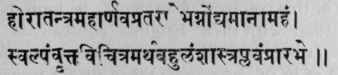
"For the benefit of those of broken attempts to cross the ocean of horoscopy, I construct this little boat consisting of a variety of metres with a multiplicity of meanings." Most of the stanzas are purposely intended to convey several meanings. Four commentaries have accordingly sprung up. The well known one is that of Bhatta Utpala; another is known as Subodhini; both of these are now with me; a third commentary is known as Mudrakshari, in which it is said that most of the stanzas are interpreted arithmetically - the letters all standing for so many figures and the figures representing the 27 asterisms, the 12 signs, the 9 planets, and so forth. The fourth commentary is known as Sreepateyam.
The author has written a smaller work on astrology known as Laghu Jataka. Hence the present work is styled the Brihat Jataka. Jataka or horoscopy is one of the three sections of Jyotis - Sastra; and the author has treated of all the three branches. The other two branches are Samhita and Astronomy. Varaha Mihira's work on the former, known as the Brihat Samhita, is now being translated by me, and his astronomical work is known as Panchasiddhantika. It was long supposed to to have been lost. Fortunately two copies of this rare work were recently discovered, and they were purchased by the Bombay Government. M. Thibaut, Phil. Dr., is now preparing an edition and an English translation of the same, assisted by Pandit Suddhakara. Varaha Mihira has also written a work known as Yogayatra. A mantiscript copy of this work is with Dr. Kerne, now in Leydon, Holland.
I have deemed it advisable to explain and retain the use of a number of Sanscrit terms for the convenience of the natives of this country, who must be more familiar with them than with their English equivalents where such exist. It may be well to state here some of the subjects treated of in the work now taken up for translation. The book contains 28 chapters. The first two chapters relate to definitions of astrological terms and to elementary principles, the third relates to animal and vegetable horoscopy. The fourth treats of the determination of the nature of issue - their physical peculiarities, fortunes, etc, from the planetary positions at the time of conception. A chapter is devoted to the determination of the description of the place of birth and the other incidents connected with the time of birth from planetary positions with a view to the correct ascertainment of the Lagna. The next chapter treats of early death - Balarishta, and the next is devoted to the determination of the length of life of a native - Jataki. A chapter is devoted to the particular avocations of men and to their sources of wealth. Then follow several important chapters on Raja and other Yogas. The chapter on Pravrijya yoga determines under what planetary aspects a native will turn out an ascetic. The chapter headed Auishtadhyaya contains a number of malevolent planetary positions, each connected with some evil of human life. A chapter is devoted to women. This is followed by a chapter which describes the particular manner in which a person meets with his death and the nature of his future life. In the next chapter the author lays down rules for the determination of the horoscope of a person ignorant of his time of birth. The above is not a complete list, and it would be wrong to judge of the interesting nature of the contents of each chapter from the brief account given above.
The appendix to the translation will contain numerous tables and diagrams relating to the construction of horoscopes and to the ascertainment of the local time by the sun-dial, by the shadow, and, at night, by the transit of the stars over the meridian. We will also state rules for the construction of the plane of meridian by means of fine threads for purposes of observation. The appendix will also contain a few tables, for the calculation of the lengths of the Dasas and Bhukties.
We may conclude this Introduction with the words of Zadkiel and "advise those who value truth to spend a few days in examining the principles laid down in this work and applying them to their own individual cases before they join the herd of the learned and the unlearned in pledging their words to a false assertion, viz., that Astrology is an unfounded science."
N. C. Madura, 2nd June 1885.
Continue to:


My Books

