


God And The World. The Advaita. Continued
Description
This section is from the book "Studies In Saiva-Siddhanta", by J. M. Nallasvami Pillai. Also available from Amazon: Studies In Saiva-Siddhanta.
God And The World. The Advaita. Continued
They differ, no doubt, in the definition and description of these three entities, as also in the description of their relationships. This third postulate could not be arrived at by direct perception, observation and experiment. We think however it can be proved by strict logical methods, by such proof as is possible, and we are at liberty to postulate it to explain the residuary facts unexplained by the Materialists and Idealists. If this postulate will explain facts, left unexplained by these people, and if it will not contradict any of the facts of human nature and probabilities, there is1 no harm in having it for a workable hypothesis. We believe also that the Materialists and Idealists leave many facts unexplained and that this third postulate is necessary to explain these facts. We, however, do not propose to go into this wide question now. We only propose to discuss God's relation to mind (soul) and matter just at present. And the relation we postulate is the same as between mind and body which we have already postulated, and we call it by the same name 'advaita'. And the couplet we have quoted from
Tayumanavar conveys the idea most beautifully, and the merit of expounding this beautiful view of 'advaita' must in the first place be accorded to Saint Meykandan whom Saint Tayumanavar himself extols as the
 "The Seer of Advaita Truth". God is related to the soul, as the soul is related to the world. God is the Pure subject, the Pure Ego, and the Soul is the pure object, non-ego. God is Sat (the true existence); Soul is Asat. As however we have called the world Asat, we are not willing to extend the term to soul also; and it, besides, occupies a peculiar postion between God, and Sat, on the one hand and the word, Asat, on the other hand; and hence, the term Sat a sat has been applied to it. The term means that which is neither God nor the world (maya) but which, when joined to either, becomes completely identified with each. When united to the body, it is completely identified with the body, and when united to God, it is completely identified with God. We have already observed that when the soul is united to the body, it is completely identified with it, it has not ceased to exist, as the body ceased, when thesoul was in its own plane. The very existence of the body implied the existence of the soul, though for the nonce, the soul was not conscious of its separateness and individuality and distinction from the object or body.
Just in the same way when the Jiva is in the Highest union with Sivam, the Jiva is not conscious of its separateness, and individuality and distinction from God. If this consciousness was present, there will be no union; and if the soul was not itself present, to speak of union in Moksha and Anubhava and Ananda will also be using language without meaning. And this characteristic of the soul is very peculiar. It is named
 or
or ' becoming one with that to which it is attached.' The Hindu Idealists try to arrive at the postulate of the soul precisely by the same mode of proof as is furnished in sutras 3 and 4 of Sivajnanabodham, and arriving at this postulate which is found to be above the 24 tattvas, above the elements, above the tanmatras, above the Jnana and Karmendriyas, above the four antahkarana, they have not paused to discover its further nature and characteristics, and have straightway proceeded to identify it with God, whom they have read of, in the Srutis, and have not tried to learn the relation between these two; and all the absurdities of the Mayavada school are clearly traceable to its not understanding the nature of the soul aright. These further aspects of the soul and its relation to God are therefore well brought out in sutras 7, 6 and 5. And how this Jiva can possibly become Sivam and in what sense, is beautifully brought out in 6. 2. (e).
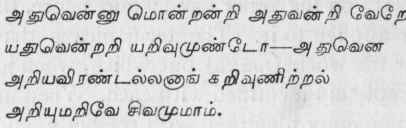
"God is not one who can be pointed out as "That." If so, not only will He be an object of knowledge, it will imply a Jnata who understands Him as such. He is not different from the soul, pervading its understanding altogether. The soul so feeling itself is also Sivam."
Chapter II of Light of Grace has also to be read in this connection; and Saint Umapati Sivacharya asks a question to bring out the importance of this great characteristic of the soul. "Are there not objects in this world which become dark in darkness and light in light?" he asks, and the answer given by himself elsewhere is "the eye, the mirror and akas are such objects." The eye loses its power of seeing in darkness, and recovers it in light; and the others become dark or bright as darkness or light surrounds it. Saint Tayumanavar also refers to this peculiarity in several places and calls the soul 
 ' You who are like the mirror or crystal removed of dust, becoming of the self-same nature of one to which it is joined.' Here the Light is God, darkness is Maya and the Mirror or Eye or Akas is the soul. We all feel that there is a sentienee which suffers this change from light to darkness. If this sentience is identified with God himself, surely, the change must descend on His head. We have not yet been able to understand (of course we are ready to confess we do not belong to the superior class of mortals said to possess 'the sharpest intellects, a bold understanding' to which ranks our brother of the Brahmavadin elevates himself - vide p. 749 current volume) how when they postulate only one padartha, one self, and no Jiva, how God can be saved from all the impurity and sins and ignorance present in nature. To say that the Sruti says that God cannot be tainted by such contact is only begging the question, and is no answer. To assert that the Infinite God by this false imposition, Avidya, had become divided into millions and millions of finite beings, and without stopping to make good this statement itself by proof except by giving an analogy, (which analogy is found to fail most miserably in most important details) and to assert with the same breath, that this sub-division is false, is a mere myth, a dream, that there is no universe, men or Gods, you or I and then to say further that you and I, Gods and men, and the world are all God seems to be the height of absurdity and not born of 'the sharpest intellect, a bold understanding.' If so, we must have altogether a different definitions of these terms.
We will close this paper by quoting two verses from Saint Tirumular, and we challenge comparison with them, with anything else found in any writing ancient or modern to express the truth of the double aspect and relation we have been describing above, with the same aptness and richness of illustration.
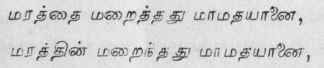

The tree was concealed in the mad elephant ; The tree concealed the mad elephant : The Supreme was concealed in the world ; In the Supreme was concealed the world.
(Here tree means a wooden toy elephant).
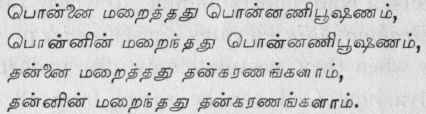
The gold was concealed in the golden ornament; The gold concealed the golden ornament. The 'I' was concealed in its own senses; In the 'I' were concealed its own senses.
These two verses, though they look similar, are not the same, and we will expound their meaning in our next.
Continue to:


My Books

