


How To Perceive Truth?. Part 3
Description
This section is from the book "Studies In Saiva-Siddhanta", by J. M. Nallasvami Pillai. Also available from Amazon: Studies In Saiva-Siddhanta.
How To Perceive Truth?. Part 3
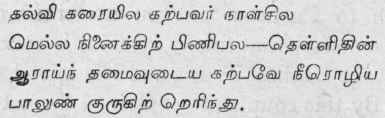
"In this matchless verse," says Dr. Pope, "not a syllable could be spared; while almost every word is common and easy, yet is the very fittest, and is used in its exact meaning. It is somewhat archaic; - has a fascinating air of mystery; - pleasantly exercises and amply rewards the students' ingenuity; - seems dark at first, but once lit up, sparkles for ever.
"This - shore suggests a metaphor: ' learning is a shoreless infinite - ocean.'
"Then comes the simple antithesis, 'the learner's days are few.' In Tamil the use of the same root twice (in and
and and again in the third line
 imports an added charm.
"Into these perfectly (to Tamil ears) harmonious lines is compressed a whole chapter.
"The subject of study with a plural verb) is infinitely numerous; but the learner's days are few; and if it be calmly thought out, men are liable to many diseases.
 natural infirmities or ' bonds' that enfeeble and restrict]. Youthful enthusiasm may lead men to anticipate great and varried triumphs; calm reflection teaches them their natural weakness. So, men should learn with discrimination
 examining closely
 ) things befitting
 suit, satisfy, gladden them) with intelligence,
 like that of the bird (the semi divine Hamsa, that drinks only the milk and leaves the water, when these mingled are presented to it? "

The mind that knows with certitude what is (First-Cause) and ponders well
Its thoughts on birth again to other life need not to dwell.
Commentary. This explains 'manana.'

When the folly of desiring birth departs, the soul can view The exalted Home of The Good Being, this is wisdom true,
Parimelalagar's Commentary.
Birth and ignorance, and Exalted Home and Truth are really related as effect and cause, they are given inversely in this couplet. Of the five faults, as ignorance is the cause of even the other faults, the author has stated this as the cause of birth. As Moksha is higher, than all other things, it is spoken of as the 'exalted.' The First Cause is spoken of as the Good Being,' inasmuch as He is eternal without birth and death, as all other things are too insignificant to taint Him by their contacts, and as He remains the same without change or taint at all time, though immanent in all things. Hence also, He is spoken of above as the 'True Being' and the
Existent The "viewing" is the soul losing its Mala by constantly realising or practising,
 Bavana) so that it may become one with God
 This Bavana is also called Samadhi or Sukla Dhyana. As it is commonly held by all schools of people that the soul when it leaves the body becomes that which it fancied at the time
 i.e., is born assuming that body to which it yearned at the time of death), and so, too, as it is necessary for people who aspire after Moksha to contemplate on the Transcendent Being, so that their thoughts on birth may cease, there is no better means than this Sadana for practice beforehand always. Thus Bavana is explained in this couplet.
Note
The commentator proves his thesis by taking the common form of belief held by all people. Every one believes that the form he sees, the object he is after, the idea which possesses him at the moment of one's death, will give him a similar form at the future birth, and stories are current about a rishi who was fondling a deer being born a deer etc. But these do not know on what principle this is based ; and except in the Siddhanta works, this principle is nowhere expounded. The principle involved regards the nature of the Soul, which is stated briefly and tersely by St. Meykandan as  'that, that becomes' as
 'that becomes that to which it is attached' by St. Arul Nandi, whi:h is paraphrased again by St. Tayumanavar as

'Like the dirt-removed crystal which becomes of the nature of that to which it is attached St. Tiruvalluvar himself has clearly expressed this principle in the verse  etc of the last chapter, and in the second verse of this chapter, and in the next verse
 &c" 'and verses 4, 5, 7 and 8 of the first chapter, wherein he shows that unless the soul leaves its clinging to one, it cannot cling to another, from whence is deduced the principle
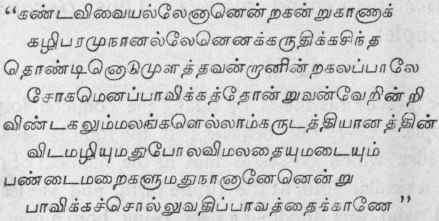
 that the soul cannot have any independent existence or form unless it is clinging to one thing, (the world or body in Bandha) or the other (God in Moksha), and while so attached, it identifies itself so thoroughly, that it is impossible to discover its separate personality. Hence it was that a Tyndal, an Huxley and a Bain with all their minute anatomical, biological and psychological analysis were not able to discover a mind in the body different from the body, though they could feel that the result was not very satisfactory. The express language used by the commentator as will appear from the beautiful stanza we quote below from St. Arul Nandi, will show to whom he is indebted for the explantion.

The word (Bavana) is important. Bavana, Sadana, Dhyana,
Yoga are all more or less synonymous terms. It means practice by symbolic meditation or realization. You fancy fixedly you are one with that and you become that. And this is the principle which underlies all the Mahavakyas 'Tattvamasi' etc. For fuller treatment, see sivajnanabodham ; and The Siddhanta Dipika, Vol. II, the article 'Mind and Body.'

The true support who knows - rejects support he sought before Sorrow that clings shall cease and cling to him no more.
Parimelalagar's Commentary.
 'conduct or practice' here means practice of Yoga. This Yoga is of eight kinds; Yama, Niyama, Asana, Pranayama, Pratyakara, Dharana, Dhyana, and Samadhi. Their explanations are too long to be given here. See them in the books on Yoga. 'The sorrows that cling to us' are the fruits of Karma which have yet to be experienced, which are the result of infinite Karma performed in births dating from eternity, and which give rise to fruits already eaten in past births and in the present birth. "Shall cease and cling no more," as they will vanish before Yoga and Jnana like darkness before light. This Jains call
 As even Good Karma is the seed of birth, it is called a 'disease.' The author holds that births will cease when the Supreme is perceived by the above-mentioned three means. When the births cease, what can all the ills do, as they cannot cling to these jnanis well practised in Yoga, and there being no support, they will die. This is the purport of the stanza.
Note
The word  in the verse and
 in the previous chapter mean a support or hold. The soul has two such supports, one in Bandha and one in Moksha and without such supports it cannot stand. This may be compared to a piece of iron held between two magnetic poles, one positive, and one negative, or better still to a fruit growing on a tree. The fruit is held up by the tree, so long and so long only, as it is raw and immature (undeveloped) but so soon? as it is ripe, it reaches the ground . (Force of gravity); fruit, as such, must be united to the tree or the ground. What happens is, as the fruit grows riper and riper, the sap of the tree does not rise up to the twig and the twig dies, and it falls off. So too as man rises higher, and his desire of the world decreases, and the bonds are sundered, he drops into the Feet of the Lord.
 The author of
 as Dhyana, and
 as Samadhi, the highest Jnana-
Yoga practices. In the next verse this Pasatchaya is further explained.

Parimelalagar's Commentary.
The eternal ignorance, avidya, the consequent ahankara, the feeling of 'I' and 'mine,' the hankering which desires this or that, the eternal desire of this or that object, and dislike or hate arising from unsatisfied desire, these five .faults are enumerated by Sanskritists. The author enumerates only three, as 'Ahankara' can be brought under 'Avidya', and 'hankering' can be comprised under 'Desire.' As these faults are burnt up before Jnana-Yoga practices, like cotton before a wildfire, so the author speaks of the disappearance of the very names of these three faults. As those who do not commit these faults, will not commit good or bad Karma caused by them, the author states accordingly in this verse that they suffer no pain therefrom. As a result of the attainment of True Knowledge, the ills of past births and of furture births are destroyed, and thus these two verses find a place in these chapter. We learn from this also, that what remains to those who have perceived the Truth is the present body and ills attaching thereto.
Note
And the next chapter discusses the means of even getting rid of this bare bodily infirmity and of guarding against what is called Vasana Mala.
Continue to:


My Books

