


The Four Paths
Description
This section is from the book "Studies In Saiva-Siddhanta", by J. M. Nallasvami Pillai. Also available from Amazon: Studies In Saiva-Siddhanta.
The Four Paths
So that all our understanding of Him till the final goal is reached will be merely fictitious, or use a better word, symbolical. The conception whether that of the Bhakta or Yogi, Hindu or Christian will only be symbolical. We introduce a real element into it when we introduce love in our conception of God. And this conception naturally divides itself into four forms, that of master and servant, parent and child, friend and friend, and lover and loved. All other conceptions can be reduced into these four. There are love and knowledge in all these different forms of Bavana or Sadana. As our Lord and master, we do Him and His bhaktas, loving service and obedience and reverence. In the master, we lose our own identity. To the father and mother, obedience and service and reverence and love in a greater degree is exhibited. To the friend we can say '1 am he,' 'he is myself,' 'all mine are his' and 'all his are mine.' In real life, this ideal of friendship is rarely manifested. Our people could hardly appreciate the act of the saint who gave his wife to the bhakta who demanded her of him.
How would you like the pourtrayal of Hall Caine of the lowborn and illiterate Manxeman who loved and continued to love more and more the high born and cultured aristocrat who betrayed him, cheated and robbed him of his betrothed, and forfeited all claims to regard and respect? It was because his friendship on his own part was sincere and true.
It is this idea] of the friendship and the Bavana required under it which reveals the meaning of the formulas of Tatva-masi and Aham Brahmasmi, given out as the mantras to be practised by the Yogi. In Yoga, the identity of Bavana is fully reached. When we understand this fully, we can understand all the episodes in the life of St. Sundara, who was of the very image of Soma Sundara and whom God chose as his own 'friend.'
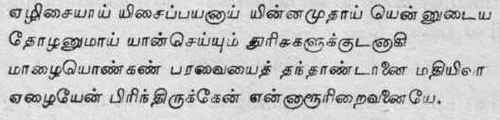
He, the seven notes, their joy, the sweet ambrosia, my very friend who is with me even in my mischiefs, my Lord who gave me my beautiful-eyed Paravai, my Lord of Arur, how can I, the poor fool, be separated from Him?
In life, have you felt the hundredth part of this love for your friend, the gnawing pain at heart when you were separated and the boundless joy when you met?
These are then the four paths or margas, Charya, Kriya Y6ga and Jnana, otherwise called Dasa, Satputra and Saha and Sanmarga. And the various duties assigned under each, are only such as our love of the master or father or friend or lover will induce us to manifest in tokens of our love. These duties are meaningless except as tokens of our love and as disciplining us to love and love more God and his creatures.

Even though, with bones for firewood, The flesh is torn to lines and burnt, like gold in fire, Except to those who internally melt themselves into Love, God is not accessible.
These duties are for the Dasa Margi,
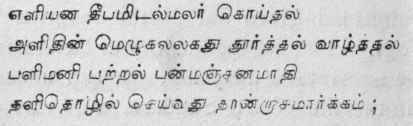
The easy duties, lighting lamps, culling flowers, sweeping and washing the temple, praising God and assisting in His service of abhisheka, cooking food, constitute Dasamarga.
Our christian friends who regard our building temples and spending in ornaments and flowers, will scarcely realize why millions of money are spent on churches and church decorations. The money spent in flowers on Easter and Christmas festivities in churches comes to a million or more each year. Christ rebuked the man who held the joint purse and who objected to Mary's wasting that precious scented-oil on Christ's feet. It was not the value of the oil that was worth anything, but the love that prompted that sacrific was worth all.
But it is not by costly gifts alone, we can manifest our love.
The duties of Satputra-margi are as follows,
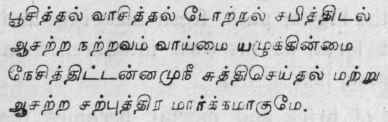
Puja, reading, reciting prayers Japa, true tapas, and truth, Purity, loving, offering food Constitute Satputramarga.

Purifying ourself by Adhara and Nadi Sodana, and becoming possessed of 18 Saktis, and entering the Temple of Jnanakasa (Chidambaram), and getting rid of one's senses and mind is Sahamarga
The eight forms of Yoga referred to are Yama, Niyama, Asana, Pranayama, Pratyakara, Dharana, Dyana and Samadhi, and we note only here the definition of Yama and Niyama.
Yama. is Ahimsa, Satyam, refraining: from theft, celebacy or chastity, mercifulness, devoid of deceitfulness, contentedness, courage, taking little food and purity. Niyama is performing tapas, japam, and vratam, believing in God, worshipping Him, reading and meditating on the Sastras, being cheerful, fearful of evil, and intelligent.
The duties of Sanmarga are stated as follows.

Getting rid of one's pasutvam and Pasa, becoming One with Pati, melting the heart which never melts, in love, entering the True Presence which one can never know, and standing steadfast there, are Sanmarga.
These four sadanas are so arranged that one may lead into the other. And the forms and symbols in each are so chosen that, as one reaches the higher path, fresh meaning and fresh beauty and life burst forth, as his own intelligence and love ripen to receive the fresh life.
The temple built of brick and mortar becomes the very soul and heart of the Yogi and the Sivalinga becomes the Loving Presence and Light of the Supreme. The food offered by the devotee, gradually comes to mean the sacrifice of anava or
The beauty of such books as the Tiruvacaga, Devara and Tiruvaimoli, consists in this, that it furnishes the required mental and spiritual food to the illiterate and the most cultured minds.
That these four paths are natural divisions, it will be readily perceived. The world's great religions may be ranged under one or other of these heads. Mahomedanism and the ancient Judaism fall under the first division. It was the merit of Jesus Christ that he brought, into greater prominence, the Fatherhood of God. The following quotations from the 'Bible' will show that the other paths are not unrecognized by Jesus Christ.
"Ye call me Master and Lord, and ye say well, (or so I am." St. John. xiii. 13.
"Little children, yet awhile, I am with you; a new commandment I give you. That ye love one another; as 1 have loved you, that ye also love one another." xiii. 33. 34.
"If ye love me, keep my commandments, xiv. 15.
"Greater love hath no man than this, that a man lay down his life for his friends." xv. 13.
"Ye are my friends, if ye do whatsoever I command you." xv. 14.
"Henceforth, I call you not servants; for the servant knoweth not what the master doeth, but I have called you friends, for all things that I have heard of my Father, I have made known unto you." xv. 15.
"Ye have not chosen me, but 1 have chosen you." xv. 16.
"That they all may be one; as THOU, FATHER, ART IN
ME, and I in thee, that they also may be one in us**." xvii. 21.
"I in them, and thou in me that they may be made perfect in one***." xvii. 23.
When 1 spoke of these higher aspects of Christ's teaching to a missionary, he observed to me that it only struck him lately that fellowship with God was a higher spiritual condition than fatherhood of God. Among ourselves, the Madhwa system may be said to be pure Dasamarga. The Ramanujah in its popular aspects, is Dasamarga and Satputramarga and a little more. Sankara's system will be Sahamarga. But the mistake is made, in not understanding that these truths are only symbolic and then, they are apt to become dogmatic. I have seen Christian friends contend that God is our real father, as Vedan-tins and Yogis may declaim that there is no other God but the self.
A true and universal religion will combine all these various paths which are required and necessitated by the varying; degrees of man's intellectual and spiritual development.
And then, we will not see the mote in our brother's eye, and will live in peace and amity for ever.
I only need quote to you one verse from the Gita, where all these four paths are set forth.
"Therefore, with bowing and body bent, I ask grace of thee, Lord and Adorable, as father to son, as friend to friend, it is meet, O Lord, to bear with me as Lover to Loved." - I may also observe that Saivaism of to-day, which I regard as the true modern representative of the historic religion of the Gita and the Mahabharata period, combines all these four paths and its great Saints Appar, Jnanasambandar, Sundarar and Manikka-vacagar are regarded as teachers of these four paths.
More than all this, I wish to emphasize the fact that love is the essence of all real Religion, and real worship of God is the worship of God's creatures and loving them one and all without distinction of caste or creed, as observed by Sri Kantha, and unless this is fully recognized and practised, no real spiritual progress is possible.
Continue to:


My Books

