


The Personality Of God According To The Saiva Siddhanta
Description
This section is from the book "Studies In Saiva-Siddhanta", by J. M. Nallasvami Pillai. Also available from Amazon: Studies In Saiva-Siddhanta.
The Personality Of God According To The Saiva Siddhanta
It will be interesting to note that, it was about 12 years ago, we brought out our first work in English on the Saiva Siddhanta Philosophy from Tiruppattur, and we have continued ever since, to work hard at it, and, our translations of Siva-jnanabodham."Sivajnanasiddhiyar,"Tiruvarutpayan/along with our contributions to the Siddhanta Dipika, during the last ten years, and Dr. G. U. Pope's 'Tiruvacagam' form the only bibliography on the subject in English. And we are glad to note that, within the last few years, considerable interest in the subject has been awakened, and several European missionaries have made a special study of the subject, and have discussed it before missionary societies and in the public press. We quote the latest opinion from the Christian College Magazine, Vol. XX, 9, from the pen of Rev. W, Goudie.
"There is no school of thought and no system of faith or worship that come to us with anything like the claims of the Saiva Siddhanta.
"This system possesses the merits of great antiquity. In the religious world, the Saiva system is heir to all that is most ancient in South India; it is a religion of the Tamil people, by the side of which every other form is of comparatively foreign origin.
"In the largeness of its following, as well as in regard to the antiquity of some of its elements, the Saiva Siddhanta is, beyond any other form, the religion of the Tamil people and ought to be studied by all Tamil missionaries.
* Reprinted from the New Reformer 1907.
"We have, however, left the greatest distinction of this system till the last. As a system of religious thought, as an expression of faith and life, the Saiva Siddhanta is, by far the best that South India possesses. Indeed, it would not be rash to include the whole of India, and to maintain that, judged by its intrinsic merits, the Saiva Siddhanta represents the high-water mark of Indian thought and Indian life, apart, of course, from the influences of Christian Evangel."
And we had remarked in our introduction to 'Tiruvarut-payan' or 'Light of Grace': "And there can be no doubt that we have, in these works, the brightest and largest gems, picked out from the diamond-mines of the Sanskrit Vedantic works, washed and polished and arranged, in the most beautiful and symmetrical way, in the diadem of Indian thought."
Through want of active propaganda, by means of lectures and conferences, the subject is not properly brought to the notice of the English-educated public, and appreciated by them as it deserves to be; and we are, therefore, much obliged to the editor for having allowed us to contribute a paper on the subject.
Despite the opinion of a few European and Indian scholars, who would trace Saiva Siddhanta to a purely South Indian source, we have all along been holding that Saiva Siddhanta is nothing but the ancient Hinduism in its purest and noblest aspects; and it is not a new religion nor a new philosophy, and it can be traced from the earliest Vedas and Upanishats. ' We do not hear of anyone introducing Saivaism at any time into India, and the majority of Hindus have remained Saivaites from before the days of the Mahabharata.
The ideal of the Highest God has, from the beginning, been centred round the person of Rudra, or Siva, and in the Rig Veda we find him described as the "Lord of Sacrifices and Prayers," and we find this maintained, in the days of Valmiki, when beliefs in other deities were slowly gaining ground.
Consistently with this position in the Rig Veda, the Yajur Veda declares that "There is only one Rudra, they don't allow a second," "Eka-eva-Rudro Nadvitiyaya tasteh" (kanda 8, 6, 10). "He who is one is called Rudra," "Ya Eko Rudra Uchyati." And St. Tirumular declares accordingly:
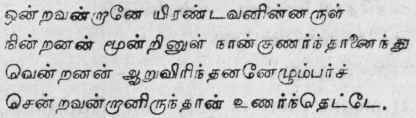
The only One is He ; The second is His Sweet Grace (Sakti).
He stood in the Three; He uttered the four (Dharmas).
He conquered the five (Senses); He spread Himself out as the six
(Adharas). He stood transcendent as the seventh, knowing the eighth.
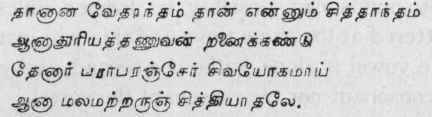
'Soham' is Vedanta ; One only (without a second) is Siddhanta, In the imperishable Turiya, after seeing the self (Atmadarsan), Thou unitest with the Parabrahman in Sivayoga. Thou canst attain the rare Siddhi, losing mala.
"God is only one." "Siddhanta declares there is God alone without a second."
The first mantra, it will be noted, is not so well known as the mantra "Ekamevadvitiyam Brahma", occurring in an Upanishat of the Sama Veda; and Max Muller has shown that the use of such words as Rudra, Hara, Siva, to denote the Highest God, is much earlier than the use of such words as 'Brahman', 'Atman' and 'Paramatman'; and, in fact, these words do not occur in the Rig Veda at all to denote the Highest God. And we may also point out that the word 'Nadvitiyam' occurring in the Yajur Veda is certainly a more ancient and original form of the word than 'Advitiyam', which has been obtained by the elision of the letter 'n'.
And St. Meykandan comments on this mantra in the following verse: -
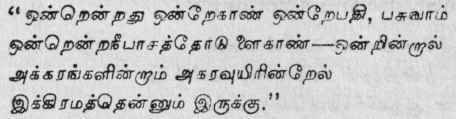
"The Vedic text means there is only one Supreme Being without a second. And this one is the Lord. You who say 'there is one, is the Pasu bound up in Pasa. The vord 'second-less' means that, beside God, nothing else will exist, as when we say that there will be no other letters (consonants) when the vowel is not."
No consonant sounds can possibly be formed unless the vowel sound is uttered at the same time; and this will justify us in stating that the vowel is alone, without a second; and yet the vowel is not the consonant nor the consonant the vowel. When we utter the consonant sound
Continue to:


My Books

