


The Nature Of The Jiva. Part 5
Description
This section is from the book "Studies In Saiva-Siddhanta", by J. M. Nallasvami Pillai. Also available from Amazon: Studies In Saiva-Siddhanta.
The Nature Of The Jiva. Part 5
The subject is illustrated with the similes of mind and body, the vowel and the consonant.

"It is a natural union when the vowel unites with the consonant as one" is the Nannul sutram (204). The word one has been used to describe this union of the vowel with the consonant. They are distinct and yet inseparable. No consonant can be thought of without the vowel. This is the meaning of the famous Hridaya sloka in Tiruvacagam.
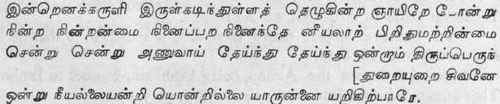
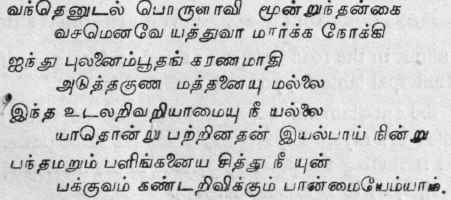
"When the soul loses its various sheaths - body, senses, intelligence and consciousness of self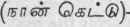 - then, what stands forth as the Lord of the Heaven of Peace is the one Supreme but not the soul." I quote here our learned Sivajnanayogi from his Dravida Bhashya where he puts the whole question so pithily.
"If you ask, what then is the meaning of the word 'Advai-tam? 1 will show how Saiva Siddhantins explain it. On hearing the great texts called Mahavakya Tatvamasi etc., which are used in the three persons, we see that these sentences speak of 'that' as one substance and 'thou' as another and enquire how one can become the other. The answer is given to remove the doubt by stating how one can become the other and what relation subsists between the two and the word advaitam is used to explain the relation." St. Umapati Sivacharya queries, "are there not objects in this world which become dark in darkness and light in light?" (Tiruvarutpayan II. 3). And the answer usually returned is, these are the eye, the mirror, the crystal and the Akasam. The eye loses its power of seeing in darkness and recovers it in light. The others become dark or light as darkness or light surrounds it. They are not lost in either case, but their individuality is lost and merged in one thing or the other. To these we may add also water, clear as crystal. But the classic simile 1 have stated in the beginning is the crystal or the mirror. This is brought out in Sankhya sutra (vi. 28) and yoga sutra (1. 4).* Now let us inquire into the nature of the crystal or the mirror or the glass.
There is before you, a picture of our late Sovereign Lord and King-Emperor (Blessed be his name)
* I bring together here all the texts bearing on the subject.
"Now a man is like this or that according as he behaves and so will he be. A man of good acts will become good, a man of bad habits bad. He becomes pure by pure deeds, and bad by bad deeds.
"As is his desire, so is his will; and as is his will, so is his deed. Whatever deeds be does, that will he reap.
"To whatever object man's own mind is attached, to that he goes strenuously with his deed.
"He who desires the Atman, being Brahman, he goes to Brahman.' That atman is indeed Brahman (Bvihad. Up. iv. 5, 6).
" As a metal disk (mirror) tarnished by dust shines bright again after it has been cleansed, so is the one incarnate person satisfied and freed from grief, after he has seen the real nature of himself.
"And when by the real nature of himself, he sees, as by a lamp, the real nature of the Brahman, then having known the unborn eternal God, who transcends all tattvas, he is freed from all pasa" (Sveta. Up. 11. 14, 15).
Edward VII. As you see it, you fail to see the glass that covers the picture. An ignorant rustic who had never seen
"From meditating (abhidyanat) on him, from joining (yojanat) Him, from becoming one with Him (tatbhavat), there is further cessation of all maya in the end." (Sveta. Up. 1. 10).
"A person becomes like those with whom he dwells and like those whom he reverences, and like to what he wishes to be." (Mahabharata. Santi Parva ccc. 32)
"As a flame is enveloped by smoke, as a mirror by dust, as an embryo is wrapped by the womb, so this (soul) is enveloped by it (desire)." (Gita m.,38).
"Though it (soul) be unassociated, still there is a tinging (reflection-ally) through non-discrimination, for there is not a real tinge in that which is. unassociated (with tincture or anything else), still there is, as it were a tinge; hence the tinge is treated as simply a reflection, by those who discriminate the tinge from the soul which it delusively seems to belong to.
"As in the case with the Hibiscus and the crystal, there is not a tinge but a fancy there is such." (Sankhya aphorisms vI. 27, 28, Garbe's translation).
"In the case of one the transformations of whose mind have been annihilated, there is entire identity with and complete absorption in, the cogniser, the cognition and the cognised, as in the case of a clear gem (crystal)." (Yoga sutras I. 41),

"The soul which after reflecting that the knowledge derived from the senses is only material, like the colours reflected on a minor, and that these colour-like sensations are different from itself, and after perceiving false knowledge as false understands the Truth, will become the servant of God Who is different from Asat." (4 Meykardan. VIll. 3. a).
glass before or a picture framed in glass would positively deny that any glass-plate was there. But with all his denial born of his own direct perception (Svanubhuti), we know he is wrong. Why is it so? Because the glass once brought into conjunction with the many-coloured picture has lost its form, has lost itself so to speak; lost its individuality but not its substance. Remove the picture, you can see it by itself. But bring it into strong sun-light; even then, you cannot see the glass but a strong blaze of light will dazzle your eyes.* So, the nature of a crystal or a mirror is, it becomes one with the form of whatever comes in contact with it, losing its own form. When covered with colour or dirt, it is indistinguishable from either the colour or the dirt. When flooded by light, it is indistinguishable from the light. Take the crystal by itself. It is pure and in a sense luminous, but its purity and luminosity do not prevent its being covered by dirt and becoming dark in darkness. This is its defect. And this purity and luminosity have to be distinguished from the purity and luminosity of the blazing sun and its light. Take a very large-sized pure diamond, the so-called brilliant, † Is this brilliance its own? If so, you must find it shining in utter darkness.
Continue to:


My Books

