


The Upanishats And Agamas. Part 5
Description
This section is from the book "Studies In Saiva-Siddhanta", by J. M. Nallasvami Pillai. Also available from Amazon: Studies In Saiva-Siddhanta.
The Upanishats And Agamas. Part 5
The next few centuries saw the rise of the great teachers Sri Sankara, Sri Ramanuja and Sri Madhvacharya. Following them, close, came the great Santana Acharyas, St. Meykandan‡

‡ The author of Sivajnanabodham.
St. Arunandi,* St. Marai-Jnana-Sambandar and St. Umapati Sivacharyar § and modern Saivaism may be said to commence from that time.
We will now begin the study of Modern Saivaism. Its form of ritualism and philosophy is determined in the South by the Agamas or Tantras, 28 in number, from Kamika to Vatula, called the Dakshina or Right-handed; and the different temples in Southern India follow the rules prescribed in one Agama or another, though there are still some temples like the one at Chidambaram where the pure Vedic Rituals † are followed. This Agama Philosophy has also been greatly developed and systematised in Tamil by a line of Teachers beginning with St. Tirumular,‡ St. Meykandan, St. Arunanidi Sivachariyar, St. Marai-Jnana-Sambandar and St. Umapati Sivachariyar. Both in the rituals and in the philosophy, the same mantras, forms and words derived from the old Vedic Times are used. For instance, the temple represents the old Yajna sala symbolising the human body. The Siva Linga,¶ (it is due to Svami Vivekanarjda to point out that this was no Phallic Symbol $ and this view was reiterated by
* The authour of Sivajnana Siddhiyar.
§ The author of Light of Grace and Sivaprakdiam.
† The pujas done in the Chidambaram are according to the paddhati of Patanjali; who takes the one from Saivagamas and the Mantras from the Vedas,
‡ The author of Tivimiantiram.
See the full subject discussed with all the authorities in Siddhanta Dipikd Vols. VI and VII .
$ The Svami said that the worship of the Siva Liriga originated from the famous lingam in the Atharva Veda Samhita sung in praise of the Yupastambha, the sacrificial post. In that hymn a description is found of the beginningless and endless Stambha or skhamba and it is shown that the said Skhamba is put in place of the eternal Brahman. As, afterwards, the sacrificial fire, its smoke, ashes and flames, the soma plant and the ox that used to carry on its back the wood for the Vedic sacrifice, gave place to Siva's body, his yellow-matted hair, his blue throat, and bull, the Yupastambha gave place to the Siva Lingam and was raised to
Dr. Ananda K. Kumarasvami in his paper read before the Historical Congress of Oriental Religions in which he shows that it is the least anthropomorphic of symbols,) takes the place of Rudra Pasupati and its form is that of the Pranava* and there is the Balipitha at the entrance to the temple with the Yupastambha † and the Pasu or animal offered in sacrifice in the form of the Bull. Every Brahmotsava still commences with a sacrifice, (the blood sacrifice is altogether given up in the South Indian Temples) and the Pasu, in effigy in cloth, is tiered up to the Yupastambha and after the festival is taken down. The position of the bull or Pasu will be found to be on the other side (God side) of the Balipitha and Stambha, and it is not called Pasu but Nandi (Blissful), God. Because, accord-ing to the phraseology of Saivaism, the Jiva or soul, once it had become freed, is no more called Jiva but Siva or Brahman. What had to be offered in sacrifice was not an animal but the Jiva; the soul called also the Ejaman of the sacrifice, had to offer his jivtavam, his animal part of himself, his individuality or Ahankara or Avidya or Ignorance, and the Naivedyam in all temples is now interpreted as this Pasutvam, or Pasubho-dham as it is called.
As soon as he enters the temple, he is asked to prostrate in front of the Yupastambha. This is his the High Devahood of Sri Sankara. In the Atharva Veda Samhita, the sacrificial cows are also praised with the attributes of the Brahman. In the Linga Purana, the same hymn is expanded in the shape of stories meant to establish the glory of the great Stambha and superiority of Mahadeva. Later on, he says, the explanation of the Siva Lingam as a Phallic emblem began in India in her most thoughtless and degraded times.
* "The whole Linga is the Omkara filled by Nada and Bindu. The base is Akara. The Kanta is Makara, and the round form Ukara". Tirmantiram.

- Ajitagama.
The standard pole represents Pati, The flag or piece of cloth that is being raised to the top represents Pasu and the cord (made of grass represents Pasa, offer of his self as sacrifice; and self-sacrifice thus becomes the centre of Hindu and Saivaite Philosophy, on which the whole process of salvation depends. This is the Arpana or Sivarpana referred to in Verse 57, Chap. 18 of Gita.
The philosophy also retains the old language for its technical terms. Whereas the newer systems have such technical terms as 'Chit, Achit, Isvara,' 'Jagat, Jiva, and Para;' the Saiva-Siddhanta technical terms to denote these Padarthas or categories are Pati (God), Pasu (soul), and Pasa (bondage).
In the hymn to the unknown God in the tenth Mandala of the Rig Veda, God is termed the Pati - which means Protector or Saviour coming from the root Pa, to protect. It strictly corresponds to the English term Providence. Even the term Isa or Isvara which simply means Ruler, does not bring out the Inner Narure of the Lord which is Love. Vide also the Brahma Sutra text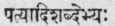 because of the term Pati and others : Pasu, as Srikantha Yogi explains, involves bondage in Pasa -
 and Pasa in its root meaning simply means " that which binds ". It means a noose or a cord only in its extended meaning of imagery. A man bound to a pole by means of cords, his hands and feet, neck and back being tied to it, can have no liberty and he is said to undergo pain. Pasa therefore does not simply mean "limitation" but is limitation which involves pain or pain to the core. The Agamas explain the noose or a cord held in one of the ten hands of Sadasiva's form as
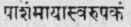 and
and
In Saivaism the soul is symbolised as a cattle tied by means of a rope to a pole. 1 his supposes the existence of a master to it. The Wayu-Samhita has.
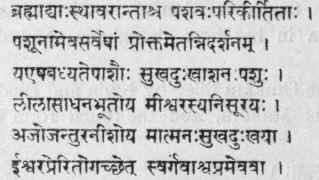
Beings from Brahma to immovable things are termed Pasus. These are the characteristics of all Pasus (i.e.,) that it is bound or tied by means of ropes that it chews the cud of Sukha and Duhkba (pleasure and pain) arising out of its own acts, that it forms an instrument for the Lords to
Pasa is the rope with which the Pasu is tied to the sacrificial stake and this is the word mostly used in the Upanishats also to describe Man's bondage or Mala. "Pasam dahati Panditah" (Kaivalya Upanishat).
The Pati is accordingly described in the text-books as follows:
This Pati is Param, neither Rupa nor Arupa, Nirguna without mark, Nirmala, Eka, Eternal, Chit of Chit, Achala, Infinite, Ananda, the unapproachable, the Goal, the least of the least, and the greatest of the great, Tat and Siva (Sivaprakasa I).
Continue to:


My Books

