


A Local Museum
Description
This section is from the book "Time Out for Living", by Ernest DeAlton Partridge and Catherine Mooney. Also available from Amazon: Time Out for Living.
A Local Museum
A group of Indian students on the reservation at Cherokee, North Carolina, through their teacher became interested in some of the historical relics that were being picked up by farmers who plowed their fields near by. Together they decided to collect as many Indian relics as they could. The schoolroom became a most interesting place, as the pupils brought in valuable articles that had been handed down in their own families for years. Other objects were picked up in near-by fields and added to the collection. So fine was this collection of Indian articles that experts from various parts of the country came to view it and take photographs.
Through such an effort as this it would not be difficult to start a local museum of interesting historical objects. If there is no such museum in your community, the establishment of one might be worth discussing with your friends. A room in the city hall, school, or even church might be found for this purpose. Publicity in the local newspaper will always bring responses from interested citizens. A museum project grows like a snowball, once it is started. From old attics you may have a stream of pottery, baskets, art, dishes, and other relics flowing to the central place. It would be a museum collection which would be enjoyed by all who beheld it. Try establishing a museum if you want to have some fun and incidentally want to learn something.
Pupils in a New York City high school became interested in tracing the movements of George Washington during the Revolutionary War. They wrote a description of his movements, which they had traced in their histories. Those who were artistically inclined made pen-and-ink sketches of some historical spots around the city that Washington had visited. All of this was finally compiled into a guidebook, and hundreds of copies were distributed to interested travelers. Not only did these students enjoy their history, but they also helped others with the knowledge they had gained.
Historical objects are not the only things that it would be worth while to collect in a community. How about the dif-erent stones and metals that are found in the vicinity? The chances are that very few people realize how extensive a collection can be made within twenty miles of the place in which they live. To this collection could be added mounted and labeled specimens of the different flowers and shrubs of the locality. Another thing that is interesting (at least one group of young people found it so) is to make a collection of photographs of the beautiful spots near by. This kind of collection is excellent for a group interested in photography. The local library will usually be glad to display such a set of pictures.
Out of an exhibit of this kind might come a little pamphlet describing the beauty spots of the community and asking the citizens to co-operate in preserving them. The pamphlet could be illustrated by snapshots taken by students. If a movie camera is available, it would be fun to prepare a two-reel thriller dealing with the history and scenery of the community.
A Community Center
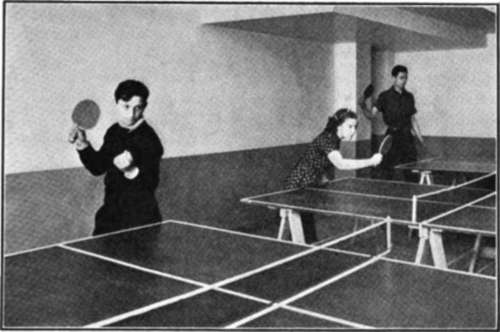
By joining forces, the families in your community might establish a play center. The ping-pong games shown in the picture are being played in a community center established in a crowded city center. There, for $3 a year, each family can enjoy all the clubs and activities that result from combined efforts.
A small admission fee to see the picture would pay for the film and other incidental expenses.
Continue to:


My Books

