


A Music Souvenir Book
Description
This section is from the book "Time Out for Living", by Ernest DeAlton Partridge and Catherine Mooney. Also available from Amazon: Time Out for Living.
A Music Souvenir Book
A great symphony orchestra finishes a concert. The last round of enthusiastic applause finally dies down. The audience is beginning to leave the concert hall. Scores of people are flocking to the stage to talk with the musicians. If you look closely, you will note that many of these people are asking the musicians to sign their programs as souvenirs of the occasion. Most of these signed programs and many unsigned ones will find their way into music souvenir books. These books can be arranged artistically and attractively for the enjoyment of the owner and his friends.
It is an easy matter to collect programs or other mementoes of this kind, and throw them into a bureau drawer for future rescue - perhaps. By far the more sensible and valuable thing to do is to mount them in a scrapbook, which will become more and more valuable as the years roll by. Such a hobby need cost nothing. A scrapbook can be made quite easily with some cardboard, colored paper, and a little paste. If you are not talented in working with your hands, go to a store that deals in wallpaper and ask for an old sample book. If neither kind of scrapbook appeals to you, exchange a few cents at the ten-cent store for a loose-leaf book. A picture salvaged from some magazine and depicting some phase of music will liven up the cover and dedicate it more definitely to the cause of music. Many such books have been made by students who are interested in some phase of music.
After the book has been secured, the interesting job is to arrange the material in logical form. Naturally, you will want to adopt a definite plan. For example, a chronological arrangement, that is, an arrangement according to dates, is an interesting plan. A group of students who toured through Europe visiting various points which were of interest to musicians and attending musical festivals collected some fascinating material. This was carefully arranged and filed away until they returned home, and then placed in books. As you can imagine, some of these represent treasures that arc prized very highly by their owners.
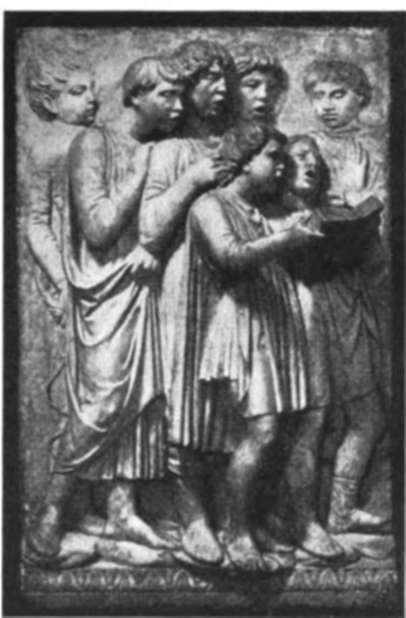
Detail from the Singing Gallery, by Luca della Robbia. A print of a painting or a piece of sculpture, such as that shown here, would be attractive on the cover of your souvenir book.
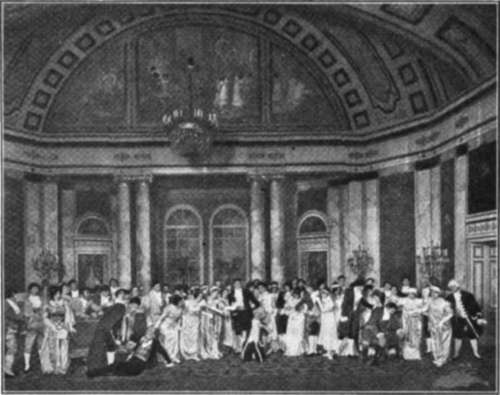
A Production of The Tales of Hoffmann. If you like opera, you might include prints of operatic scenes and pictures of your favorite operatic stars in your souvenir book.
A book such as this, if it is attractive and well planned, will not only be of interest to you but will entertain your friends also. When we look over a collection of pictures and programs which we have collected, we can more easily recall the music that we have heard. These recollections help us to understand the compositions and to describe to others the features which we enjoyed.
Perhaps you are asking yourself what one could put into such a musical souvenir book. Really, there are so many things of importance that one could have several books. Here are a few suggestions which may be of service to you. First, there is the great field of composers and their music. Pictures of famous composers may be had by writing to various music stores or by inquiring at book stores and art stores. Sometimes magazines have pictures of these masters. Sometimes pictures can be obtained from museums. To have a picture of the composer to go with a program containing some of his music, which you have enjoyed, makes it doubly interesting because you feel more intimate with the personality that created the music.
Another way of making your souvenir book valuable is to include criticisms of concerts or recitals, and the photographs of the performers. Newspapers usually review concerts and recitals. The day following the program the music editor of the paper will run an article concerning the concert. Before the concert is given, if you watch the papers, you may find a picture of the artists with a story about them. So you can start collecting material even before the concert has been played. You may be fortunate enough to have your program autographed, and then it becomes more valuable and more personal to you. In connection with a composer from a distant land, you can even include scenic views of his country. Notes on his life are also interesting.
You can have pictures in your book of the composers of your favorite compositions. If you list the titles and numbers of the phonograph records of these pieces as you come across them, it will aid you later when you are ready to buy them.
No doubt there are many musical happenings right in your own school. Even though you are not active in participating in them, you could keep information relating to them in a book. As you go on in life, these notes will become more and more valuable to you and to your friends who may have taken part in these activities. It's possible, you know!
You can greatly enhance your book by including pictures of the instruments used in the orchestra. Catalogues which would be suitable for this purpose can be obtained from dealers of instruments. The pictures of the instruments should be grouped in your book into the "four families," as musicians speak of them, namely, the strings, woodwinds, brasses, and percussions. Then, too, you can include pictures of the various bands and orchestras throughout the country. You can find them in advertising material which instrumental dealers send out. There may be a picture of your own high-school band in one of the advertising pamphlets or in the school paper. Such a picture is a splendid remembrance of your band and the personalities connected with it.
Pictures of broadcasts and radio stations add to the attractiveness and usefulness of the book, especially if you have visited them or plan to do so some day.
In suggesting a music souvenir book we have tried to point out two values. First, a music souvenir book is an artistic record of some of the things suggested in the previous chapters. Second, your interest in musical matters will grow as your book and your knowledge expand.
Music is a human heritage that belongs to all mankind. As you have seen in the previous pages, there is music to suit everybody, and today there are means of enjoying it that never before existed. By taking an active interest in this rich art you will come to know the really fine contribution that music can make to your life. You will discover as you grow older that music is one of your best friends. It wears well. As a matter of fact, the better you know it, the more of a friend it becomes. Tune yourself in to the music about you. Embark on a journey to become better acquainted with it. You will find your way in life richer and richer with the things that really matter.
Some Interesting Things To Do
1. Organize a music club. It's worth the effort expended.
2. Learn what other clubs are doing throughout the country.
3. Plan a program of activities for your club. Put it on a running basis.
4. Arrange for a group to attend a concert or recital.
5. Make a musical scrapbook. Begin collecting material for your book right now.
6. Make a booklet showing by pictures and brief comments the evolution of musical instruments.
7. Which is better - to play music for money or for sport? Talk it over.
8. Why not start a musical souvenir book? It's a good idea.
9. Here's a good theme for a class composition period: Why (or Why Not) Use Music for a Hobby?
Helpful References
Bowcn, C. D., Friends and Fiddlers. Brower, H. M., Story-Lives of Master Musicians. Hall and McCreary Co., Portraits of Great Composers with Biographical Sketches.
McKinney and Anderson, Music in History.
Wheeler and Purdy, My Brother Was Mozart.
Wheeler and Deucher, Sebastian Bach, the Boy from Thuringia.
Continue to:


My Books

