


Part 10. At Home With Leisure. Chapter Twenty-One. Some Things To Do At Home
Description
This section is from the book "Time Out for Living", by Ernest DeAlton Partridge and Catherine Mooney. Also available from Amazon: Time Out for Living.
Part 10. At Home With Leisure. Chapter Twenty-One. Some Things To Do At Home
Back in those "dear, dead days beyond recall" folks used to think, say, and sing that there was no place like home. Now, in our age of changing civilizations, there are so many interesting things going on outside the home that some of us - like the children who went seeking the bluebird only to find it when they returned home - have forgotten or have never learned the many satisfying activities there are in and around the house. Too many of us, for example, have missed the thrill of stretching out in front of a snapping wood fire on a cold winter night to enjoy a good book, with a bowl of apples from the cellar near at hand. Too few of us have learned the hospitable art of entertaining our friends in our own living room, in our own pleasant, familiar setting.
When your grandfather was a boy, the home was the center of many activities. In the fall when the fruit was stored in the cellar, the bins were filled with nuts, popcorn was in storage, and the nights began to have a snap; then came the time when it felt good to have a cheerful fire on the hearth. Home was a popular place because there were few things to do away from home. Even if young people in those days did yearn for something else, there were no automobiles or good roads to carry them quickly to places where they could buy a good time for a few cents. Once in a while a traveling show would come to town and the whole population would turn out to see it, but there were neither movies nor engaging, peppy activities going on every night. Travel over the dirt roads was so difficult that it was discouraging.
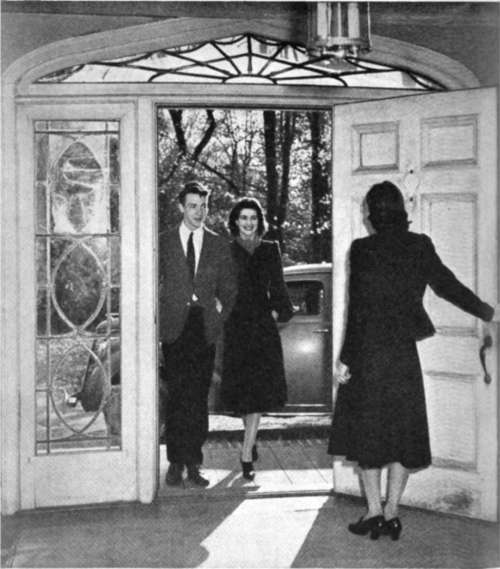
Unexpected Callers. Do You Know How to Entertain Them?
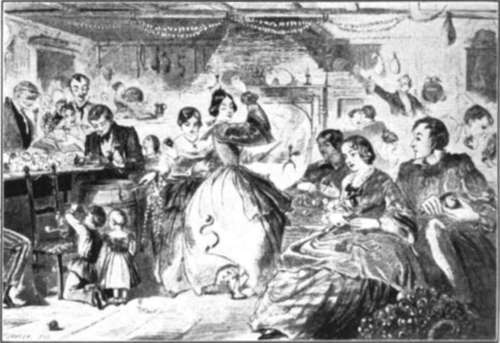
An Autumn Party in the Old Days. The home used to be the center of entertainment and fun. Peeling apples, husking corn, quilting, popping corn, singing, and dancing were among the interesting pastimes.
Improved Homes For Leisure
Thanks to those who are designing and building new homes, there are many more chances for recreation and leisure-time activities than there were in the houses of other days. Most of the newer homes are built with recreation in mind. Many of them have game rooms in the basement or in the attic where it is possible to have groups of friends in for an evening or to play with members of the family. These rooms are valuable when planning a party, especially if one has been wise enough to collect the necessary equipment. With a bit of paint and varnish, for example, one can lay out a shuffleboard court on the floor. Table-tennis sets can be made easily and are good for parties or rainy days. A dart target hung on the wall is another good addition to the recreation equipment.
For those quiet moments when we choose to relax, there are quantities of good books, magazines, and newspapers. One need not own all of these things, either. Libraries are handy in most cities and will gladly lend you enough good reading material to occupy many happy hours. In addition, millions of homes now have radios that bring entertainment from the four corners of the earth to the living room. The telephone makes it possible to talk to friends without leaving the house.
Some families are fortunate enough to have their own small movie machines and never tire of the thrill of living over some of the jolly days of the past. The older the film gets, the funnier it is because styles and people both change.
Perhaps you have seen a workshop fully equipped right in a house. For folks who enjoy puttering around with a favorite hobby it is a great idea. You can saw, hammer, glue, and carve to your heart's content in such a place. It does not have to be a workshop either, if you have some other interest. Any hobby room, whether it be for photography, sewing, collections, or star maps, will add much to your interest in being about the house.
It is unfortunate that so many people do not know how to enjoy their own "castles." In many cases home simply means a place for father to come home to for rest; for mother, a place from which to go; and for the children, a place to come to when there is nothing else to do. In these instances one suspects that the families have not learned to use their homes and enjoy the many advantages that have been passed on to them. When you have your own home, you will want to know how to entertain your friends there and how to enjoy it yourself. The suggestions in this chapter should help you to do this. Even before that day comes you can be your own architect and plan how your present house can be better equipped for recreation. See how many of the ideas that follow will be helpful to you.
Recreation In An Apartment
Hundreds of thousands of American people live in apartments, where they have no extra rooms, backyards, or basement workshops. Perhaps you live in such a city apartment. If you do, some of the things that are suggested here may seem out of place to you. However, there are a number of things that you can do to make a small apartment more enjoyable. For example, there are games that take little space and that make a rainy day enjoyable in a tiny room.
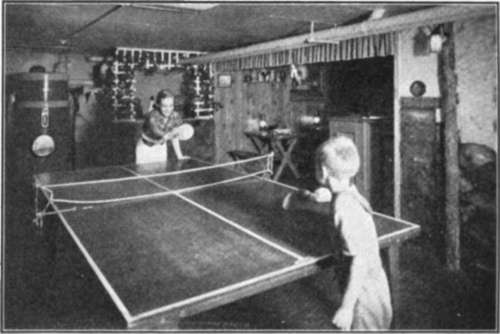
A Basement Recreation Room. With a little work and ingenuity you can make the most humble basement room into an attractive playroom.
Often it is possible to interest several families living in the same apartment house to co-operate in furnishing a recreation room in the basement. A table for tennis, a smooth wall for handball, and a few small tables for craftwork are enough with which to start. As time goes on other things can be added if they are necessary. Even the roof of a house in the city can sometimes be put to good use after securing the co-operation of the owner of the building. Small game areas and sunny spots for deck chairs can bring some of the advantages of the country or seashore within a few floors by means of the elevator.
Apartment-house owners are beginning to see the value of providing facilities of this kind for their tenants along with hot water, gas, and electric light. In a crowded city, where play space is difficult to find, an apartment house owner who furnishes such conveniences is doing his tenants a good turn.
Recreation On The Farm
To those who have not lived on the farm it may seem a little strange that we should spend some time considering recreation for those who live there. It is true that there arc many leisure-time activities on the modern farm that are not to be had in the city. Horseback riding, walks through the woods, fishing, and games in the fields arc usually a part of the advantages young people living in rural areas have. Now that the radio, the phonograph, and the motion pictures have been provided for us, there are even more things for rural people to do with their spare time.
Yet you must remember that those who live on the farm probably have less time to themselves than do those in the city. There arc usually many chores to do night and morning. In the spring there are the crops to plant, and in the fall the harvest is in full swing. When a person living on the farm gets some free time he likes to do something that is entirely different from the tasks that he does every day as part of his work. For this reason (and for rainy days, also) there is much to be gained by making a few of your own games for the near-by field or for the spare room in the house. Many of these games and other activities outlined here are quite suitable for the farm and small village. A special attempt has been made to include suggestions that can be used in many different places.
Continue to:


My Books

