


How To Dress For Hiking
Description
This section is from the book "Time Out for Living", by Ernest DeAlton Partridge and Catherine Mooney. Also available from Amazon: Time Out for Living.
How To Dress For Hiking
In selecting clothes for hiking it is not necessary to purchase a new outfit according to the latest style. The main purpose of hiking clothes is protection and comfort, and these two things need not cost a great deal. Very often one has all of the necessary garments around the house and needs but to assemble them. Simple, comfortable clothing that can be cleaned easily is best.
Generally, tight-fitting clothes are not desirable since they impair normal circulation of the blood and thereby cause the legs or arms to ache, depending upon where the tightness occurs. Tight-fitting leggings or high boots are not needed and should not be used, especially for long trips. In some cases, such as in country thick with thorns, high boots are necessary, but for most hiking high boots are heavy and do not allow proper ventilation of the legs and feet.
In selecting clothing the kind of cloth is important. Loosely woven woolens gather burrs and snag in thorns and twigs on the trail. Trousers or skirts, therefore, should be of light, smooth texture. Denim or some such cloth is excellent. Flannel shirts are very popular in the West.
If long trousers are worn, they should be tucked in the tops of the shoes to keep insects and burrs from entering. Shorts are becoming increasingly popular in this country among hikers and campers of both sexes. They are especially desirable in the summer because of the comfort and ease of keeping them clean. In Europe, shorts have been a favorite form of dress for the outdoors for many years. Whether one wears shorts or not depends upon many things, such as the kind of hiking country, the time of year, and the condition of one's knees. Men and women who have worn shorts in all kinds of woods find them to be most satisfactory.
In a section of the country where rainy days are frequent, it is necessary for the hiker to be prepared at all times to keep dry. The best thing for this purpose is a good, light-weight oilskin poncho. In recent years many excellent new materials have been developed for this purpose. If these are too expensive, a small piece of light canvas can be waterproofed at home. *
When one is properly dressed there are few thrills to compare with a walk through the woods in the rain. There is something fresh and invigorating about such an experience.
Shoes
The main point about hiking shoes is that they should be broad enough to keep the feet comfortable on long journeys. The average shoe worn in the city is not suitable. These shoes are usually made for light wear and for short walks on smooth surfaces. In the woods the feet have a tendency to spread out because of the weight on the hiker's back and the long hours of walking. For this reason the shoes should be long enough and broad enough to allow heavy socks on the feet and ample, but not too much, room for the feet. Tight, ill-fitting shoes can ruin a hike about as quickly as anything. If the shoe is too loose around the heel, it may slip and chafe and sometimes cause a blister.
* A good way to waterproof canvas for this purpose is as follows. Melt 2 cakes of paraffin wax and stir it into 2 quarts of turpentine that has been heated in a double boiler. Do not heat the turpentine on an open flame in the house. The safest way is to heat a large pot of water to the boiling point, then take it off the stove and set the can of turpentine in it to heat. When the mixture has been thoroughly worked together, fold the canvas into strips about six inches wide and paint one strip after another with a broad brush, using plenty of the liquid. It will soak through into the canvas if it is spread while hot.
If you want to make certain of a correct fit when buying hiking shoes, try carrying fifty pounds on your back when you try the new shoes on. This will give you some idea of how your feet spread when weight is added on the back. Speaking of shoes, never start out on a hike in a new pair until you have broken them in. They should be worn on several short walks until they become easy on the feet.
Rubber and canvas footwear is usually not satisfactory for long hikes. The low, sneaker type of shoe is especially unsuitable for long hikes. There is a tendency for the feet to perspire in rubber-soled shoes, and canvas uppers do not repel the water as leather will. Furthermore, canvas shoes may not last on a long strenuous trip. Leather shoes with a special composition sole are finding increasing favor among experienced hikers. They should come above the ankles.
Leather shoes should be waterproofed at intervals. Waterproofing can be done with a preparation you make yourself and apply while it is warm, with a brush. The leather should be warmed, also, before the preparation is applied. Here is how to prepare two different kinds of waterproofing:
1. Two parts of yellow vaseline and one part of paraffin melted together and applied while hot.
2. Equal parts of paraffin or beeswax, tallow, and harness or neat's-foot oil melted together and applied hot.

Shoes for town, shouting cramping of toes
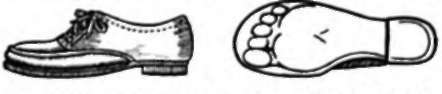
Moccasin type shoes with thick flexible Soles and plenty of toe space.
The shoes you wear can help you enjoy a hike or make you utterly miserable.
Socks
Socks are almost as important as shoes for foot comfort. They should take up perspiration and protect the feet against the leather. In cool weather, wool socks are best because they are loosely knit and allow ventilation. Some outdoorsmen prefer to wear thin cotton socks underneath the wool for extra comfort. In hot sunny weather, when one is hiking in the open, a pair of heavy cotton socks seems to be best. In any event, cotton or wool, you should carry an extra pair or two along, and at night wash the soiled socks and hang them out to dry ready for use the next day. Don't forget them when you leave camp.
Continue to:


My Books

