


How To Make A Collection
Description
This section is from the book "Time Out for Living", by Ernest DeAlton Partridge and Catherine Mooney. Also available from Amazon: Time Out for Living.
How To Make A Collection
It is not easy to explain in general terms how to make a collection. Each particular kind of collection has its own romance and method of display. If you are collecting rocks of various kinds, a small box divided into sections might be the thing with which to start. A collector of different kinds of wood may wish to hang his specimens in orderly fashion along the wall, while the person interested in shells could find an excellent display case in an old china cupboard.
Small corner cabinets hanging on the wall are finding favor with collectors of small things because they are convenient places in which to lay out the articles. A woman who collects small carved elephants has a parade of them from the smallest to the largest in such a hanging shelf, and they are most intriguing.
Perhaps one good general rule about collecting is to find out all you can about what you are assembling. In this way you learn to appreciate the value of new specimens and can tell your friends the stories behind each article. Also, you will learn new and different things about your hobby and thus come into possession of more valuable items.
By finding other persons in your own community and in distant places who have the same hobby you have, you can multiply the chances of securing what you are seeking. You can trade ideas and actual articles.
The Fun of It. Now that we have briefly surveyed part of the field for collectors, it might be well to stop for a moment and see where the fun comes in. If you are a collector, you will know that it is fun, but you may not be able to explain why beyond the fact that you like it. This is true of many hobbies. It is possible, however, to see certain values that appeal to those who make a hobby of collecting.
Take the matter of classification, for instance. A real collector will take great pains to see that each specimen is carefully classified and understood. No part of the article misses his inspection. In this way he comes to understand the object and to know the romance behind it. He knows where it fits into his complete collection, and he knows what to look for in order to find new and more precious additions.
Here is where some more of the fun comes in. Once you get on the trail of items for a collection, you will find that the search may lead you anywhere. You may rush into the library some day to find a reference to your hobby in a book mentioned by a fellow collector, or you may find yourself visiting another person about whom you have heard, someone who is interested in the same thing or who may have a specimen you want. You will find, also, that by writing to people in other cities and even other countries you can extend your collection and also your knowledge.
Last, but by no means least, is the satisfaction that collectors gain from talking with each other about their hobby. Listening in on two such hobbyists you might hear:
"You should see the new button I found the other day! It fits into the empty space in my collection. . . ."
Such is the fun of collecting. Everybody does it! You, too, can be a collector without any investment whatsoever, if you choose the right things to collect.
Here is a list of collections some people have made:
Albums Anecdotes Animal bronzes Antiques Apostle spoons Apothecaries' medicine jars Armor Arms Guns
Medieval weapons Savage weapons Small arms
Association items (that is, articles that once belonged to well-known people, as Lincoln, Napoleon, Dickens)
Autographs
Bandboxes (old bandboxes were decorated with pictures or patterns)
Banks, children's (many quaint designs of penny savings banks) Barber bowls Beads Bells
Bird cages
Books (see special list)
Bottles (with pictures of the Presidents or other designs pressed in glass)
Bows and arrows
Broadsides
Buttons
Cameos
Canes
Carved ivories Chess pieces China
Historical plates
Pitchers
Spode
Tea sets
Tobies
Wedgwood Church vestments Cigar bands Cigarette cards
Circus stuff (playbills and posters) Clocks
Coaches and carriages (ancient, full-sized or models) Coins
Coverlets, bedspreads, and quilts
Cowbells
Curios
Decanters
Dime novels
Dolls
Elephants (small models in china, glass, wood, brass, cloth, etc.) Embroideries Fans
Figurines (small statues, terra cotta, Chelsea, etc.) Firearms
Firebacks (that once stood behind the fire in old fireplaces) Furniture Glassware
Early American pressed
Glass dishes
Sandwich
Stiegel Gold plate
Guns
Hall marks Hooked rugs Hourglasses
Icons (Russian sacred images) Indian arrowheads Insurance plaques Ironmongery (old handwrought hinges, latches, brackets) Jade Laces Lamps
Leather fire buckets Locks and keys Maps
Matchbox covers Medals
Miniature coaches Mortars and pestles Musical instruments Nails
Names (odd surnames and place names)
Natural objects (see special list)
Newspapers (old)
Paper money (any period or any country) Penmanship (old copybooks) Pewter
Phonograph records Pictures (see special list) Playbills (actors' photographs) Playing cards (of all nations, old and modern) Postage stamps Postcards Posters Pottery
Prints (see special list) Rogers groups
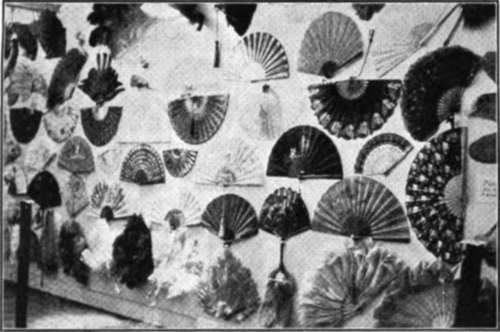
A Fan Collection mounted for exhibition.
Candid Shots of friends from a photograph collection.
Rugs and carpets Russian brass Samplers
Scarabs (sacred beetles of ancient Egypt carved from precious stones and other material)
Scrimshaw work (tusks of walrus and bones of whale carved by sailors)
Sculpture
Sheet music
Sheffield plate (old silver hammered on copper) Shells
Ship models Silver Snuffboxes Songs and ballads Spurs
Steins and mugs Streetcar tokens Tapestries
Tear bottles (Chinese, of jade and crystal, beautifully carved) Tiles
Toys (dolls, lead soldiers, all old-time playthings, of all nations)
Tradesmen's cards (old advertisements) Uniforms and insignia Watches Weapons
Books - General Almanacs
Americana (early books about or printed in America) Books about books
Children's books Early printing
First editions (including modern firsts) Hornbooks
Illuminated manuscripts (missals, books of hours, etc.) Illustrated books
Incunabula (the earliest printed books) Miniature books Old schoolbooks Private press books
Books - Specific Subjects
Continue to:


My Books

