


New Horizons. Part 4
Description
This section is from the book "Time Out for Living", by Ernest DeAlton Partridge and Catherine Mooney. Also available from Amazon: Time Out for Living.
New Horizons. Part 4
There is another kind of horizon. It is our mental horizon - our horizon of knowledge. In all ages there have been great explorers pushing back this horizon. Such a man was the Greek philosopher and scientist Aristotle. Galileo, who made the first real telescope and discovered the spots on the sun, was another scientist who pushed back the horizon which separates the known things from the unknown. Although Leonardo da Vinci was an artist, he was also a good scientist. Whenever he discovered a new thing, he wanted to make it of some benefit to all men. In that respect Benjamin Franklin was like him.

Tin?. World, after a map by Henricus Martellus Germanus, 1489. The map shows the world as it was popularly supposed to be before the discoveries of the late fifteenth century.
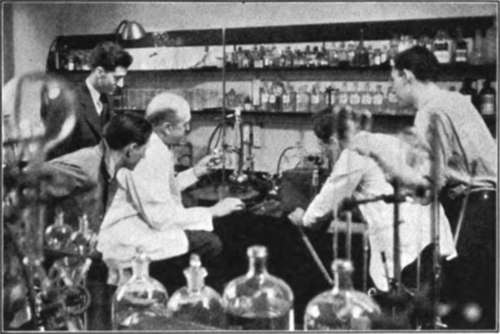
Scientific Explorers help push back the horizons of knowledge.
Those ancient explorers, who were searching for knowledge instead of islands and continents, were very few in number. Today there are tens of thousands of research scientists who are busy pushing back that imaginary sky curtain.
In the year 1500 a.d., the average man in a village in Europe knew very little about the world. His horizon of knowledge was very close at hand. Even the things men saw in those days did not mean much to them. Birds were just birds, but most men could not help noticing that some birds were large, some small, some black, others yellow. Perhaps they had names for the birds they saw most frequently, but they did not know about the great families of birds, or where birds stayed in the winter, or what they ate, or how they helped the farmer raise his crops.
And so it was with the stars. Mr. Average Man noticed that the sky looked like a huge bowl turned upside down, and no doubt he felt that the stars were just peepholes in this big bowl. He knew nothing about the millions and millions of miles of space in the sky, the size of the many stars, and how many millions of them there are. Furthermore, he did not know the relation of this earth to those stars. To him the earth stayed still, and the sun and the moon came up in the east and went down in the west followed by all the stars. Little did he realize that it was the movement of the earth that caused these heavenly bodies to appear to move.
Most of the things man saw every day of his life were a source of great wonder to him. The average man accepted them as they came and never asked many questions. He wandered about in an environment that was strange and could not be controlled. He saw little and understood less. Even if he had been fortunate enough to have leisure time, it would have meant little to him, for he could not travel because the means were not available. He could neither read nor write. Life to him was very narrow.
Even today, when much is known about the earth and about the universe of which it is a part, there are many, many people who arc like the average man of the Middle Ages. Their known world is very small. They have heard of distant lands by rumor, and they have explored a limited area in their own city; but of all the things they could know and see, they have experienced little. Two men living in the same city, yes, in the same block, can have entirely different worlds. Examine the two maps on the following pages. They show the known world of Mr. A and Mr. B. Mr. A has a job in the center of town and every day he goes to it by the shortest possible way. After work, he walks straight home and stays there until the next day, when it is time for him to do the whole thing over again. For this man, a vacation in the summer means going to the same resort, fishing a little, walking a little, talking a little, and sleeping a lot. He is not much better off than the man who lived in the Middle Ages.
Mr. B, on the other hand, has learned what interesting things there are to be seen about him. He also walks into town to work, but he hikes through the woods. Fishing trips have taken him up the rivers. In the winter, he skates on the near-by lakes; and during his summer vacation, he plans a different trip, each year, to some interesting part of the country with which he is unfamiliar.
These two men differ also in how much they know about things to do in their leisure time. Mr. A knows one or two things slightly. Mr. B, on the other hand, has many hobbies. To him, leisure is a blessing. He is an explorer, an adventurer, a man who pushes back his own horizon and uncovers more and more new lands. Worlds without end are his for the asking.
Are you an explorer, an adventurer? What can you do? Try making a list of things you can do well - not the things you have heard about or think you can do, but those you have actually learned. Where have you been? Sketch a map similar to the one used for Mr. A and Mr. B, based, of course, on the country surrounding your home. Shade the territory you know well. Or take a map of your state and on it show what your known geographical world is. Perhaps it will extend beyond your state. With this as a starting point, you can begin to push back your horizon and see what is beyond.
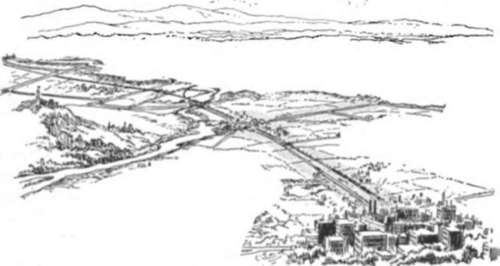
The Known World of Mr. A. The shaded portions show where he has been. He knows little of the surrounding country and has not explored the mountains, lakes, and streams. Compare his known world with that of Mr. B.
Continue to:


My Books

