


New Horizons. Part 5
Description
This section is from the book "Time Out for Living", by Ernest DeAlton Partridge and Catherine Mooney. Also available from Amazon: Time Out for Living.
New Horizons. Part 5
More than a dozen subjects are briefly described in this book, and as we think about these subjects it is amazing to realize that the majority of Americans can have more fun and a greater amount of leisure than could the kings of Europe a few hundred years ago. The states and the Federal government have given us beautiful forests and parks in which to camp, hunt, and hike. For a small charge the movies bring all the world to us, both past history and contemporary events. If we want the fun of learning to be good marksmen with the bow and arrow, we can easily have it. We also can take our own movies and make movie plays. Finally, if we wish, we can practice describing all these things to our friends in writing.
In a cafeteria, we walk before a long table loaded with many delicious dishes. It would be nice if we could taste a dish here and there and then come back and take a real helping of the two or three kinds that we liked best. Of course we cannot do that in a restaurant; but we can do just that in this book.
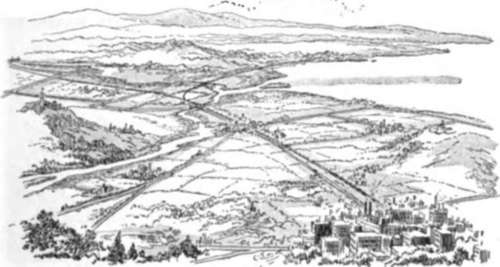
The Known World of Mr. B. The shaded areas show where Mr. B has been. He "goes places" and does interesting things. He has explored the countryside rather well. He knows where to go to hike, swim, skate, boat, or ski.
A taste of each subject is given. Select your favorite dish, and you will find many books which will give you your intellectual meal.
Some Interesting Things To Do
1. Make a hobby book. In this book collect clippings, magazine articles, pictures, and other things that may show interesting hobbies you would like to follow or are valuable to the hobby you have already chosen. There are several ways to make such a book. A loose-leaf book from the five-and-ten cent store is good enough to start with, or you may prefer to make one yourself by binding it in a special cover of thin boards or leather. The loose-leaf book has many advantages because you can add to it or rearrange your clippings when necessary.
2. Plan a hobby exhibit for your class or neighborhood. Have each person write a short explanation to accompany his part of the exhibit. Have as many different hobbies and articles displayed as possible. Offer small prizes for the best display or the most unusual hobby. Appoint a committee to judge each entry for this purpose, and to clear the cost of the prize a small fee of one cent for admission would not be too high.
In organizing a hobby fair it is well to plan in advance, so that each person will have ample time to make up his exhibit and finish any article upon which he may be working. As a special feature of the fair, men and women who are outstanding in some hobby may be invited to speak briefly on the opening night. They can explain their own hobby and award the prizes to the winners. It is necessary to have plenty of space on tables and on the wall for displaying hobbies properly. Each person may then be assigned a place to show his wares. Arrangements can usually be made with a library to display books of interest on various hobbies.
3. How do the people of your community use their leisure time? Observe them for a week and see what activities are most popular. List what you believe to be the needs for a definite program of leisure-time activities in your community. Write an article about this for your local paper.
4. What types of sports or recreation do you consider to be of greatest value to your community? List your reasons.
5. Make a map of your neighborhood and on it show all the playgrounds, parks, public recreation facilities, and commercial amusement places.
6. Make a survey of your class to find out how the members spend their leisure time. Have the members vote on their favorite sport or amusement. What is the most popular pastime? What unusual pastimes do you find?
7. Make a list of the hobbies of persons you know in the neighborhood. What unusual hobbies do you find?
8. Find out by a questionnaire approximately what percentage of their income each family represented in your class spends for various kinds of commercial amusements each year. Do this in a quiet way, listing the families by number instead of by name. Make a table of your results.
9. Figure out how much you spend weekly, monthly, or yearly on recreation of all kinds. List the types of recreation in each case, and make a chart to show the results.
10. Plan a leisure budget. How much could you save from cutting down on candy? unnecessary movies? other items? How much could you save in this way in a week? in a month? What materials that you need for hobbies could you buy with your savings in these other things?
11. Make a study of your family budget to understand the relationship between the amount of income spent for food, rent, fuel, and light and the amount of income spent for leisure-time activities.
12. Chart a daily record for one week to show how you use your time. List the amount of time given to (1) work and study, (2) sleep, (3) eating, (4) leisure. In column (5) list briefly what you did in your leisure time.
13. Draw a circle graph or pie chart showing the percentage of your time spent on the various activities listed in the previous project.
14. Make a map of your known geographical world. Where have you been? What have you seen?
15. Make a list of things you can do in your leisure time that a peasant in the Middle Ages could not do.
16. Write for the school paper or for a local paper an article or editorial entitled Hobby Hunting, Here's a Hobby!, or the like.
17. Make a list of amusements which you believe are harmful to an individual and another list which you believe to be beneficial. Find out how many in your class agree with you. Could an amusement be harmful to one and beneficial to another? Give your reasons.
18. Make a booklet showing how nature and the seasons change the forms of recreation. Cut pictures from magazines to illustrate your conclusions.
19. Make a chart showing the kinds of recreation suited to people of different occupations. Keep in mind such things as cost and whether the activity is different from what the individual does at work.
20. Figure out how much leisure time a man has if he works forty hours a week. Allow eight hours a day for sleep, three hours a day for meals, one hour to go and come from work.
21. If you live in a rural district your "field for fun" will be much larger than in the city. Discuss with your friends the kinds of activities for leisure time that are available in your neighborhood. Draw a map to show these facilities, placing the school about in the center.
22. Write a short article for your town paper comparing the types of amusements in city and country fifty years ago with those of today.
23. If you have a keen interest in history, trace some of the recreational and leisure-time activities of people through the ages.
24. Write a letter to the National Recreation Association, asking for information concerning the work done by the organization in the interest of better amusements for the public. Their address is 315 Fourth Ave., New York City.
25. Is your city, like others, taking a growing interest in recreation? List the facilities it has made available, such as parks, playgrounds, and so on. Do the same for your state and for the nation.
26. Plan a radio broadcast dealing with the favorite recreational activities of George Washington, Benjamin Franklin, Abraham Lincoln, Theodore Roosevelt, Woodrow Wilson, Thomas A. Edison, and Will Rogers.
27. Form a Leisure League. Your librarian will help you list magazine articles and good books concerning the wise use of leisure. Assign readings to be reported upon in a series of meetings of your club.
Helpful References
Burns, C. D., Leisure in the Modern World.
Calkins, E. E., Care and Feeding of Hobby Horses.
Collins, A. F., How to Ride Tour Hobby.
Cut ten, G. B., The Threat oj Leisure*
Dark, S., After Working Hours.
Frankl, P. T., Machine-Made Leisure.
Gibbard, M. K., Pastimes and Sports for Girls.
Greenbie, M. B., Arts of Leisure.
Hambidge, G., Time to Live: Ad-ventures in the Use of Leisure.
Jacks, L. P., Education through Recreation.
Jacks, L. P., Education of the Whole Man.
Joad, C. E. M., Diogenes; or, the Future of Leisure. Lampland, R., Hobbies for Everybody. Neumeycr and Neumeyer, Leisure and Recreation. Overstreet, H. A., Guide to Civilized Leisure.
Pack, A. N., The Challenge of Leisure. Riggs, A. F., Recreation in a Balanced Life (a play). Walker, L. C, Distributed Leisure.
Continue to:


My Books

