


Part 2. Fun On Foot. Chapter Two. Highlights Of Hiking
Description
This section is from the book "Time Out for Living", by Ernest DeAlton Partridge and Catherine Mooney. Also available from Amazon: Time Out for Living.
Part 2. Fun On Foot. Chapter Two. Highlights Of Hiking
"Say, Tom! Mix up a little flour and water, will you? I want to thicken this stew. I think you will find the flour in my rucksack by the tree."
Russ had just lifted the lid off the steaming pot of stew and was tasting it cautiously. He licked his lips. It was good! Just a little more salt, some thickening stirred in, and it would be ready. Russ was more than ready for it, too. Cooking over a fire when your appetite has been whetted all day long on the trail makes food smell extra good. What a day they had just finished! Mile after mile they had tramped along together over shady trails, then out into the open on some sunny slope to view the valley below, only to dive into the woods again for a short distance.
Lunch had been eaten on Scar's Bluff overlooking Greenwood Lake. After lunch they had lain on the grass and watched the clouds drifting across a deep blue sky. It was restful with nothing to disturb them but the subdued noises of the woods to which they had become accustomed from many trips into the open.
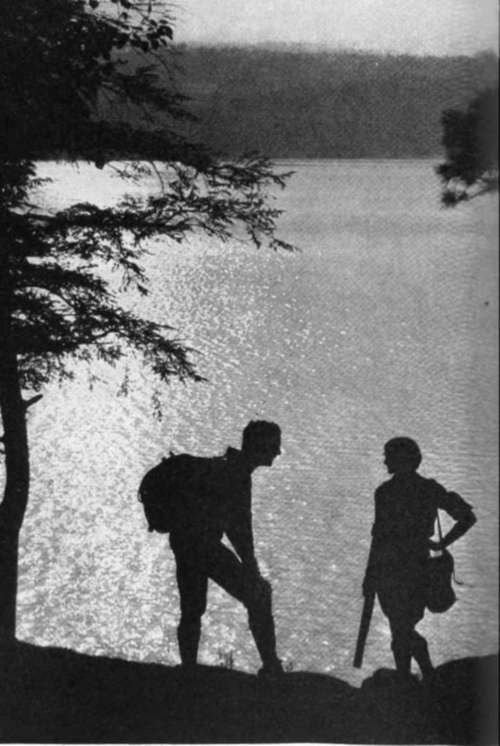
Hiking in the Evening when the Sun Is Low.
Then more miles through the woods - and now here they were at evening camp. The small tent they had made together was pitched jauntily in the background, a folding candle lantern burning inside. Dinner was almost ready. The smell of the stew made them both impatiently hungry. Tom had the plates laid out just in front of the tent, with bread and butter on them. Russ was putting the finishing touches to the meal, which was cooked to a turn by his experienced hand.
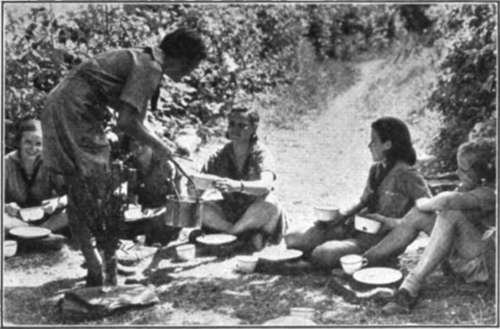
Time to Take on Supplies.
While they ate, the darkness closed in. In the distance night birds were tuning up for an evening of broadcasting. Occasionally the wind would stir the pine trees overhead and make the fire jump as though it were afraid of something in the darkness.
They washed the dishes quickly and sat down to enjoy the last embers of the fire. Tom unfolded a map and, with his pocket flashlight handy, pointed out the route they had covered that day. Together they planned their jaunt for the morrow.
Bedtime arrived all too soon, and, after banking the fire so that the sparks would not fly dangerously around, they turned into their blankets and stretched out for a long rest under the summer sky. It was the end of another perfect day in the woods.
Thousands of people in America enjoy days like this, but there are millions who have never tasted camp cooking, have never slept under the stars or watched a campfire die down at night. Once the outdoor bug bites you, it's hard to keep the fever away - but unfortunately too many people have never been bitten. Do you know why more people do not enjoy such times? The answer is simply this - they don't know how. First of all, you should decide to hike for fun.
John Muir was one man who learned to enjoy the out-of-doors. He liked to hike into the woods during a storm and feel the force of the wind and the rain. Sometimes when the wind blew hard he would climb a tall tree and sway back and forth with the wind. Here is his description of one experience in Alaska. *
"One night when a heavy rainstorm was blowing I unwittingly caused a lot of wondering excitement among the whites as well as the superstitious Indians. Being anxious to see how the Alaska trees behave in storms and hear the songs they sing, I stole quietly away through the gray drenching blast to the hill back of the town, without being observed. Night was falling when I set out and it was pitch dark when I reached the top. The glad, rejoicing storm in glorious voice was singing through the woods, noble compensation for mere body discomfort. But I wanted a fire, a big one, to see as well as hear how the storm and trees were behaving. After long, patient groping I found a little dry punk in a hollow trunk and carefully stored it beside my matchbox and an inch or two of candle in an inside pocket that the rain had not yet reached; then, finding some dead twigs and whittling them into thin shavings, stored them with the punk. I then made a little conical bark hut about a foot high, and, carefully leaning over it and sheltering it as much as possible from the driving rain, I wiped and stored a lot of dead twigs, lighted the candle, and set it in the hut, carefully added pinches of punk and shavings, and at length got a little blaze, by the light of which I gradually added larger shavings, then twigs all set on end astride the inner flame, making the little hut higher and wider. Soon I had light enough to enable me to select the best dead branches and large sections of bark, which were set on end, gradually increasing the height and corresponding light of the hut fire. A considerable area was thus well lighted, from which I gathered abundance of wood, and kept adding to the fire until it had a strong, hot heart and sent up a pillar of flame thirty or forty feet high, illuminating a wide circle in spite of the rain, and casting a red glare into the flying clouds. Of all the thousands of campfires I have elsewhere built none was just like this one, rejoicing in triumphant strength and beauty in the heart of the rain-laden gale. It was wonderful - the illumined rain and clouds mingled together and the trees blowing against the jet background, the colors of the mossy, lichened trunks with sparkling streams pouring down the furrows of the bark, and the gray-bearded old patriarchs bowing low and chanting in passionate worship!
* From Travels in Alaska by John Muir, published by Houghton Mifflin Company.
Continue to:


My Books

