


Part 1. Worlds Without End. Chapter One. New Horizons
Description
This section is from the book "Time Out for Living", by Ernest DeAlton Partridge and Catherine Mooney. Also available from Amazon: Time Out for Living.
Part 1. Worlds Without End. Chapter One. New Horizons
Robinson Crusoe had to work nearly all the time in order to keep alive. His method of getting food was necessarily so crude that it took him a large part of his waking hours to keep from being hungry. In order to get a new pair of shoes he had to kill an animal, laboriously turn its skin into leather, and cut and fashion some kind of makeshift footwear. He had to raise and store his food, make his own clothing, and even design his odd umbrella. He probably enjoyed working because he had nothing else to do. In his leisure time he seems to have had no other amusement than talking to his parrot.
His story seems to be a sad one, yet we gather from the famous book that Crusoe really enjoyed life. He had to figure out ways of doing things. Then, too, he was his own master. He could do what he wanted whenever he wished; but the penalty he paid for his leisure and perfect independence was that the only thing he could do when his chores were done was talk with his parrot. He led a solitary life.
Like Crusoe, our remote ancestors gave up a solitary way of living as soon as they could, and came together in tribes. Probably it would be more correct to say our ancestors never lived a solitary or lonely life. Even animals flock together. Our ancestors were more intelligent than the animals and so they divided the work of the tribe among its members. For example, someone probably spent most of his time watching for the approach of an enemy. Even some of the less fierce animals, the herbivorous groups, protect themselves in this way. When the herd is eating grass, one member will stand guard to give warning of an approaching lion, tiger, or other carnivorous animal. In the same way our ancestors probably made standing guard one of the first divisions of labor, one of the first professional occupations. They little realized that these guardians would eventually become so powerful that they would turn some of the tribe of free cave men into slaves. But this they did. Modern dictators resemble them in this respect.
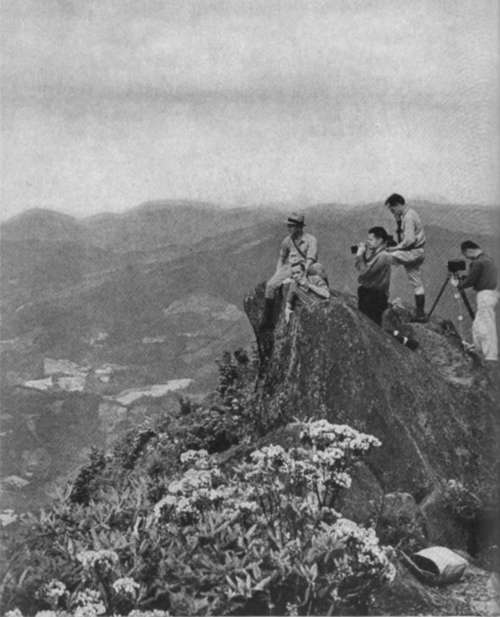
Worlds without End. The Higher You Climb, the Farther Back Is the Horizon.
In the course of time our ancestors created other occupations besides standing guard. There are beautiful drawings in the caves of France and Spain which were made ten or twenty thousand years ago. They are so well done that even at that remote time persons who had artistic ability must have been allowed to devote much of their lives to the drawing of pictures.
We know that about five thousand years ago the people who lived on the shores of the Mediterranean began to make real progress in their way of living. More and more they divided the work of the community among its members. Some built houses, some farmed the land, and some became soldiers instead of sentinels. Now we have so many occupations - plumbing, engineering, storekecping, teaching, and so on - that we forgot there was a time when life was almost as simple and solitary as it was for Robinson Crusoe. The division of labor gave communities soldiers with spears, shields, and helmets. It gave them farmers, fishermen, and builders. Those who spent all their time designing and building houses became so expert that they constructed some wonderful buildings. Artists, who were fed and clothed so that they might devote all their time to painting pictures and carving statues, produced some works which we now treasure in our museums. During this time trade developed. At first, trade was carried on by barter. That is, an ax may have been exchanged for some wool, or a bag of salt for some grain. Later, money came into use.
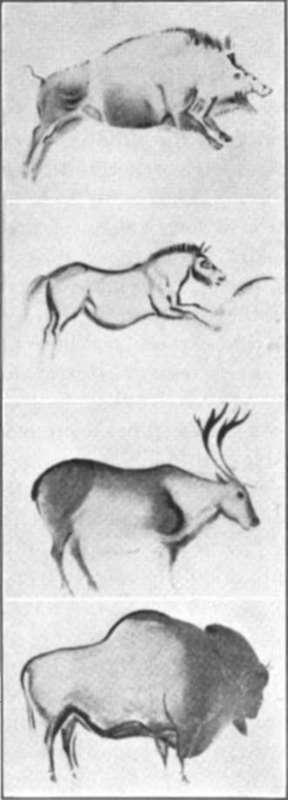
Cave-man Drawings. Leisure made them possible.
We now think that the majority of the people in those days did not have any more leisure with this increase of civilization than they had had before. They were obliged to work from daylight to darkness, and when their chores were done they did not even have a parrot to talk to. In some respects the history of our ancestors has been tragic.
All of the members of the community did not live so hard a life. A few of the rich and powerful had leisure. The kings and governors lived in great buildings, guarded by soldiers, and had the best the country could produce.
As civilization developed, the amount of happiness of the few grew greater and, in many cases, the amount of happiness of the many grew smaller. The kings and governors, in order to seize land and wealth, would go to war. The poor people had to do the fighting. If the king was successful, he brought back captives and used them as slaves. If the enemy won, the people, if they were not killed, were taken away as slaves. So there began a new kind of life in our family history, when many men in Europe, especially those on the shores of the Mediterranean, were either slaveholders or slaves or so wretchedly poor that they were like slaves.
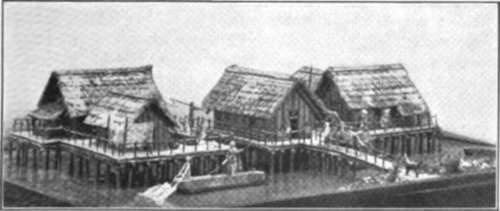
Houses of Early Lake Dwellers.
In time, cities grew up. Later, wealthy rulers made their cities beautiful. In the Roman Empire, marble temples were built. Stone-lined canals brought water to the cities from great distances. Beautiful columns and handsome round arches carried these canals, called aqueducts, over valleys. The Romans built thousands of miles of paved roads in the Mediterranean region and as far north in Europe as Scotland. Yet the majority of men and women had no time for fun - and leisure. Either they were slaves or they worked as hard as slaves. The uncivilized people on the islands in the Pacific Ocean were probably happier than the majority of the people who walked on Roman roads.
Then came the fall of Rome (476 a.d.). The collapse of the Roman Empire left in its wake poverty, misery, and ignorance.
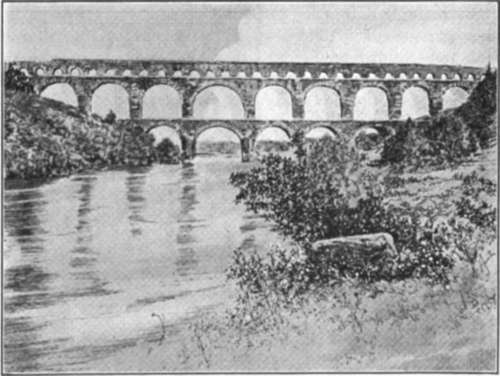
A Roman Aqueduct. Few people had leisure in the days when this was built.
This condition lasted for several hundred years. Slowly there emerged the next stage in the story of Western civilization - the Middle Ages. Here is a description of life in those days:
Continue to:


My Books

