


New Horizons. Part 2
Description
This section is from the book "Time Out for Living", by Ernest DeAlton Partridge and Catherine Mooney. Also available from Amazon: Time Out for Living.
New Horizons. Part 2
The sudden blast of a trumpet shattered the quiet autumn air. This was followed by the pounding of hoofs and the baying of hunting hounds hot on the trail of a stag. Shortly the pack was in sight, swarming across the clearing and heading toward the near-by woods. It was followed by several gaily dressed riders urging their well-groomed horses to keep up with the dogs as they raced over the rough ground. The hunt was on!
As the hunters dashed after their dogs they passed a small cultivated field near the woods where a peasant and his family were harvesting the grain for their winter supply of food. The peasant was sweeping a long scythe before him in wide circles. It was hard work for him, cutting grain all day long, and hard for his wife, too, who bent over in the sun hour after hour, tying the golden bunches together. A ten-year-old girl helped the mother as best she could by laying the wheat into shocks before tying.
The farmer stopped to see the noisy pack of dogs disappear into the woods. The mother, still kneeling over a shock of wheat, looked up briefly, and the little girl, with pigtails dangling, held a bunch of wheat in each hand as she stood and watched the hunters with a broad grin. What fun it would be, she thought, to race through the woods on the back of a beautiful horse in pursuit of game and then return to the castle for a feast and dancing.
The man sharpened his scythe with a stone. The woman sighed and finished tying her bundle. The girl continued to watch with sparkling eyes, longing for the day when she, too, might have time to play like that and not have to work day after day in the fields.
All day long the little family worked. Rising before sunup, there were cattle to feed while mother made breakfast. With a scanty meal of porridge, milk, and dark bread, they would all go into the fields to spend the day tending the crops. The whole year around there were things to do. In the spring it was the plowing and planting, while during the hot summer months the crops had to be weeded and the soil furrowed. In the fall, harvesting and storing the crops for winter use kept them busy. Even in the winter, after the crops were in and the weather began to get cold, there was wood to gather and cut for the fireplace, and winter clothing to spin, knit, weave, and sew.
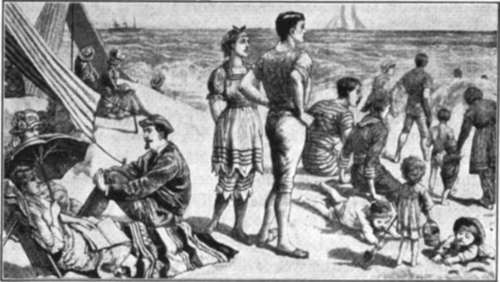
Surf bathing was a popular sport in the 1880's. Today we wonder how bathers managed to swim in their elaborate costumes.
There were some gay times, however. After supper the girl usually found time to play with her homemade dolls. On Sundays she went to church, and once a month or so the villagers would get together for a dance. Then she would put on her best and most colorful clothes to learn the steps. The men sang and drank wine; the women danced and talked. Sometimes traveling entertainers and their marionettes dancing on a string would make these village crowds laugh. But these times were far too few to suit the girl with pigtails. She liked to laugh and sing and dance. But her father had warned her that there was much work to be done in every season of the year. There was little time for play and recreation, and, besides, too much fun was thought to be wicked.
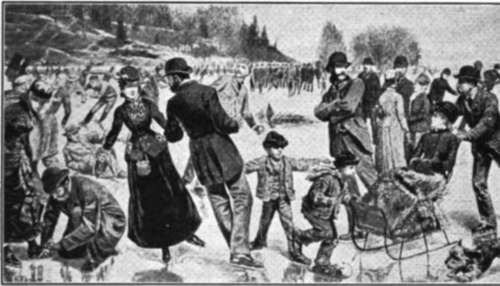
In the winter skating was popular in the North. This was before the invention of the automobile, radio, and movies.
Such was the life of the peasant in the year 1400. Down through the ages men and women have struggled and prayed for the time when too long hours of work would no longer be necessary. For thousands of years they have longed for leisure. Most people have had to look with envy upon those who were fortunate enough to have leisure hours on a weekday. Until recent years, only a handful of individuals have been lucky enough to have a reasonable amount of leisure in combination with their work. In other words, only a small amount of the population has had time for enjoyable activities. For the great mass of the people it has been a case of working ten, twelve, or more hours a day in order to create enough food, shelter, and clothing to go around.
About two hundred years ago mechanical slaves were invented, when James Watt made a steam engine which could drive machinery. Then a man merely had to tend the machine and watch the wheels go around, and the cloth came out in rolls. More machinery helped cut the cloth and sew it into clothing. Yet human slavery persisted for more than a hundred years after the introduction of the steam engine. For generations after James Watt's discovery neither happiness nor leisure came to the majority of the people. To be sure, they stood and watched the wheels go around instead of weaving the cloth by hand; but unfortunately they stood from daylight until dark. When they got home to their houses, they had little strength left even if they had had time for enjoyment.
We have this description of the conditions in a town in 1835, where thousands of mechanical slaves were being used: The children were scarcely "allowed time to take their scanty meals. They retire to their beds at night worn down and exhausted with excessive labor; hence, they are deprived of any privilege except working, eating, and sleeping. Is it to be wondered at that our country has become the great theater of mobs, yea, we may say murderers, when we remember that the poor and their children are kept in ignorance and regarded as but little superior to the beasts that perish?"
Continue to:


My Books

