


Our Solar Family. Continued
Description
This section is from the book "Time Out for Living", by Ernest DeAlton Partridge and Catherine Mooney. Also available from Amazon: Time Out for Living.
Our Solar Family. Continued
Venus presents phases, as our moon does, since its orbit is inside that of the earth. Venus is so far off that when it is projected against the sun it appears to be about the size of a small circular sun spot. When Venus moves to one side of the sun, we begin to see more and more of the illuminated surface. In this photograph Venus is seen as a crescent.

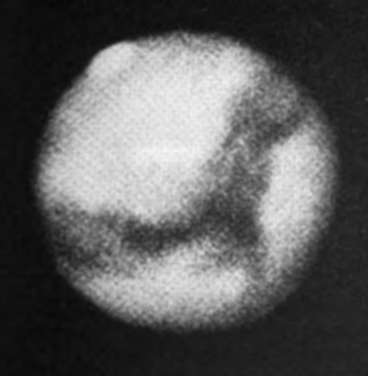
Mars does not take a good photograph. The fine details of this planet arc best shown by means of drawings. When a large telescope magnifies the image of Mars, it also magnifies all the heat waves in the air. To get rid of this tumultuous atmosphere, telescopes are placed on high mountains. Even then observers must wait for quiet moments, when the image is distinct.

Neptune is so far from the sun that its surface must be both dark and cold. It is thirty times farther from the great central campfire of the solar system than wc are. We know so little about Neptune that wc cannot say that the planet is cold merely because the sun appears about as bright as Venus or Jupiter does to us. It may have a very hot interior about which we know almost nothing. Neptune has one satellite, which is nearly the same size as our moon. The planet is about 35,000 miles in diameter - more than four times the diameter of the earth.
Jupiter
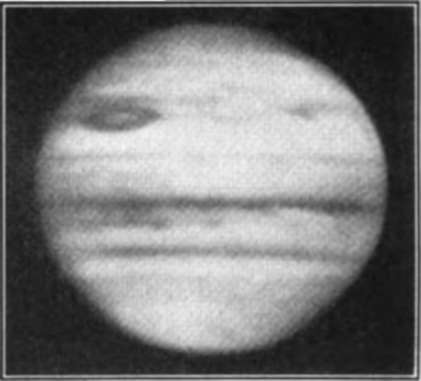
As with Saturn, a photograph of a drawing is shown here instead of a photograph of the planet. This drawing was made at the Yerkes Observatory by E. E. Barnard, who was famous for the accuracy of his observations. We are looking down upon an atmosphere of clouds. The bands which are parallel with Jupiter's equator may be something like our trade winds. We know very little about what is underneath this layer of clouds.

Uranus requires 84 years to make one trip around the sun. It is probably a cold and dark trip. We are sufficiently warm at our distance from the sun, but Uranus is nineteen times farther from our source of heat. If in the autumn you are comfortably warm 10 feet from a campfire, you certainly would be cold at a distance of 190 feet, or nineteen times as far off. The planet was discovered by Sir William Herschel in 1781.

Saturn, one of the most beautiful objects in the sky. We are looking down upon clouds, and so far as we know no one has ever seen the body of Saturn. It is farthest from the sun of those planets known to the Babylonians, Greeks, and Romans. This photograph of a drawing is by the astronomer E. E. Barnard, who used the great 40-inch refracting telescope of the Yerkes Observatory.
Beyond Jupiter lies Saturn, another large planet. The reflected sunlight from Jupiter is slightly yellow, but the reflected light from Saturn is white. Again we must plead ignorance concerning this planet. Saturn has one feature which is different from all other planets about which we know. It is surrounded by several broad but very thin rings. They look almost like paper rings around a white marble. Because of these rings some people think Saturn is one of the most beautiful objects in the sky. They are not solid rock, as astronomers once thought they were, but consist of a multitude of minute rock particles so close together that at our great distance, nearly 900 million miles, they look like thin sheets of white translucent marble.
Beyond Saturn we come, in order of distance, to Uranus, Neptune, and Pluto. This brings us to the very frontier of the solar system - as the sun and planets are called - about three billion miles from the sun. At this great distance our source of light and heat looks like a mere star.
Because we have been busy escaping from the terrible heat of the sun by jumping from planet to planet, we have neglected to mention the round ball which, next to the sun, is our most important neighbor. It is the moon, which, as wc all know, revolves around the earth with such speed that there are 29 days and about 12 hours between successive full moons. If the planets were countries, we would say that the moon is within our "sphere of influence." It is about 2,000 miles in diameter, and its distance from the earth is more than a quarter of a million miles.
New Moon
When the moon is exactly between us and the sun, obviously the dark side is turned toward us. Therefore the moon is invisible, unless it is faintly illuminated by the sunlight reflected from the earth. When the moon moves to one side a trifle, we can see just a bit of the illuminated surface. We call this the new moon. When the dark side of the moon is slightly illuminated by the light from the earth, we say: "The old moon is in the new moon's arms." The moon in this photograph is 3 4/5 days old.

Half Moon. The farther the moon gets from just between us and the sun, the more of the illuminated side can be seen. When the moon has gone just a quarter of the way around the earth, the disk is one half illuminated. We say it is " half moon." The border between daylight and darkness is then a straight line. In this photograph the moon is 7 days old. The photograph was taken with the 40-inch refracting telescope.

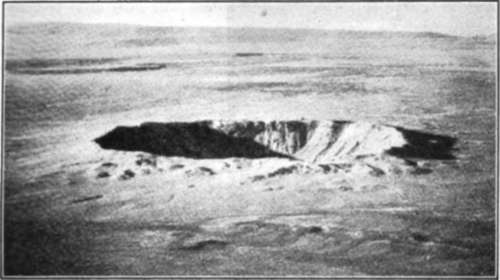
A Meteor, when it strikes the earth, can make a dent. When the earth was young perhaps some very big meteors were embedded in the rock of our continents. Some of the craters in the moon may be meteor craters.
The moon is so near that with a telescope you can see mountains, valleys, plains, and even cracks in the ground. In reality, of course, the cracks are probably huge chasms, but even in powerful telescopes they are merely irregular dark lines.
The most curious feature about the moon is that there are hundreds of mountains which look exactly like volcanoes. It may be that some of these craters are dents which were made when enormous shooting stars fell upon the moon. Shooting stars are usually called meteors. It is thought by some that a very long time ago, when the earth and the moon were both young, hundreds of big meteors fell upon both of them. A large body of rock or iron will splash up the ground as a stone will when it is thrown into soft mud. These meteors might make many craters on the moon, which at our distance of a quarter of a million miles would look like volcanoes.
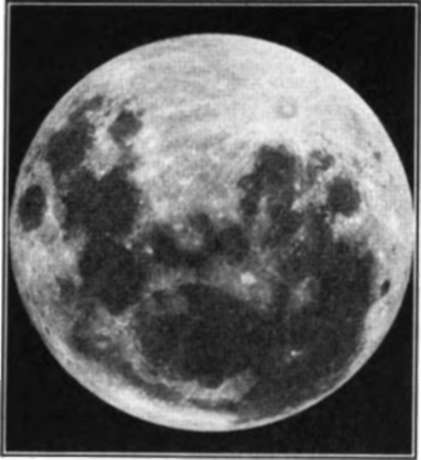
Full Moon
When the earth is directly between the moon and the sun, we see only the illuminated side of the moon. The level lands or plains on the moon then appear as slightly dark spots, which make our familiar Man in the Moon. This photograph was taken when the moon was 15 1/2 days old. The 40-inch refracting telescope was used.
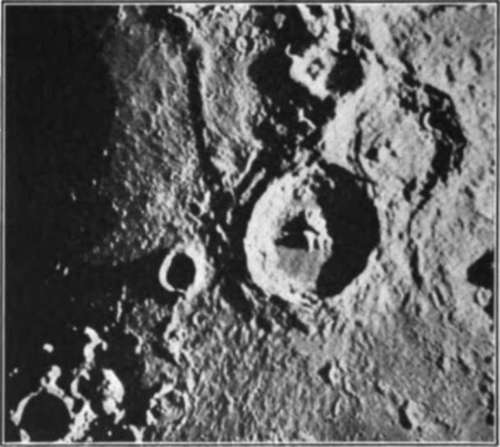
A Part of the Moon's Surface. Here we have a variety of craters, mountain chains, and plains. The double crater near the middle of the left edge of the moon has been named Theophilus. Thiscrater is 64 miles in diameter and itscir-cular walls rise to a height of 16,000 feet above the plain. The shadows cast by these mountains arc plainly seen on the lunar surface. By measuring the length of the shadow, astronomers can compute the height of the mountain. This photograph was taken by the new 82-inch telescope of the MacDonald Observatory.
It may have been several thousand years ago that a large meteor fell into what is now Arizona. The crater is still there. It is about three quarters of a mile in diameter and several hundred feet deep. The meteor that made this hole was made of iron, for thousands of pieces of that metal have been picked up in the neighborhood.
Another peculiar thing about the moon is that it has no air - no atmosphere. Consequently if a meteor throws some rocks up so that they form a ridge, there is no rain, or snow, or even wind to wear them away. A crater once made on the moon becomes a permanent feature. On the earth, heat, cold, wind, and water will wear away even our largest mountains. There have no doubt been many meteor craters on the earth which have entirely disappeared.
Continue to:


My Books

