


Babylonians And Chinese
Description
This section is from the book "Time Out for Living", by Ernest DeAlton Partridge and Catherine Mooney. Also available from Amazon: Time Out for Living.
Babylonians And Chinese
For complicated forms of writing we give the laurel to the Babylonians and the Chinese. The former called their effort cuneiform writing and it came into vogue about 3000 b.c.
For everyday information, these wedge-shaped letters were made usually in the soft clay of tablets made from the mud of the fertile Crescent, the land near the Tigris and Euphrates rivers. These tablets were dried in the hot sun of the desert. For more permanent records, the writing was carved carefully in stone. Perhaps the best examples are to be found on many of the statues of the winged bulls and other pieces of Assyrian art found in our museums today. The greatest treasure of all is the Behistun Rock of Persia, on which Darius I had his great inscription engraved in three kinds of cuneiform writing, five hundred feet above the level of the land on the ancient road to Babylon. It was discovered by Sir Henry Rawlinson in 1835, and within a year that remarkable young English officer had solved the riddle of its message long forgotten by the scribes and historians.
The most complicated form of writing that we still have with us is the Chinese, and even yet it remains a mystery to most of us in the Western World. When we hear that a diligent Chinese student with a keen mind can by careful study master its forty thousand or more signs by the age of twenty-five and when we contrast that with the fact that our average chi d of ten or less has mastered all our twenty-six symbols, you can see what the Chinese reader is up against. If you wish to express the idea of "man" in Chinese, there are about six hundred combinations that all denote something relating to him. If it is "tree" you are concerned about, you had better review the nine hundred symbols there are depending on the kind, wood, use, etc. Just imagine that! You see why only the Chinese with property and with considerable leisure can ever learn to read. No wonder that students are so well thought of in China! No wonder

Cuneiform Writing was made in soft clay with a wedge-shaped instrument called a cuneus. The baked-clay memorial tablet shown here is now in the British Museum in London.
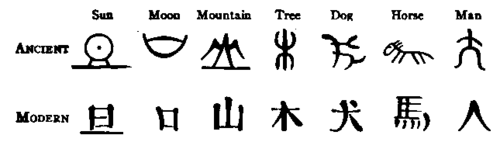
Chinese Writing.
China has been a silent, peace-loving country with its thousands of students writing noiselessly on reams and reams of rice paper with millions of little, brushes - overlooked by the noisy West for ages.
Continue to:


My Books

