


Phoenicians
Description
This section is from the book "Time Out for Living", by Ernest DeAlton Partridge and Catherine Mooney. Also available from Amazon: Time Out for Living.
Phoenicians
Now, in this maze of experiments with expression, there arose along the busy eastern shore of the Mediterranean a commercial nation with a bent for sailing. Sailors from Phoenicia roamed along the shores and among the islands of the blue Mediterranean Sea and soon built up a thriving business of barter. Business calls for records - orders to be filled, amounts of money due, names of new and old customers, preferences, references, even guarantees - and these seafaring men soon found that sailors' knots and picture language were not suitable for records of sales and purchases. So they devised an alphabet composed of symbols which stood for certain sounds meaningless in themselves. We use these same symbols in a modified form, for our alphabet was developed from the Phoenician.
These Phoenicians could sail into any port from Tyre to Memphis, from Carthage to Byzantium. No matter what the language, the idea could be conveyed in writing by moving those twenty or more letters about to suit the sounds of the language. And it grew most intriguing to be smart enough to write and be able to read what had been written. Minstrels and bards continued to give news and entertainment for the next two thousand years. The invention of the alphabet made scribes more numerous and their records more important.
It probably took centuries to devise the Phoenician alphabet. The Phoenicians undoubtedly were very much assisted by the work of their predecessors and also of their contemporaries. The greatest contribution which they made to civilization was teaching the Greeks and Romans how to use an alphabet. Later the Romans introduced the Phoenician alphabet to western Europe. Then it became known as the Roman alphabet and, as you know, is now used in nearly all parts of the world.
We get our name alphabet from the Greeks, who called the first two Phoenician letters alpha, beta.
You would think that everyone would have started almost immediately to learn to write. Writing was so new and fascinating! On the contrary, the ability to read and write spread through the world very slowly. It is not easy to learn to read and write even in our wonderful modern schools. It took most of us several years to learn to read. Unfortunately, it takes even longer to learn to write correct English.
There were other reasons why only a small percentage of each community could use the alphabet. In ancient Athens and Rome, only fairly wealthy parents could afford to send their children to school. One reason why schooling was expensive was that books were very costly. They were all written in longhand, as we would say nowadays. If a school hired someone to copy a book in longhand today, it might easily cost a hundred dollars.
Notwithstanding the lack of free public schools, some wonderful books and songs were written by the Babylonians, Hebrews, Egyptians, Greeks, and Romans. Among the few who could write many were geniuses. The psalms of the Egyptians and the

The Development of Our Alphabet from picture-writing to symbols. The first column shows Egyptian hieroglyphics; the second, hieratics; the third, Phoenician letters; the fourth, Greek; and the last, Latin letters of the alphabet.
Hebrews and the poetry of Homer and Virgil are merely a few of the ancient writings which have become classics.
The most famous of these classics was a manuscript that was written by the Jews. In this they wrote down their religion, civil and religious laws, health precepts, customs, psalms of praise, and biographies. In the main, it is a brief history of their wars and migrations. This manuscript was the Old Testament of the Bible.
The name Bible has had a curious history. When the Greeks learned to read and write, they naturally needed paper. The Phoenicians, who gave the Greeks the alphabet, also sold them the necessary paper. A modern salesman would say that the Phoenicians gave the Greeks the alphabet in order to create a demand for paper. The paper, of course, was papyrus, which came from Egypt; but the Phoenician port from which it was shipped to Greece was named Byblos. So the Greeks called papyrus biblos. When they wrote about the siege of Troy on a long roll of this papyrus, they called the roll biblos, also. Therefore biblos came to be the name of any book. Later the Jewish records became so very important that they were called "The Bible" or "The Book."
After the fall of Rome (476 a.d.) there was little scholastic learning in Europe. Fortunately for us, the Arabs became the leaders in intellectual life. They gathered manuscripts from all the countries that used to be in the old Roman Empire. They translated these books into Arabic. Later the books were translated into Latin. The introduction of Arabic translations of the classics from Spain, where some of the Saracens lived, and from Africa and Asia, helped the revival of learning in Italy and finally in all Europe.
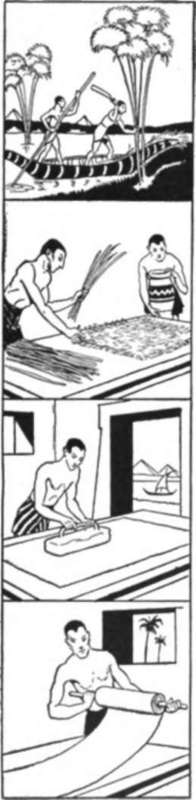
After the papyrus stalks were cut they were laid in crosswise strips, soaked, hammered, pressed, and dried. Then the papyrus was rolled on a stick.
In the meantime, after the fall of Rome, monasteries were established in nearly all parts of Europe. The monks made many copies of the famous Greek and Roman books. In many cases these copies were adorned with paintings and elaborate and beautiful designs. Although there was a great deal of fighting during the time between the fall of Rome and the revival of learning, the monasteries were seldom destroyed. So the monks together with the Arabs preserved for us the intellectual treasures of the Greeks and Romans.
During the Middle Ages, a higher standard of living and a greater volume and variety of commerce made it necessary for an ever larger number of people to know how to read and write. We have already learned that the Phoenicians learned to read and write for much the same reason. Ever since this revival of learning, the people of Europe and the distant lands settled by Europeans have taken an increasingly keen interest in writing. Now we are shocked if even a small percentage of the population of a country cannot read and write.
With the revival of learning and with the increasingly large number of people who knew how to read and write, correspondence increased and entertaining letters were written. The ancient Greek and Latin works were read and enjoyed. Monuments were erected and inscribed. Records of men and their deeds were made. When Marco Polo returned from China after his many eventful years, his deeds were all deemed worthy of repeating and jotting down for future generations. Some historians say that little boys like the young Columbus learned to read and absorbed stories that set their hearts aflutter with worthy deeds and dreams of brilliant adventures.
As you can see, one of the inventions most important to modern civilization was the printing press. Johann Gutenberg is usually credited with introducing printing with movable type in Germany about 1454 a.d. Actually, the Chinese were the first to print. In 868 a.d., a book was printed in the Province of Kansu. In 1041 printing was done with movable type in China, but the Chinese had so many different characters in their system of writing that printing was not practical. In Europe, the great epics of the West and the East vied with each other for the favor of those readers of the printed page who were fortunate enough to see a few books in their lifetime. With writing and printing, civilization became a possibility. Progress of man was assured. The past became as real as the present. The pen became mightier than the sword!
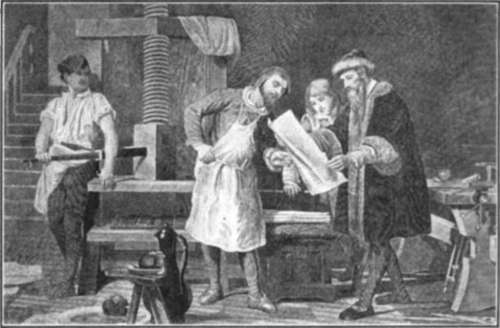
Gutenberg is credited with being the first European to print from movable type.
Why Not Write? But now that men have the tools - an easy alphabet, plenty of pens, ink, pencils, lead, erasers, typewriters, wastepaper baskets, schools to teach cursive and manuscript writing, eradicators, a hundred varieties of paper, and great imaginations with all sorts of fine stimulation on all sides - they still seem to take a long time to get started. Even those who complain that they have so much time they don't know what to do with it, because they haven't the money for movies, travel, magazines, or crafts, never seem to think of taking a pen in hand and trying their luck at the cheapest and most fascinating game of life, writing!
And why not? Everyone has to ask himself that question. If it isn't lack of tools, of imagination, of time, then what is it? Perhaps the first thing we should do is to ask ourselves our own truthful opinion. Why don't we ever jot down the creative urges our fanciful minds have manufactured to date? Why do our minds seem to go blank and our thoughts cease to flow when we sit down with a pencil in hand?
We have no doubt been the slaves of propaganda. Someone has said, or we have worked it out for ourselves, that there are too many people writing already. The field is flooded. Witness the newsstands and libraries filled daily, weekly, monthly, yearly, with more and more contributions to the field of letters. We can picture quite clearly the amount of printed matter that comes into our lives in a brief span. All this is quite true, but who said that you have to be a real author? You may only want to amuse yourself, and in the field of amusement there is always room for one more. In fact, the more, the merrier!
Some have the feeling that they can never do as well as the great writers, and if they can't do as well, they don't want to write at all. Now, these very same people cannot dance with the grace and agility of Fred Astaire, yet they seem to have a grand time at the local hops. They cannot sing like Lawrence Tibbett, yet they will raise their voices in a hearty, rollicking song. They cannot swim like a fish, yet they will dive into the briny deep and frolic about in a merry way. It is high time to realize that life is like that. As long as you are doing your best and getting a thrill out of it, what more do you want? Aren't you glad that your favorite storytellers, playwrights, poets, and reporters didn't have the idea that there were too many great writers in their day or before their time? You would never have had the pleasure of their creations. And then there is this to remember: your happiness may in some cases be as great as that of the recognized genius.
Continue to:


My Books

