


Part 15. All Roads Lead To Roaming. Chapter Thirty-Three. The Auto Is With Us
Description
This section is from the book "Time Out for Living", by Ernest DeAlton Partridge and Catherine Mooney. Also available from Amazon: Time Out for Living.
Part 15. All Roads Lead To Roaming. Chapter Thirty-Three. The Auto Is With Us
Three hundred years! That's a short period of time when you think about the whole long history of man, yet if you contrast life in America today with that of 1620 in old Plymouth there is an amazing difference. A vast wilderness lay before the eyes of the brave Pilgrim Fathers, alone in a strange, untamed new world. Today we have a thriving, bustling nation of about 135,000,000 people. The most amazing thing about this nation, however, is not the number of persons, or how they have spread across the continent, but rather the unusual progress they have made in conquering nature.
Today the North American continent is woven together with a great network of hard-surfaced highways. In the United States alone we have more than 3,250,000 miles of roadways over which automobiles may travel. They lead from city to city, across rural farmlands, around mountain peaks, and in and out of sandy deserts and shady forests. There is hardly any part of the continent that cannot be enjoyed by a person who chooses "to go places" and see things at first hand via the modern automobile.
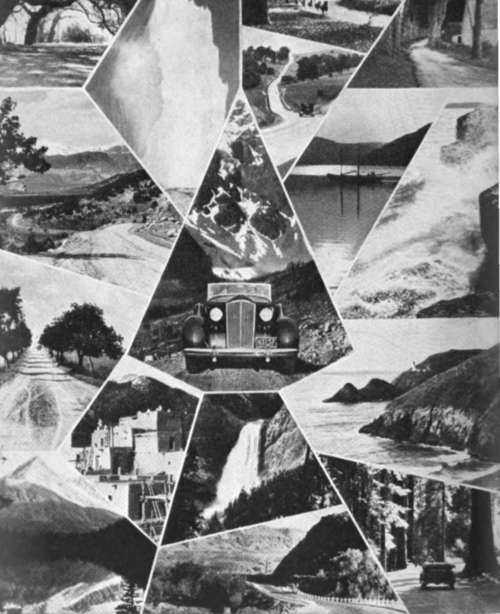
The Roads of America Lead Everywhere!
Travel With Difficulty
In ancient times roads were made largely for war and trade. As early as 55 b.c. we find the Romans planning a great road-building project for Britain and northern Europe. Hundreds of years before that time, the famous Royal Road of Asia Minor had been worn smooth by the feet of runners and horses in the hope of holding a great empire together.
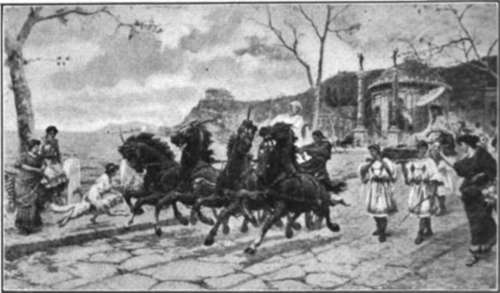
The Romans were the great road builders of ancient times. Their highways were well constructed and extensively used.
Who traveled in colonial times in this country? Mostly men on business trips or peddlers with handmade goods to deliver. Certainly the narrow, treacherous strips of dirt that connected the main seaports were far from inviting, filled as they were with rocks, ruts, and impassable places. You can imagine how George Washington or Benjamin Franklin must have been bounced up and down in a wooden stagecoach or carriage without rubber tires and with poor springs. Probably one of the best roads of the time was the Boston Post Road, built before the Revolutionary War. It extended from Boston to New York - a distance of about 250 miles. That they could travel it in two weeks' time was the startling boast of the mail carriers who rode the route! Many of our modern roads follow the trails blazed by these early colonial adventurers as well as those of the red man.
The Horseless Carriage
Even as late as the early part of the twentieth century most of the roads in America were dirt or gravel. At that time there were some 8,000 automobiles in our entire country. These puffing and snorting machines were looked upon as a fad soon to die out and were viewed with curiosity and contempt by the general public.
"No, sir!" you might have heard one of the village philosophers say. "Those contraptions are just a toy. No sensible man would ever think of buying a horseless carriage! They scare the horses off the road, stir up a terrible dust, and smell like a drug factory. Another few years and they will all be gone. They're not practical !"
You and I know that these predictions were wrong. Still, if we had followed the owner of an early car on a short trip we would have thought that the automobile was more trouble than it was worth. While the roads had been widened considerably since horse-and-buggy days, they were still in a deplorable condition for any motorist with his wheezing vehicle. Deep wagon tracks in the road made it very difficult to steer a car, and in some cases it was almost impossible to move when the ruts were so deep that the wheels of the car could not hold the axle above the center of the road.
When it rained, the safest thing for the motorist to do was to find a shelter and wait until the sun had dried the road. Roads became streams of mud and there was no driving on them unless one could lay short boards over the mud holes. If this method failed, you "hired a horse" or two, to pull you out of your difficulty.
In those days a trip from Detroit, Michigan, to Flint, a distance of 60 miles, could be made in one day of hard driving if you were lucky, did not have too many blowouts, and the weather remained favorable. Today the trip can be made in an hour and forty minutes of safe driving.
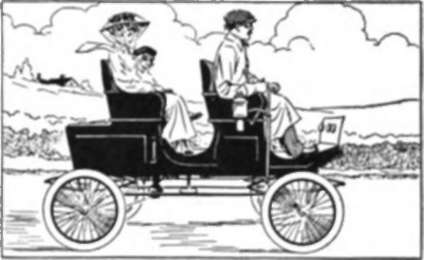
Early automobiles look comical nowadays, but in their time they were a marvel of man's genius.
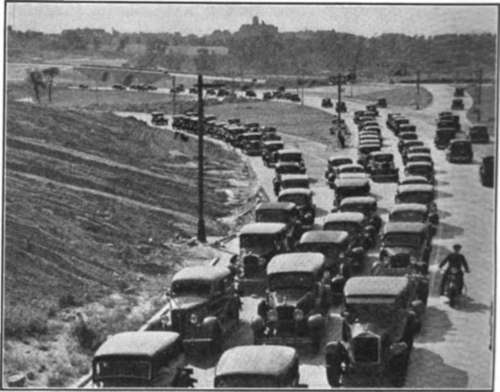
Modern Roads are built to stand heavy traffic. Highways leading into and out of large cities must be planned in such a way that they will carry thousands of automobiles safely every day.
Just turn these figures over in your mind a moment or so and see if you are not a little surprised to find that in 1904 there were 150,000 miles of roads, 141 miles of which were dustless, while today, about forty years later, there are some 3,250,000 miles of improved roads in the United States.
By 1906 there were 100,000 cars in the United States, yet they were still noisy and generally disliked. As more and more interest grew in their use, the manufacturers, in order to increase sales, began to note the points about a car that made it attractive. Constantly the type of car was improved and the price continually became more and more reasonable until by 1916 there were two million proud automobile owners. By this time it became quite evident that the automobile was here to stay, and the various states as well as the Federal government began to build concrete roads for the motor age. The result is the splendid system of hard-surfaced roads we ride over today. More than thirty million cars and trucks travel over them. The age of the automobile is here.
Continue to:


My Books

