


Photographing Birds
Description
This section is from the book "Time Out for Living", by Ernest DeAlton Partridge and Catherine Mooney. Also available from Amazon: Time Out for Living.
Photographing Birds
A new angle of bird lore has developed in the last few years for those who like to follow the careers and antics of their feathered friends. Small cameras and extra- sensitive film now make it possible to take pictures of birds in dark places. Hunting for good bird pictures with the camera is great sport and often demands patience and skill.
There are several kinds of photographs that can be taken of bird life. One is a picture of a nest and young birds in various stages of development. In taking pictures of this kind, the photographer must be very careful not to disturb the birds or in any way change the nest and its surroundings. Under no circumstances should young birds be handled, since handling may injure them and is likely to make the family desert its home. Small branches that cover the nest should not be broken off because their removal may expose the nest to the enemies of the birds. When it is necessary to move branches slightly, tie them back with a piece of string and then release them after the picture is taken.
Another kind of picture is of the grown birds in their natural surroundings. Such pictures take skill and patience. The hunter often needs to remain concealed for hours at a time in order to catch an unsuspecting bird with his camera. By building a small "blind," such as big game hunters use to conceal them from the animals they hunt, it is possible to lie in wait for a bird to come near. A small piece of canvas large enough to cover a person is usually sufficient for concealment. No flapping ends should be left to frighten the birds. A pup tent is good because it has a neutral color and will not disturb the birds. By covering such a piece of canvas with leaves and grass and leaving a large enough hole for the camera to come through when it is time for the shot, it is possible to settle in a comfortable position and wait for the birds. When birds are near, it is important to remain absolutely quiet. The slightest movement is enough to frighten a bird away.
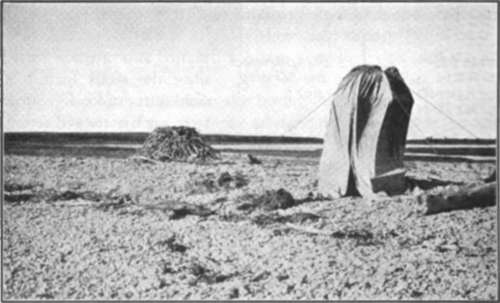
Photographing a Fish Hawk's Nest from a Canvas Blind. The scene is an island in Long Island Sound.
Another way to get good pictures of birds is to rig up an attachment to your camera so that you can release the shutter by pulling a string. By setting up the camera facing a feeding station or some limb where you have often seen birds or even a nest of young birds, you can wait at a safe distance to pull the string when the bird comes into the field of your camera.
In Conclusion
One of the most interesting things about having bird friends is a count of your dividends. These dividends are not always the kind that can be seen immediately, but they are paid in installments that make this world a better place in which to live. With the aid of his great army of birds, man can conquer the hosts of insects that sweep the country every year.
Today we know the value of birds and we are not likely to make the mistake our colonial forefathers did when they offered rewards for the heads of certain birds and fixed fines upon the farmer who did not kill the number demanded of him each year. For two centuries these laws were the cause of a terrific slaughter of birds.
Some people who do not know much about birds will tell you that some species, such as hawks, should be killed because of the harm they do. Those who have studied the feeding habits of birds tell us that, with the possible exception of the common English sparrow, every bird pays time and again for the little grain or few cherries he occasionally eats.
When you hear the song of the bobwhite you can rest assured that the steam for his whistle is coming from nearly 145 different kinds of insects. The meadow lark, which some people unfortunately kill for the small amount of food it furnishes them, keeps fat on grasshoppers and weed seeds. It is estimated that in the state of Iowa alone the tree sparrows eat 875 tons of weed seed each year. Certainly tree sparrows are a great boon to the farmers of that state.
If more people become interested in birds, it will be possible to educate the public in the value of birds and to preserve bird life. Some day, no doubt, the friends of birds will succeed in having laws passed to protect them. Laws are not nearly so important, however, as education about birds. It is far better to teach everyone the value of birds and how to enjoy their companionship. Can we count on you to spread the news that our feathered friends are fine friends and that we should be good neighbors?
Some Interesting Things To Do
1. Make a list of the states and countries a bobolink visits on his flight north.
2. Make a map for your scrapbook showing the travels of a bobolink.
3. Make a collection of snapshots of birds' nests. See how many different kinds you can find and snap with your camera. Be careful not to disturb the birds when you take their pictures.
4. Draw up a lease that might be used to describe the agreement between a bird family and the owner of a birdhouse. List all of the things the bird is expected to do to "pay" for the use of the house.
5. Try taking some pictures of wild birds. Get as close to them as you can, or construct a device like that shown on page 554, to snap a picture of a bird at the nest.
6. Write a brief statement for your scrapbook outlining the points in favor of bird lore as a hobby.
7. Write an article for your school paper on Bird Lore As a Hobby, Bobolink - World Traveler, Birds Need Brothers, or Fine Feathers Make for Friends.
8. Build a birdhouse or feeding station and set it out near your house. Watch it to see what kinds of birds it attracts. Report periodically as to what birds are using it.
9. Make a graph of bird "speeds" or bird paths of flight.
10. You can tell birds by their habits on the wing, according to the rhythmic pattern they make in the sky. Trace some of the patterns, or make up games that illustrate the hopping of a robin, the walk of a crow, the waddle of a duck - and try them out in pantomime or dance.
11. You have probably heard the song that asks you to "sing like the birdies sing." Imitating calls of the birds you observe will give you many hours of pleasure. Try your luck.
12. Find out if Argentina and Chile have the same kinds of birds as we have. Your librarian and the encyclopaedia will help you.
13. Find a map of South America and decide why the birds of North America do not fly farther south than they do, say at least to Tierra del Fuego.
14. What birds raise families in South America?
15. From the story on pages 543-545 estimate the average speed of a bird's flight from Brazil to New England.
16. Find or sketch a map of North America and South America. In blue trace the northward flight of the bobolink. Print the name of each month at the place where the bird is during that month.
17. What would you put on a birds' "free lunch counter"?
18. Make up a believe-it-or-not story about birds, such as Cowbirds Use Other Birds' Homes.
19. Look over some of the bird books mentioned, and list Birds I Would Like to See under Name, Country, Reason.
Helpful References
Allen, A. A., The Book of Bird Life. Byers, E. F., Out of Doors with Birds. Chapman, F. M., The Travels of the Birds.
Daglish, E. F., How to See Birds. Dayton, E., Adventures of a Bird Watcher. Dixon, R., Human Side of Birds. Gilbert and Brook, Walchings and Wanderings among Birds. Halle, L. J., Birds against Men. Job, H. K., How to Study Birds. Miller, O. T., In Nesting Time. Morris, M. N., Stay-at-Home Birds and Their Traveling Friends.
Nicholson, E. M., The Art of Bird-Watching.
Peterson, R. T., Song-Bird Sanctuaries. Roberts, T. S., Bird Portraits in Color. Siepert, A. F., Bird Houses Boys Can Build.
U. S. Dept. of Agriculture, Supt. of Documents, Farmers' Bulletins No. 621, 760, 844, 912. U. S. Dept. of Agriculture, Dr. F. C. Lincoln, Migration of North American Birds.
Williamson, K., The Skyys Their Highway.
Wright, M. O., Birdcraft.
Continue to:


My Books

