


The Auto Is With Us. Continued
Description
This section is from the book "Time Out for Living", by Ernest DeAlton Partridge and Catherine Mooney. Also available from Amazon: Time Out for Living.
The Auto Is With Us. Continued
Naturally, this tremendous growth in the number of automobiles has changed life greatly. Hundreds of new occupations have suddenly sprung up to cater to our needs. Families ride many miles from home to seek fun and amusement in the new leisure time afforded to all. The national parks have opened their gates to thousands upon thousands of touring citizens, who roll along in the greatest comfort in modern motor cars designed to be beautiful, safe, and sturdy. A new world of wonders lies ahead, beckoning the average man, woman, and child to come and explore for themselves the treasure trove called America. The gasoline buggy has completely changed the whole of modern life.
A Good Thing? We still have our "village philosophers" who have a few words to say against the contraption, perfect as it seems in this day and age. They are quick to point out that all the changes that the automobile has brought are not desirable. They say that many of the results are tragic and gruesome. It may get us where we want to go quickly, but it has brought new menaces to our civilization in return for the favor.
"Unless man can control this new plaything it will lead to serious consequences. The new automobiles are beautiful and powerful but they also call for skillful handling. Like any powerful instrument, the automobile must be controlled properly at all times," comes the voice over the radio.
"Our death toll resulting from automobiles alone is greater than the wars in which this nation has engaged since its birth! The United States has engaged in six major conflicts since 1776. When added together, the total length of time that the country has been at war equals fifteen years. During this time 244,357 men lost their lives in battle or from wounds received in batde. Compare this with the toll of death from the automobile. During the last fifteen years of peace more than 450,000 persons have been killed in automobile accidents. Twice as many, my friends! Is it any wonder that thoughtful citizens feel something must be done to train the American people to use the automobile properly?" exhorts the principal speaker at the main civic banquet of the year.
Should we look at the dark side of the picture? If we ever expect to own a car, or to drive one, we had better examine the picture closely. Statistics prove the following facts:
In an average year, approximately 32,600 persons are killed in automobile accidents in the United States. About 1,150,000 persons are injured in automobile accidents yearly. Of this number more than 100,000 are permanently injured or crippled.
Even these facts do not show all of the dark side of the picture. Young drivers - and by young drivers we mean drivers under twenty years of age - have by far the highest automobile accident rate. About thirty-nine out of every thousand licensed drivers in this age group have an automobile accident in the course of a single year - twice as many accidents as have the licensed drivers between the ages of forty and forty-nine. Why?
Young People At The Wheel
Driving a car is a serious business. Learning to shift the gears and to put on the brakes is the least of the process. Every moment that the car is in motion new problems are arising that need calm, intelligent solutions hastily and correctly made. Is youth at the wheel equal to the challenge? Believe it or not, experience has shown that young people as a rule do not seem to have the judgment necessary for the task of dealing with the complicated problems that seem to pop up constantly on the modern thoroughfare. But some young people have the judgment required and may be far superior to some adults who are permitted to drive. How can this group of dependables be separated from the rest without letting down the bars completely?
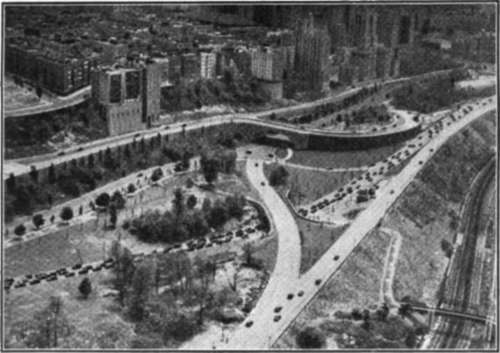
Modern Road Construction is a science of planning and building. By underpasses and overpasses traffic can be kept on the move and accidents reduced.
Most Of Us Enjoy Speed
We get a certain kick out of whisking away through the balmy air at a breath-taking pace. To take a plane and soar high above the clouds, to ride merrily up and down in the cushioned elevators of our highest skyscrapers, to tear across the waves in our speedboats is a whale of a lot of fun and quite a safe venture. Yet a car hurtling along at fifty miles an hour is a menace to everybody and everything in sight.
Even if the driver is the safest sort of soul, if he should for one moment lose control of the car, he may be responsible for the serious injury and death of several people, including himself. Anyone in the science class can tell you that if a car going sixty miles an hour strikes anything, it hits it with the same force that it would hit it if it were dropped from a twelve-story building.
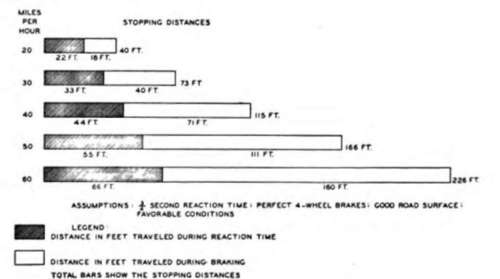
According to the latest tests, four-wheel brakes will stop a car that is going 20 miles an hour in 40 feet, but it takes 226 feet to stop one making 60 miles an hour. This diagram shows the facts:
You have all seen a car recklessly dash around a corner. If you have been near enough to the spot to wonder what would happen next, you may have realized then and there that the most unreliable "nut" in the whole car was in the driver's place. No car to date has been made to bend a bit when rounding a corner, and yet many drivers handle their cars as if the cars were double-jointed.
A Monkey At The Wheel
The most important thing in a car is the driver. Three fourths of the accidents are the fault of the driver rather than of the car. In the circus or on the stage it may be quite an amusing stunt to see an act with a monkey at the wheel. There the act can be fully controlled; but on the highway, intelligence, foresight, adaptability, and resourcefulness are needed because something new is happening every minute. The time of day, the weather, other drivers, your own state of mind, and the mechanical condition of your car have to be considered. It is only after a period of good training under a competent person and a wealth of experience to top it off that a new driver can acquire the skill to meet these emergencies. There are ways of gaining this skill without endangering the lives of other mortals. Driving is a privilege, not a right. It should be granted only to those who arc fit to drive. For this reason most of the states have laws that require the renewal of licenses and careful examinations before a license is granted at all. Yes, there is much to be done about this business of driving, especially now that we as a nation have taken to the road in such large numbers. A set of uniform traffic laws throughout the country may one day be a possibility, so that none of us will be getting our signals mixed when en route for fun and frolic.
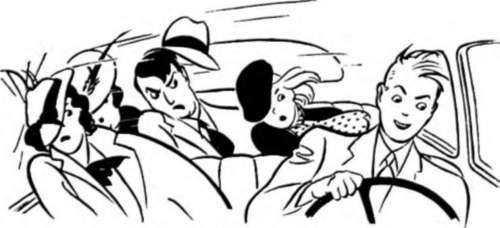
A Monkey at the Wheel.
Good eyesight, good hearing, co-ordination of the muscles and the mind, good driving habits, and courtesy are all necessary for the proper use of a car. How about keeping all these points in mind and helping to do something about it? That's a good civic project for you!
The Bright Side
We have purposely painted the dark side of the picture, in some detail, because it is important that every young person growing to maturity in this country should understand motoring facts and be prepared to do something about them. There is a bright side of the picture, too. That side paints the joys of motoring and explains the way in which young people can fit into the family car with the greatest benefit to themselves and to the adults who are required by law to be responsible. You will find that if you go about it sensibly, there are scores of experiences to be had in connection with the family car that will train you to be the skillful driver who is likely to come home alive from each trip. Furthermore, you can help the family tremendously in planning and executing their trips.
Some Interesting Things To Do
1. How many different kinds of vehicles seen on our highways can you list in five minutes' time? Try it!
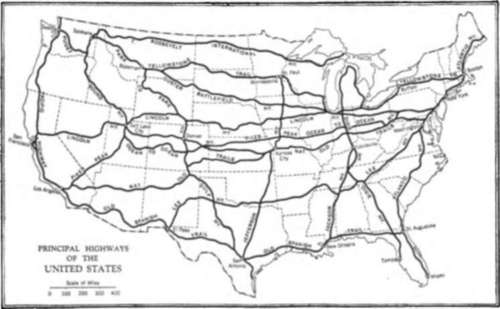
2. Ask your dealer for one of those splendid maps of the United States showing the routes made famous by the automobiles in our country. Bring one to post on the bulletin board.
3. Here's a game to play with that map. Choose two players who will act as "expert information clerks." All three of you stand before the map. You ask for the famous highways, as, "Show me the Lincoln Highway." Note the one who can point it out first. You could divide the class into two groups and give all a chance to compete. Keep score.
4. The history of highways is a most enjoyable one to read about. Plan a program about your findings. Call it Ancient and Modern Roamin' Roads, or some similar title.
5. Do some pantomimes to illustrate early automobile travel.
6. The question of youth at the wheel is a timely one. Should young people drive or should they not? Think up a few good reasons pro or con; divide the class into two factions and debate the question,
7. Some folks enjoy working out quite intricate problems in mathematics. You'll find some fine material on page 568. Invent some original problems and try them on your classmates.
Helpful References
American Guide Series (Federal Writers' Project, W. P. A.), U. S. One (Maine to Florida).
Eaton, J., Behind the Show Window.
Floherty, J. J., Youth at the Wheel. Reck, F. M., Automobiles from Start to Finish.
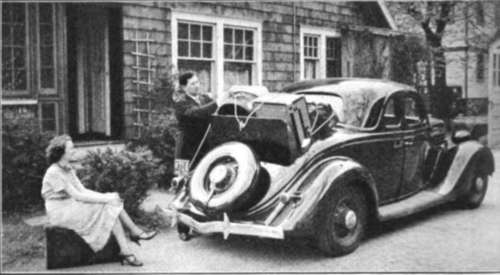
Good Times Ahead!
Continue to:


My Books

