


Safety Service
Description
This section is from the book "Time Out for Living", by Ernest DeAlton Partridge and Catherine Mooney. Also available from Amazon: Time Out for Living.
Safety Service
Closely related to health is the matter of safety. In modern society with its fast-moving vehicles, high buildings, electricity, swimming pools, and crowded streets there are coundess opportunities for injury. Little things may cause serious injury or death, if they are not properly attended to. A small object on a stairway, for example, can cause a person to lose his balance and roll down the rest of the way.
Boy Scout troops have been especially active in promoting safety among the people of their neighborhoods. By making careful inspections of their homes and meeting places they have eliminated thousands of hazards that might have meant serious injury or death to some innocent person. A class in school or a group of friends in a neighborhood could do as much if they wished. As a good-deeding hobby, this type of service is interesting and very constructive.
In safety campaigns, as in health campaigns, one of the most worth-while things to do is to educate the public as to their responsibility to themselves and others in living skillfully and safely. Posters prepared by students and articles in the town paper may mean decreasing the terrible toll of more than 35,000 lives that are sacrificed each year through automobile accidents alone. One never knows when such accidents will strike near home. The proper education may mean more cautious driving on the part of the motorist and more care on the part of the pedestrian. The attitudes of citizens in this case seem to be more important than passing laws. Safety can best come through the combination of skill, common sense, and proper regulations.
Many unfortunate accidents occur to children in city streets, because they have no other place to play. Youngsters in New York City, who were prevented from bathing in the running stream of a fire hydrant, carried their protests to the city authorities and were rewarded with cool sprinklers in the streets on hot days. Later, certain city streets were blocked off for play areas. Through such small beginnings big things may happen.
Suppose you have "play streets" assigned to you. Your good-deeding just begins! You have to plan what to play and how to use the materials on hand, or the group of youngsters who come to use the play street will end by running around in circles and batting one another on the pate. Did you ever watch a playground for which the recreation heads have not planned the play, or helped the young people to plan it? Make up games like the following. Find two barrel hoops and make a "basketball" setup - basket and all - against a pole. Be sure the pole is not carrying electric wires or it may end all play activities then and there. If you like games of chance, take some old cans, mark numbers 5, 10, 15, 20, 50, etc. on them and use them with stones as ammunition to see what score you can make.
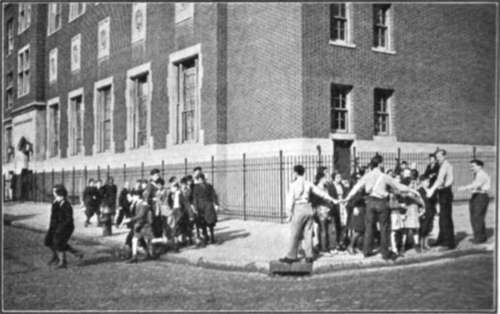
In many schools reliable students assume responsibility for the safety of younger pupils at crossings. They render a valuable community service.
A board dotted with nails and numbers makes a dandy beginning for a game played with rubber mason-jar rings.
A long board on some sort of sawhorse arrangement will make a seesaw. No doubt you can think of many other pieces of equipment that could be made at home.
Continue to:


My Books

