


Helping Others To Health
Description
This section is from the book "Time Out for Living", by Ernest DeAlton Partridge and Catherine Mooney. Also available from Amazon: Time Out for Living.
Helping Others To Health
This scene took place in a small rural school in Missouri. The teacher called the roll.
"Tom Smith," she said, looking up. There was no answer.
"Does anyone know where Tom is today?"
"I think he has typhoid fever," his friend Dick volunteered.
In the discussion that followed, the class recalled that two members of the Smith family had had the same disease the year before. In the light of what they had been studying about typhoid fever and how it spread it seemed to the group that something had to be done about the Smith house. What caused the disease to reappear in this way? Accordingly, they decided to ask Mr. Smith if they could make a study of his home and its surroundings to determine, if possible, what was causing the disease. A committee was appointed to look into the matter.
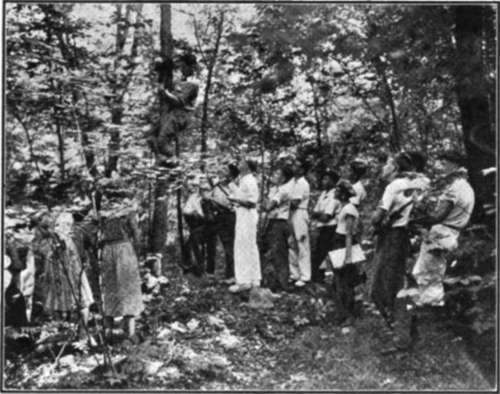
In Massachusetts a group of 4-H club members established a nature trail by putting up bird houses in the woods. The entire community benefited from the project.
With the co-operation of Mr. Smith, the committee investigated Tom's home and discussed the findings in class. As a result of the investigation and the discussion, the chairman of the committee wrote the following letter to Mr. Smith:
Dear Mr. Smith:
This is the report that we promised to send you on the cause of typhoid in your home. We have spent several weeks studying this disease. We believe that flies, impure milk and water, and uncleanliness are the causes of most typhoid in our homes. We find that your well water is not likely to be the cause of typhoid in your home. It is located on higher ground than your home and barn and has a good cement top and curbing. Bad milk cannot be the cause, as we found that you were not using milk. We noticed many flies in your home. Also, you did not have any screens on your doors and windows. We saw many flies in your kitchen. Our reference books say that the fly is the carrier of the typhoid germ. When he touches any food he leaves the germs on it. If people eat this food they get typhoid because they eat the typhoid germ. We believe that this is what happens in your home. We have studied several other homes in our community where cases of typhoid had been. We found conditions in these homes that we found at your home. Almost all of them had flies and did not have any screens. Our reference books and bulletins ordered from the University say that the fly causes most cases of typhoid. We believe that the fly is the main cause of typhoid in your home and recommend that you use the following methods in fighting the fly in your home:
1. We recommend that you screen your two outside doors and three windows. Screening your doors and windows will keep flies out of your home. We have figured the cost of screening doors and windows. We find that five yards of screen wire will cover the windows and that you can get it at the Goodman Hardware for thirty-five cents a yard, making $1.75. You can get the screen doors for $1.25 each, making $2.50 for the two. The total cost would be only $4.25.
2. We recommend that you cut and burn all the weeds and rubbish in your yard. Our books say that flies live in such places.
3. We recommend that you move the hog pen that adjoins your yard fence. It attracts flies and makes a good breeding place for them.
4. We recommend that you remove the manure piles in your barnyard. Our books say that the manure pile is the best place for breeding that flies can find.
5. We recommend that you keep all slop and scraps of food in a covered garbage pail. The dish water thrown out in the yard attracts flies and also supplies them with food.
6. We recommend that you use fly traps and fly swatters in your home. Mr. Bosserman uses the fly trap during the hot summer months of July, August, and September, and swats the fly during the cool months.
We are sending you one of our big fly traps and garbage pail with cover. We made these in school. We would like you to try them out in your home. We would like to know what you think of them.
We are glad to know that Mary and Johnnie will be back in school soon. We miss them.
We plan to have a community meeting soon to show some moving pictures on the fly. We will send you word by Tommie when we have the meeting. We are having the University of Missouri send you a bulletin called "The Fly."
Yours truly,
Tommie Beavers Chairman, Second Group*
The above example, which is an actual case, shows what a group of young people can do to help others to good health. Many of the causes of disease are beyond the understanding or financial position of those whom they affect. For this reason some co-operative action is necessary if disease is to be controlled. A sick person, no matter whether poor or well-to-do, is a responsibility of the whole community, especially if he has a communicable disease. Therefore one of the best possible forms of good-deeding is to help improve conditions that might be responsible for the spreading of disease.
In doing good turns of this type, it is well to keep in mind that in the long run the best results can be accomplished by teaching those who do not know how to care for their health rather than by doing things for them. Of course, there are some things that are beyond the help of the individual and must be accomplished by neighborhood or community co-operation. But even in such cases one person usually starts the ball rolling. In one eastern city, for example, a girl who was studying sanitation in school noted that many of the cellars in her neighborhood were flooded much of the time, and that there were no sewage facilities. She wrote a letter to the Commissioner of Sanitation for the city and received in reply a petition form. This she circulated about among the owners of houses in the neighborhood, and it was not many weeks before a sewer was being laid down.
* Collings, Ellsworth, An Experiment with a Project Curriculum. The Mac-millan Company, New York, 1929. Reprinted by permission.
So it is with many conditions that lie beyond the power of a single individual. By united action a neighborhood can do much to improve its surroundings. Whether it be the elimination of rats, mice, flies, mosquitoes, or poison ivy, by working together a group of people can accomplish wonders in cases in which a single person may have difficulty. But it often needs the energy of one person to start things going.
When speaking of health we cannot afford to overlook the fact that many people, perhaps in our own neighborhood, are in need of the bare necessities of life. It is especially unfortunate when growing children cannot have the kind of food that will build strong bodies while they are young. In many of the large cities it is possible to help such cases by contributing to the milk fund. This money is devoted to securing milk for them. A group of interested young people, by the preparation of posters, by writing articles for the school and town paper, and by serving on committees, can do a great deal to pass good health on to others.
Young People - Front and Center! In many ways young people are in a better position to help with community health than are adults. Because young people move about more and visit every part of a neighborhood, they have a better chance than adults to spot neighborhood conditions that might be detrimental to health or safety. In this way unfortunate conditions, such as garbage heaps, dumps, stagnant water, and many other things that breed germs or pests, can be located and reported to the proper authorities. Do you know where to report such things if you find them?
In large cities many storekeepers have trouble reading English and for this reason may not be familiar with the sanitary codes; hence they may be breaking the law without knowing it. The story is told of one particular shopkeeper in the congested district of a large American city who was at his wit's end, because he could not understand why he was being arrested and fined, threatened, or cajoled every other day by the local Board of Health. One night an ardent sympathizer, aged ten, on his evening errand for the family groceries, solved all this dilemma by reading the very official-looking paper that had been handed to the grocer and by explaining in the man's native tongue just what it meant.
You can be helpful, if you know what the law is (and if you don't know, you can usually get a copy by writing to the department involved). Then talk it over with your storekeeper friends and see if you can help them find the conditions that should be changed.
When speaking of health, we cannot overlook those many individuals who because of some unfortunate circumstance are crippled, blind, or deaf. A little good-deeding properly directed can do a great deal to enrich their lives. Boy Scouts in Philadelphia derived great satisfaction from preparing some of the Scout literature in Braille (the raised writing that blind people can read by touch) and distributing it to various schools for the blind.
If there is no Braille Center in your community, there's an idea for you! Plan one. All the books you now enjoy could be made available to those afflicted by blindness, if a group could manage to borrow, beg, or buy a machine and learn how to work it. A machine, of course, involves expense. If you lack money, you can certainly give time to the blind - even as little as twenty minutes a week. How much these folks enjoy a visit, in which your only expense is conversation, cannot be over-estimated. Have they found out about all the free facilities open to them? Do they get those free records of entire books sent out weekly by the library department? Do they have people to read daily papers and magazines to them? Are there chores to be done and errands to run for them? Could you lead them out safely for a stroll in the sunshine and air? Have they a radio, a victrola? Isn't there some way in which you could help? Crippled children and adults in hospitals always appreciate various kinds of toys, books, and games to help them while away the hours. By setting up a toy repair shop or a club to collect old games and books, a group of good-deeders could do a great social good in this way if it is not already being done in their community by some other group.
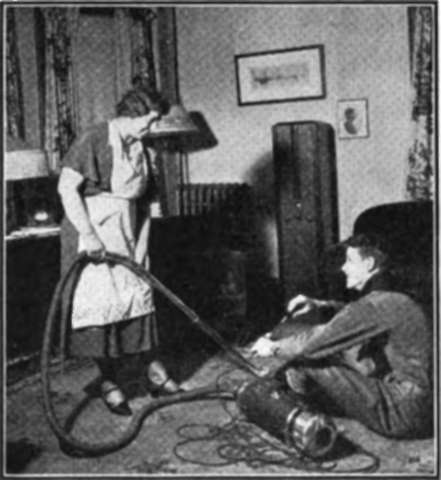
Boy Scouts perform a variety of neighborly deeds. The Boy Scout shown here is repairing a vacuum cleaner in order to lend a helping hand.
Lately the deaf have begun to enjoy life more because clubs are being formed to learn the sign language, and even those not afflicted are joining in order to learn to make themselves understood by their friends. Lip reading is quite an adventure and comes in handy many times in life for those who are not deaf. It's good training. Try it sometime.
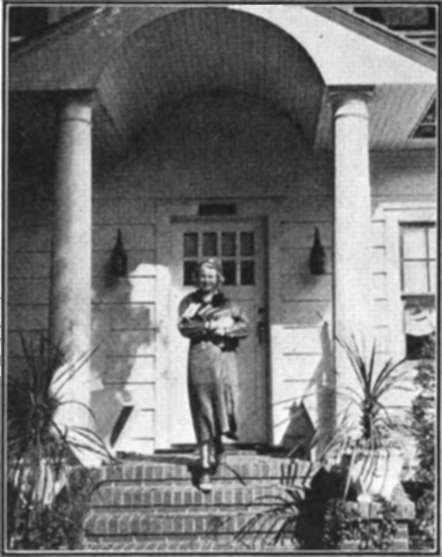
Help the Handicapped. You might aid in distributing books to persons who are unable to leave their homes.
Continue to:


My Books

