


Chat 22. The Scout Group: Curbing, Scouting And Senior Scouting
Description
This section is from the book "Handbook For Scoutmasters. Volume 1 & 2", by Boy Scouts of America. Also available from Amazon: Handbook For Scoutmasters.
Chat 22. The Scout Group: Curbing, Scouting And Senior Scouting
Nothing succeeds like success," says the proverb.
Scouting gives evidence that this is true. With the growth of our Movement, young voices were lifted: "Give us something to do until we are old enough to be Scouts"-and from higher age levels was heard: "Give us a program of activities that fit our needs as we grow into manhood."
The Troop In The Group
After much experimentation and research, the Boy Scouts of America has spread its program of activities to meet the needs of boys who are younger and youth who are older than those who participate most actively in Troops, Neighborhood Patrols, Lone Scouting and Lone Scout Tribes. It reaches down to attract younger boys, and it reaches up to provide for the further growth of its older members. Thus the Scout Family has grown until it now includes the following possible organization units, any two or more of which when organized in a given institution constitute a Scout Group-as it is universally called.
For boys 9, 10 and 11 years of age The Cub Pack Lone Cubbing The Neighborhood Den
For boys 12 years of age and over The Scout Troop The Neighborhood Patrol Lone Scouting The Lone Scout Tribe
For boys 15 years of age and over Senior Scouting in the Troop Explorer Scout Patrol in the Troop, or separate
Explorer Troop Sea Scout Patrol in the Troop, or separate Sea
Scout Ship
For young men 17 years of age and over The Rover Scout Crew
For graduate Scouts 21 years of age and over The Old Scout or Alumni Association
The Group's "Committee on Scouting"
When two or more of these sections (such as Cub Pack, Scout Troop, Sea Scout Ship, Rover Crew, and
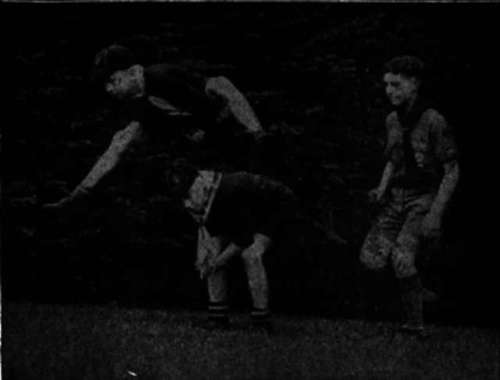
The youngest members of the Scout family. The Cubs, and their Scout Den Chief. Cubs make fine Scouts. They have learned team work.
Alumni Association), providing activities for boys of different ages, are organized under the sponsorship of one institution or a community group, they become a Scout Group; and it is recommended that a Group Committee-known as the "Committee on Scouting"- be appointed by the sponsor to coordinate the activities of the sections.
Such a Committee may comprise the membership of the individual Troop, Pack, Crew, or Ship Committees registered with the Boy Scouts of America incident to the chartering of these sections, or it may consist of representatives of these committees or of other persons as the Sponsoring Institution may deem wise.
The duties of the general "Committee on Scouting," however, should not extend to the assumption of the responsibilities or the taking over of the duties prescribed by the By-Laws of the Boy Scouts of America for the respective committees or commissioned Scouters or Cubbers of the various sections of the Scout Group. These responsibilities may be performed only by the registered Scouters or Cubbers related to the specific sections.
The Troop Is The Primary Unit
It should be at once observed that in this Scout Group the Troop still preserves its fundamental status as the primary unit. While there is provision for specialized Senior Scout organizations, it is recognized that in the great majority of cases the regular Troop program is such that older Scouts desire to carry on with Scouting in the Troop (or in the Neighborhood Patrol, or Lone Scout Tribe, as the case may be) without any specializing organization. In any case these young men must not be denied the opportunity to secure leadership experience as Patrol Leaders or junior officers in the Troop by reason of any Senior Scout organization.
And in the case of the Cub Program for younger boys, care has been exercised to see that their activities are such that there is "no trespass upon Scouting," such as would sap their later interest in it, but rather that they graduate normally from the Cub Pack to the Scout Troop more zealous than ever for Scouting.
Continue to:


My Books

