


The Long Span Program
Description
This section is from the book "Handbook For Scoutmasters. Volume 1 & 2", by Boy Scouts of America. Also available from Amazon: Handbook For Scoutmasters.
The Long Span Program
Thus a plan is provided whereby any institution or community may adopt a program that will carry on with its boyhood from the age of nine until voting citizenship is attained-and then through its Scout Alumni will carry over into adult life and service the idealism of Scouting.
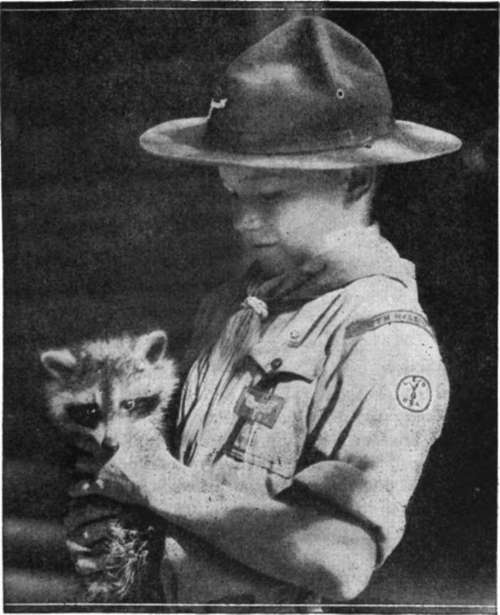
This young Lone Scout has his pet raccoon. His Tribe meets after the chores are done. His Counselor is his hero and friend.
The long span program of Scouting parallels the educational program for boys and young men in the institutions or communities that adopt it, and may be logically related to it to the end that there may be produced for America "men of character, trained for citizenship."
Cubbing
Cubbing, then, as the younger boy program of the Boy Scouts of America, interests the Scoutmaster because it is almost inevitable that at some time he will have relations with Cubbing, directly or indirectly, through a Cub Pack as a part of the Scout Group of which his Troop also is a section, or through a former Cub who becomes a Scout in his Troop. So the inclusion of this section on Cubbing in this Handbook for Scoutmasters is intended to explain to the Scoutmaster those phases of Cubbing-its program, organization, leadership and boy-training-to which the Scoutmaster may find himself related as he goes forward with the leadership of his Troop.
Program
There is no reason why any Scoutmaster should feel that Cubbing might trespass on Scouting's program and "spoil" a boy for Scouting by giving him "a taste of its activities" before he is twelve years old. Cubbing is sharply and distinctly different from Scouting and, in fact, it gears in to strengthen the boy's Scouting experience and make it more effective.
Cubbing Different From Scouting
As boys grow in age, their lives and interests change. Life itself is progressive and they are continually outgrowing their past and desiring new experiences. Therefore, Cubbing is not "Junior Scouting." It is entirely different, with its own interests, projects and methods, separate leadership and psychology. Cubbing is given to Cubs; Scouting is saved for Scouts.
Cubbing is a home-centered program, whereas Scouting is a community-centered program. It differs essentially from Scouting in that it does not take the boy far afield for camping or hikes, big scale adventure or intensive training, but operates in the neighborhood and back-yard and vacant lot near the Cub's home.
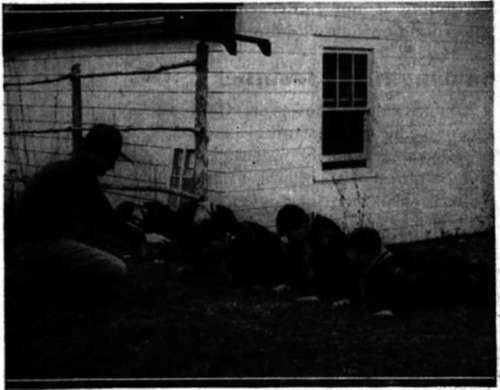
"Push up. Ease down." Makes straight, strong shoulders and backs. The friendly Den Chief puts them through their paces.
Cubbing is a day-time program, whereas Scouting is not so restricted. The only Cubbing activities that may extend into the evening are those that the boy may carry on at home alone or with his dad or mother.
Cubbing's outdoor program is based on the natural neighborhood play of the boy. Camping and hiking are reserved for the Scout of older years, while the Cub enjoys "walks" and "outings" conducted as a family or neighborhood responsibility. Also he may improvise tents or build little shacks and lean-tos in the neighborhood-"backyard camping."
Cubbing is not built around "going somewhere" but around enjoying "doing things where one is."
Cubbing Helps Scouting
Like Scouting, however, Cubbing lays stress on certain character-forming emphases such as self-expression and development, personal responsibility and helpfulness to others, although naturally in the closer environment of the Cub's own neighborhood.
While the Cubbing Program has been kept different from that of Scouting, it provides a progressive growth for the Cub so that when he completes the last grade in Cubbing, that of Lion Rank, he is definitely prepared for Tenderfoot induction; and, according to the reports of Scoutmasters, they are more and more anxious to receive Cub-trained boys into their Troops.
These Scoutmasters have found that these boys are used to group work and play, and better prepared to understand and practice the Scout ideals as expressed by the Oath and Law because of having already practiced similar ideals in their own simple, effective code which declares "A Cub is Square," "A Cub Does His Best," and so on. The fundamental ideal is the same as that of Scouting.
For the boy to go forward in Cubbing makes him ready to go forward in Scouting, at the proper time another link in the long, unbroken trail whose ultimate goal is the development of young men of fine character.
Organization
It is only necessary here to discuss briefly the organization set-up of Cubbing which involves the Cub Pack and the Den, Lone Cubbing and the Neighborhood Den.
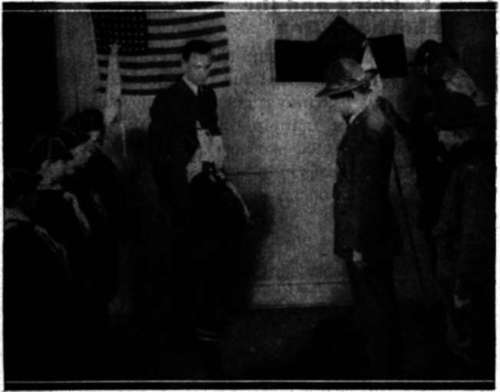
Graduating from the backyard fun of Cubbing, to the wide horizons of Scouting. What a happy birthday, his twelfth, for this Lion Cub.
The Cub Pack And The Den
The Pack is a unit of organization similar to the Troop in size, leadership and sponsorship. But it is customary to hold meetings of the Pack only once a month and to carry out the daily activities of the Cubs through Dens which are natural neighborhood groups of playmates. Formal Den meetings are held weekly in the afternoon m and around the homes, and "start" many things that are carried on between these meetings by the boys "working" alone or in small groups meeting informally.
The real job of the Pack is to motivate and encourage and help the Dens carry on their activities. Prior to the time when the Dens are able to function on their own, the Pack may meet as often as once a week.
Lone Cubbing And The Neighborhood Den
Because of its home-centered program, Cubbing is particularly well adapted for use in rural areas for individual boys who may register as Lone Cubs. A Lone Cub selects a fine man in the community-his own father may be selected-to be a Cub Friend and Counselor. With this man's help and that of his own family, the Lone Cub can carry on effectively the program of advancement.
Of course, where possible, a small "one-Den Pack" should be organized as a Neighborhood Den, with from two to eight boys. This operates under a Cubmaster endorsed by three fathers in the community. The parents agree to cooperate and serve as sponsors.
Leadership
Because it is difficult for men who have been successful Scouters to adapt themselves completely to Cubbing in a way that will insure "no trespass" on Scouting, it has been found that, as a rule, Scoutmasters and other Scouters do not make the best Cubbers. They are inclined to draw upon their Scouting experience and use it unwisely.
Fathers of boys of Cub age are the field from which the majority of Cubbers are drawn.
The Cubmaster
As leader of the Pack, the Cubmaster has a position comparable to that of the Scoutmaster in Scouting. In addition to his Assistant Cubmasters, he receives leadership help over the Dens from Scouts-"Den Chiefs" -each of whom leads one Den. The Den Chief is helped by one of the Cubs, the "Denner," elected by the boys for their backyard Den meetings on their own.
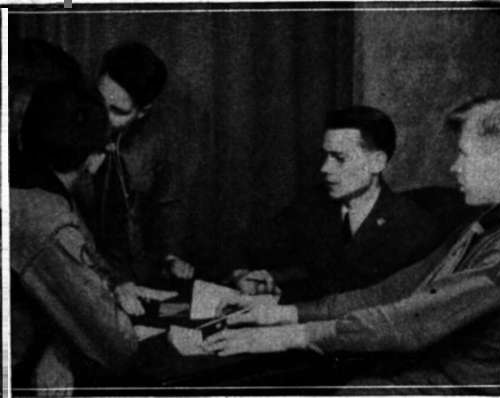
A Cubmaster heads up all the Dens into one grand Pack. He works through his Scout Den Chief. Executive ability is developed.
The Den Chief
Since Den Chiefs are Scouts, Scoutmasters are closely related to their activities and it is essential that both the Cubmaster and Scoutmaster have an understanding of just what the Den Chief's responsibilities are both to his Troop and his Den.
The selection of a Den Chief is important. A Scoutmaster should not be asked to give up Patrol Leaders or other junior leaders, but rather the Cubmaster should consult with the Scoutmaster to select a Scout who is not already loaded with leadership responsibilities in the Troop. This sort of selection should be welcomed by the Scoutmaster because it opens the door to leadership opportunity for a greater number of boys.
The Den Chief may be of any age or rank, but preferably he has come up himself through the three ranks of Cubbing, or has had some Cubbing experience.
The values which come to the Den Chief himself are tremendous values. In his frequent contacts with the Cubmaster and with Cubs, he receives training in boy leadership which prepares him to assume Patrol and Troop leadership later. He should counsel weekly with the Cubmaster, perhaps just before or after his own Troop meeting, so as not to involve an extra night out.
The Den Chief meets with his Den once a week and is available at other times when his Cubs need his advice or. help. He gives his time to the Den and its members as an individual Good Turn, and as a chance to develop his ability as a leader.
The desire to achieve is stimulated in the Cubs by the Den Chief who is also ideally suited to instruct the Cubs, especially in the things that prepare them to become Tenderfoot Scouts when they become twelve years old.
The Den Chief should not be expected to conduct "walks" or "outings" for his Cubs. He is too busy in school, church, Troop and his own social life. The Den Chief should take his hikes with his Scout Troop and should be encouraged to participate in its camping and advancement program-keeping a wise balance between the amount of time he devotes to his Den and to his Troop.
The Scoutmaster, cooperating with the Cubmaster, has a real opportunity to serve the Scouts who are Den Chiefs and through them the Cubs they lead.
Den Mothers And Den Dads
Associated closely with all of Cubbing's activities are the parents of the Cubs, some of whom may serve as Den "Mothers and Den Dads-the latter on the Pack Committee. The Den Mothers and Dads assume, with the Den Chiefs, the responsibility for the activities and progress of the Cub Den. And the Dads also assume responsibility for leading Den "walks" and "outings" which, as just mentioned, the Den Chief should not be expected to conduct.
The Den Mother, registered with the Boy Scouts of America, carries on in the home-centered Cub Program. Her work is inspiring.
Scoutmasters will welcome the fact that parental interest aroused through Cubbing carries over into Scouting. When sons graduate from Cubbing, we find a much more interested group of parents, participating in and supporting Scouting activities as a result of their having worked together in Cubbing on Den and Neighborhood projects,
Continue to:


My Books

