


"Going-Up" Into Scouting
Description
This section is from the book "Handbook For Scoutmasters. Volume 1 & 2", by Boy Scouts of America. Also available from Amazon: Handbook For Scoutmasters.
"Going-Up" Into Scouting
When the Cub becomes twelve years of age, he automatically ceases to be a Cub. It is natural and likely that he will go on into Scouting, but that "going-up" should not be taken casually. It is important that here again the Scoutmaster and Cubmaster cooperate to give to the boy the most worthwhile experience.
Pro-Graduation Contacts
As has been said, upon completion of requirements for the Lion Cub Rank the boy is prepared to become a Tenderfoot Scout, but the Den Chief and the Cubmaster should consult with the Scoutmaster and be sure that the preparation given to the Lion Cub is acceptable in every way to the Troop. This is important so that the Cub may experience no embarrassment that might discourage him from going on with Scouting to receive its expanding character values. If a Cub has not reached Lion Rank, it will be necessary, of course, for him to prepare for and meet the Tenderfoot Requirements. The joint aim of Cubmaster, Scoutmaster and Den Chief should be the boy's happy transfer into the long-awaited Scouting.
The Cub who is about to "go up" should have advance contact with the Troop and Patrol into which he will go. He is leaving a friendly group; his "promotion" should be so prepared for that friends await him in the new place. Several months before he reaches twelve, the Cub should meet the Scoutmaster and his future Patrol Leader. Also he should probably visit the Troop meeting just before he can graduate into it. In addition, there may be occasional get-togethers of Pack and Troop, for friendship meetings, for the Troop's or Pack's anniversary, or even for a special picnic at which the Troop entertains the Pack.
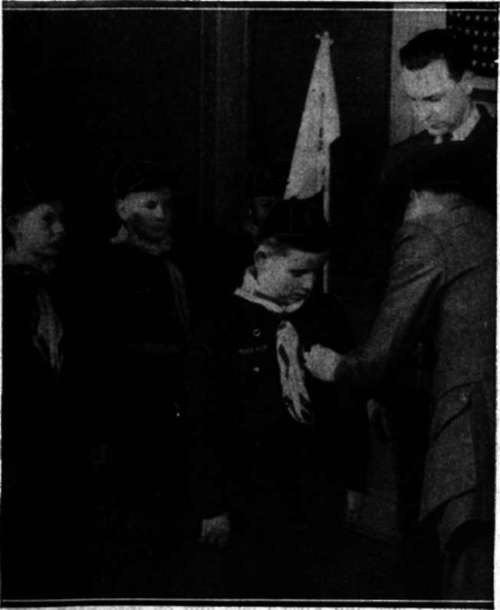
The Scout Tenderfoot Badge is in place. He has said good-bye to his Cub pals. He is a Tenderfoot Scout and on his way to Eagle.
In this way the Cub will come to see himself as not just a member of the Pack, but of the-Scout Group.
The Graduation And Investiture
At the Pack Meeting closest to the Cub's twelfth birthday, he should be graduated from the Pack and welcomed formally by the Troop. This can be done by a ceremony participated in by the Pack and representatives of the Troop-probably the Scoutmaster and the Patrol of which the new Scout will become a member.
A suggested ceremony follows:
(1) The Cubmaster calls the Pack into formation, a half-square.
(2) The twelve-year-old's Den brings forward the graduate. The Cubmaster salutes the graduate, who returns it.
(3) The Cubmaster speaks: "Lion Cub Jack Jones graduates from our Cub Pack tonight. He has reached his twelfth birthday. He has spent three years among us and tonight he graduates and transfers into Scout Troop Number 12. We are proud of him. Tonight he climbs another round in the ladder to manhood and good citizenship."
(4) The Cubmaster calls on Jack's Den Chief who says something congratulatory, not sad at seeing him go.
"Jack, we've been mighty glad to see you grow into this hour when you're ready to become a Scout and to represent Den 4 as a Scout and as a good citizen. Den 4 wishes you good luck and steady progress into Second Class and First Class and on into Star, Life and Eagle Scout ranks."
(5) Den 4 gives Jack nine rahs! and Jack! Jack! Jack! at the end.
(6) The Cubmaster presents Jack with his Transfer Credit Certificate into the Scout Troop and perhaps with a little personal letter certifying what Jack has done and saying any personal word desired. Jack may treasure this in later years.
(7) Then the Cubmaster will introduce the Scoutmaster and Patrol Leader who come from Troop 12 to officially welcome and receive Jack-Jack having previously met the Troop and visited it at the last meeting before his graduation. The Scoutmaster welcomes Jack:
"Jack, we're glad to welcome you to Troop 12. We have high traditions and standards there and we hope you'll help make them better. You will become a member of the Beaver Patrol which contains two boys, Bill and Henry Douglas, who were members of your same Den, and we'll be watching for the other members of Den 4 to come on and graduate until before long the Beaver Patrol will be Den 4 grown up. I'm glad to welcome you to Troop 12 and to the world wide Scout Brotherhood."
(8) He extends the hand of fellowship to the Cub and whispers in his ear what the Scout Handclasp is-- following which they shake hands with the left hands.
(9) The Pack keeps its same position but each boy turns to the graduate-salutes and on signal shouts: "Jones! Jones! Jones! Good Luck, Jones!" and the ceremony is over.
At the next Troop meeting, the former Cub should go through the Troop's usual Investiture Ceremony for new Scouts. (See Chat 15, His Entry; and Index: Ceremonies.)
Cub Registration And Transfer
The registration steps in Cubbing are the same as in Scouting-the Cub's registration fee is fifty cents and the Cubber's is one dollar. The Cub graduating into Scouting at twelve years of age "transfers" into the Scout Troop for the unexpired portion of his year's membership.
Senior Scouting
Mention was made early in this Chat of Senior Scouting in its various aspects for boys 15 years of age and older, who may want to take advantage of its special opportunities. This phase of the Scout program has been developed to care for the many thousands of older boys who want to carry on with an advanced kind of Scout experience either as members of their Troops or in special groups with older Scouts. There are several plans available whereby this can be done.
Senior Scouting In The Troop
The most popular plan for maintaining the interest of older Scouts is to have them carry on as Senior Scouts in the Troop. Thousands of boys have been maintaining their connection with Scouting in this fashion down through the years. Senior Scouting now makes it possible to hold the interest of more of these older fellows by furnishing them with additional inducement and activities.
First of all, older Scouts may, with the approval of their Scoutmaster, become Senior Scouts. This means they can wear a special membership strip over their right pocket that reads "Senior Scouts, B. S. A." rather than "Boy Scouts of America." In addition to this they can participate in advanced Merit Badge work (see Index: Senior Scouting Merit Badge Program).
It is by no means intended that the boy upon becoming a Senior Scout should sever his connections with the Troop or that he should not continue his activities as a Patrol Leader, Scribe, etc. On the contrary, most of Senior Scouting is done in the Troop and Senior Scouts are expected to carry on their activities in the Troop Program.
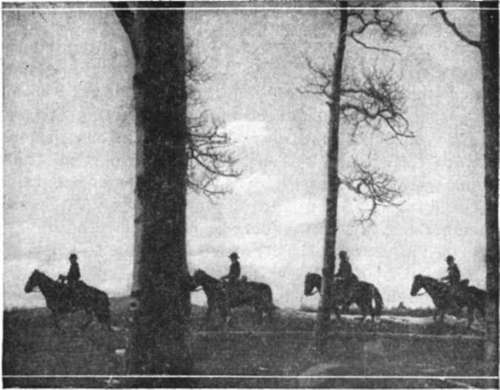
Saddle leather creaks-the horses whinny-beyond the divide these Explorer Scouts will pitch a snug camp.
Even though in many cases there may be only one or two boys of Senior Scout age in the Troop, still these Scouts become eligible for Senior Scout status. If, however, there are a sufficient number of Senior Scouts in the Troop and if the Scoutmaster feels that there is a need for extra activities for these boys, he may organize in connection with his Troop one of the special Senior Scouting sections outlined below.
Basic Considerations Before Going Ahead
Before going ahead with the organization of a special Senior Scout section, whether it be Sea, Air or Explorer Scouting, there are a few basic considerations which should be reviewed by those having charge of the Troop. Some of these considerations are:
1. Is the Troop succeeding with the basic program of Scouting already? Senior Scouting, and especially Explorer, Sea and Air Scouting are not intended as panaceas for weak Troops. If a Scoutmaster is not succeeding with regular Scouting there is no reason to suspect that the addition of an Explorer, Sea or Air Scout Patrol will make this problem any easier. Explorer, Sea and Air Scouting are programs that cannot succeed unless there is a strong Scout program feeding trained Scouts into Explorer, Sea or Air Scout membership. Certainly there is no point in having a special Patrol for older Scouts connected with a Troop which cannot hold the interest of the younger Scouts long enough for them to become of Senior Scout age.
2. Is this particular Troop ready for Senior Scouting? There are many good Troops carrying on a splendid program which may not be ready for Senior Scouting right now. It may be that the older Scouts are too few, or too well integrated into the Troop Program to be disturbed. Better to let a good job continue to be good than to sink it of its own weight by adding responsibilities which may not help.
3. 7s the right leadership available? A great deal depends on the matter of leadership for Explorer, Sea or Air Scout Patrols. Not all men will succeed equally well with older fellows. If the Scoutmaster is not suited to deal with this upper age group then some man who is qualified should be secured and properly trained before the Patrol is organized. A Patrol is much more apt to succeed if all such matters as leadership are well in mind before starting.
Continue to:


My Books

