


Chat 37. The Merit Radge Program—Star, Life, And Eagle Ranks
Description
This section is from the book "Handbook For Scoutmasters. Volume 1 & 2", by Boy Scouts of America. Also available from Amazon: Handbook For Scoutmasters.
Chat 37. The Merit Radge Program—Star, Life, And Eagle Ranks
THE Merit Badge Program is a valuable and integral part of Scouting. It is the continuation of the boy's forward striving; it is a means of keeping his interest alive and thus of holding him and continuing in his life the character influence of Scouting; it prepares him for advanced service to individuals and the community; it gives him an opportunity for vocational and avocational exploration; it brings him into personal contact with some of the finest men in his city, town or community who serve as Merit Badge Counselors. The pursuing of Merit Badge skills develops character through application, thoroughness, resourcefulness and unselfish service. It aids the boy in discovering his native aptitudes and in releasing his potential powers.
Classification Of Merit Badge Subjects
The Merit Badge subjects may be roughly divided into five groups:
Service—such as First Aid, Firemanship, Interpreting, Safety, Public Health, and the like. It is particularly important in badges such as these, which involve service to others, that a high standard is kept, to ascertain that the Scout is actually capable of rendering service.
Scoutcraft—such as Camping, Cooking, Hiking, Pioneering, Stalking, and so on. The boy will master these skills as he grows in Scouting and delves into more advanced activities in his outdoor quests.
Physical Fitness—such as Athletics, Personal Health, Physical Development. The older boy particularly will desire to take up these subjects, as he attempts to live up to his promise "keep myself physically strong."
Hobbies—such as Handicraft, Indian Lore, Leather-craft, Reading, Stamp Collecting, Woodcarving. These subjects aid the Scout in the profitable employment of his free time, by affording him constructive activities.
Vocational Exploration—such as Agriculture, Black-smithing, Business, Dairying, Masonry, Plumbing, Salesmanship, etc. Possibly the greatest value of the Merit Badge Program lies in this, its relation to the boy's vocational outlook. He is encouraged to explore a wide variety of vocational fields, which in turn enables him to a certain degree to determine his fitness and his liking for each vocation and helps him to form a reasoned opinion on the question of selecting his life work.
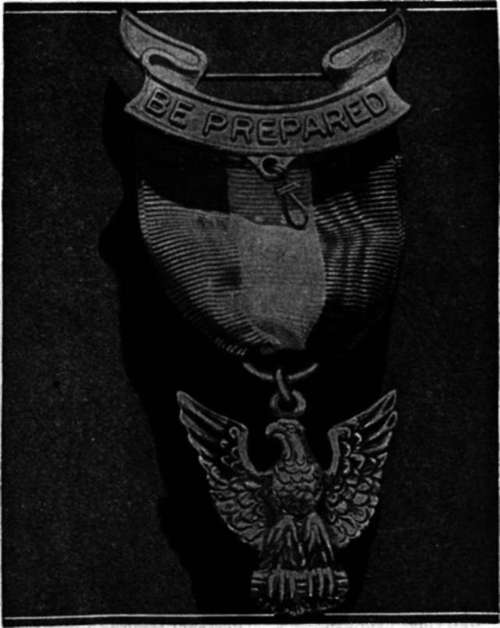
The Eagle Badge. The mark of twenty-one subjects met and mastered. Eagle Scouts are making places for themselves.
Merit Badges For First Class Scouts
Agriculture Angling
Animal Industry Archery Architecture Art
Astronomy
Athletics
Automobiling
Aviation
Basketry
Beef Production
Bee Keeping
Bird Study
Blacksmithing
Bookbinding
Botany
Bugling
Business
Camping
Canoeing
Carpentry
Cement Work
Chemistry
Citrus Fruit Culture Civics
Conservation
Cooking
Corn Farming
Cotton Farming
Cycling
Dairying
Dog Care
Dramatics
Electricity
Farm Home and Its Planning
Farm Layout and Building Arrangement
Farm Mechanics
Farm Records and Bookkeeping
Fingerprinting Firemanship First Aid
First Aid to Animals Forestry Foundry Practice Fruit Culture Gardening
Grasses, Legumes and
Forage Crops Handicraft Hiking
Hog and Pork Production Horsemanship Indian Lore Insect Life
Interpreting ,
Journalism
Landscape Gardening
Leathercraft
Leather Work
Life Saving
Machinery
Marksmanship
Masonry
Mechanical Drawing Metal Work Music
Nut Culture
Painting
Pathfinding
Personal Health
Photography
Physical Development
Pigeon Raising
Pioneering
Plumbing
Pottery
Poultry Keeping Printing Public Health Public Speaking
Radio
Reading
Reptile Study
Rocks and Minerals
Rowing
Safety
Salesmanship
Scholarship
Sculpture
Seamanship
Sheep Farming
Signaling
Skiing
Soil Management Stalking
Stamp Collecting
Surveying
Swimming
Taxidermy
Textiles
Weather
Woodcarving
Wood Turning
Wood Work
Zoology
Merit Badges For Second Class Scouts. (As Well As For First Class Scouts)
Agriculture Animal Industry Art
Basketry
Beef Production
Bee Keeping
Blacksmithing
Bookbinding
Bugling
Carpentry
Cement Work
Corn Farming
Cycling
Dairying
Farm Home and Its Planning
Farm Layout and Building Arrangement
Firemanship
First Aid to Animals
Fruit Culture
Gardening
Handicraft
Hog and Pork Production
Horsemanship
Leathercraft
Leather Work
Masonry
Metal Work
Music
Painting
Pathfinding
Personal Health
Photography
Pottery
Poultry Keeping Printing Reading Safety
Sheep Farming Soil Management Weather Woodcarving
Who May Qualify For Merit Badges?
The complete list of Merit Badges (see preceding pages) is available to First Class Scouts (and to Scouters, other than Assistant Scoutmasters under 21 years of age—except such of the latter as qualify as First Class Scouts), "who meet to the satisfaction of the local Committee on Scout Advancement, such requirements as may be authorized by the Executive Board for the various Merit Badges . . ." (By-Laws, Art. VI, Sect. 6, CI. 1).
From a restricted list of forty Merit Badge subjects (on preceding page) Second Class Scouts (and Assistant Scoutmasters under 21 years of age, and of Second Class Rank) may qualify for not more than five Merit Badges. These Merit Badges are made available to Second Class Scouts to provide a lateral spread in the Merit Badge field for those Second Class Scouts who may be in a "stale-mate" as far as completing First Class Requirements is concerned or who may for other reasons fail to find other interests in Scouting to maintain their active participation in its program.
Although, as stated above, Scouters are eligible to qualify for Merit Badges, they are not encouraged to do so because it is usually found that a Scoutmaster or other Scouter can do a better job of leadership if he utilizes his time in helping his Scouts to climb rather than climbing the advancement ladder himself.
Requirements For Merit Badges
The requirements for all Merit Badges appear in the Handbook for Boys of the Boy Scouts of America.
They are prescribed by the National Executive Board, upon the recommendation of the National Committee on Badges, Awards, Scout Requirements and Uniform Design.
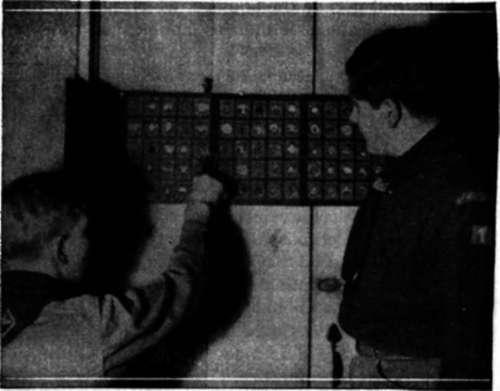
Among the Merit Badges are subjects that will appeal to every type of Scout. Science, Art, Farming, Machinery and others.
Merit Badge Advancement Procedure
While advancement in the Second Class and First Class Scout Requirements is a natural feature in the Troop's life and continuously involves all its members, Merit Badge Advancement is more of an individual proposition. By the time boys have reached First Class, their interests diverge as to their further advancement and a proper cognizance must be taken of this. The activities of the Troop may be so planned that they will lead Patrols and individuals to specialize along certain lines in Merit Badge subjects, but more often the boys will pursue the subjects which already have an appeal to them—either as hobbies or potential vocations.
In Merit Badge Advancement as well as in all other Scout Advancement, the four processes of PREPARATION, EXAMINATION, REVIEW and AWARD are involved.
How It Works
The usual procedure in most Local Councils is for the Scout to be prepared in his own Troop, with the aid of a Merit Badge Counselor appointed by the Council. He is examined by the Merit Badge Counselor. The review is made by the Council Board of Review, or a District Board where Districts are organized, and the award is made before the Council or District Court of Honor.
Since the National Council permits a certain latitude in the routine connected with Merit Badge Advancement procedure, the Scoutmaster should secure the rules of his Local Council. The following pages describe the main features.
Continue to:


My Books

